
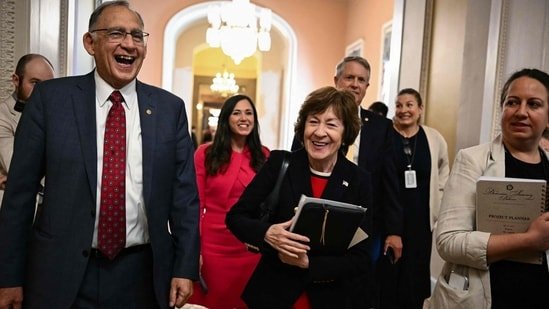
The U.S. Senate delivers to the President Donald Trump In the early hours of Friday, the United States passed a bill to provide the Department of Homeland Security with an additional $70 billion for immigration enforcement, sending it to the House of Representatives for final consideration.

The Senate passed the bill in a 52-47 vote without Democratic support or a provision prohibiting a $1.8 billion “anti-weaponization” fund that would have compensated Trump’s political allies over accusations that the government mistreated them. One Republican voted against the bill.
Senate Republican Leader John Thune said the fund was a “settled issue” and cited acting Attorney General Todd Branch’s congressional testimony that the Justice Department would not move forward with the fund, although Democrats said his words did not go far enough. Trump has nominated Branch to permanently lead the Justice Department.
“I find it hard to believe that they would submit someone who sat before a House committee and made a clear statement on this and then all of a sudden turn around and back out,” Thune told reporters. “I don’t think that’s going to happen.”
Also read: US Visa Laws: State Department issues major clarification amid concerns raised by Indians, ‘No…’
Additional funding to fight deportations
Republicans have accused Democrats of “cutting” funding for Immigration and Customs Enforcement and the Border Patrol, even though the agencies have a combined $100 billion in unspent funds as part of a larger Homeland Security spending plan enacted last year by Republicans who control Congress.
The House is not expected to take up the measure before next week.
Much of Thursday’s lengthy debate over the ICE funding bill was overshadowed by efforts by Democrats and some Republicans to insert language that had nothing to do with immigration. The proposals revolve around prohibiting the use of federal funds or even private donations to build a lavish 90,000-square-foot ballroom on Trump’s desired White House grounds.
Senators also debated a provision that would make it illegal for federal funds to go to “anti-weaponization” funds. None of these amendments were approved.
Funds provided by the bill will help pay for Trump’s controversial immigration deportation crackdown over the next three years.
Earlier on Thursday, lawmakers began voting on amendments to the immigration bill in a “Vote Rama” session, culminating in a vote on the underlying measure in the early hours of Friday morning.
Senate Democratic Leader Chuck Schumer initially moved to eliminate the “anti-weaponization” fund, which Democrats described as a “slush fund” for Trump allies, and the session was halted procedurally for several hours after Republican Sen. Susan Collins voted in favor of the motion. She was later joined by fellow Republicans Jon Husted and Dan Sullivan.
Schumer’s measure failed in a 50-49 vote, but exposed the political turmoil among rank-and-file Senate Republicans. Five months before the November midterm elections, some of them are seeking their own amendments to permanently eliminate the fund.
Collins, Husted and Sullivan all face re-election competition at a time when Trump’s approval ratings are declining, even among Republicans.
“Republicans’ refusal to permanently dismantle Trump’s $2 billion slush fund leaves taxpayers relying on the promises of Donald Trump’s personal fixers,” Schumer said of Branch in a statement after the final vote.
The fund has been suspended by the White House and the Justice Department.
But on Wednesday, Trump declined to say whether the program had actually been terminated, telling reporters: “I love it. I think it’s very important.”
Republican Sen. Thom Tillis, who opposed Schumer’s motion, told reporters he would not support passage of the appropriations bill without a Republican amendment vote to codify Branch’s congressional testimony. Tillis argued that failure to do so would place a burden on congressional Republicans up for re-election in November who fear a voter backlash against the fund.
Opponents call Trump fund an ‘imminent and dire threat’
Nearly all of the immigration bill’s funding will go to the Department of Homeland Security’s ICE and Border Patrol agencies, which are enforcing the Trump administration’s aggressive deportation campaign across the United States.
Tillis later introduced his own amendment to reallocate resources from the controversial Trump Fund to fraud enforcement operations. The bill failed on a vote of 84-15 but received support from 12 Republicans.
Republican Sen. Bill Cassidy, who introduced his own amendment to end the fund, joined Democratic Sen. Cory Booker in an amicus brief urging U.S. District Judge Leonie Brinkema to uphold the blockade she imposed on the Trump fund last week.
They believe the fund “poses a direct and dire threat to our constitutional order and the authority of Congress.”
A series of Trump’s recent actions have prompted public criticism from some Republicans, from seeking $1 billion in taxpayer money to build the White House ballroom and security upgrades to his decisions to nominate Branch as attorney general and political ally Bill Pulte as director of U.S. intelligence.