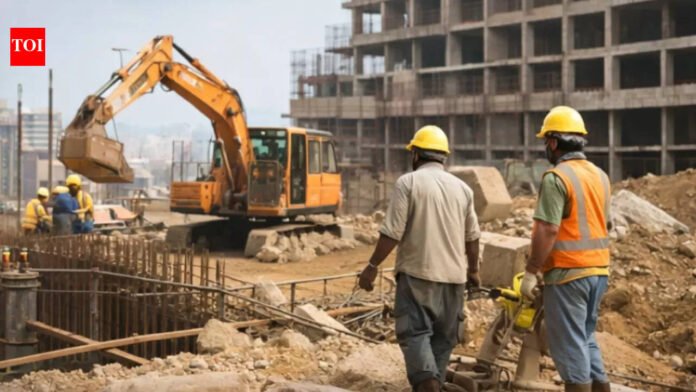
Over the past eight years, Uttar Pradesh has undergone structural transformation. Historically, the country’s agricultural roots are rapidly shifting toward an urban-centric economy. The shift from farm employment to non-farm employment grew at a rate of 7% per decade between 2011 and 2021, exceeding the 5% growth rate in previous decades. For India’s most populous state, this shift is the backbone of a new era of diversified economy.
Fundamentals of Governance and Funding
The country’s strategy begins with expanding the scope of local governance. Since 2017, 117 new urban local bodies (ULBs) have been established and 123 urban local bodies have been expanded to cater for the growing urban population. This administrative expansion is backed by huge financial commitments: budget allocations for urban development increased by an astonishing 287% between 2016 and 2025.Funding through the State and Central Finance Commission has also increased significantly:
- State Finance Commission (SFC): From Rs 6,406.09 crore in 2016-17 to Rs 14,400 crore in 2024-25.
- Central Finance Commission (CFC): Increased from Rs 1,667.22 crore to Rs 5,118 crore during the same period.
Cleanliness as a Culture: The Swachh Bharat Revolution
The most obvious changes are in sanitation and waste management. Uttar Pradesh has moved from ‘planning’ to ‘execution’ status.
The introduction of Integrated Command and Control Centers (ICCCs) powered by artificial intelligence has turned cities into “smart hubs” that can monitor waste, traffic and even emergency response in real time – a system that has proven vital during the Covid-19 pandemic.
Infrastructure and Living Standards: AMRUT and PMAY
Through the AMRUT 1.0 and 2.0 missions, the country has prioritized the basic necessities of life: water and sewage.
- Water connections: structured progress from zero to 1.5 million connections in 2017.
- Sewage pipe network: covering 940,000 households.
- Housing (PMAY): There has been a significant increase from 7,409 housing units approved in 2017 to over 15.49 million units by 2025.
Smart cities and modern policing
The smart city mission is nearly complete, with 95% of the project completed. In addition to the 10 cities selected by the central government, Uttar Pradesh has launched its own national smart city program for seven more cities.A standout achievement was the management of Mahakumbh 2025, which leveraged artificial intelligence and IoT for crowd management and security, achieving a 97% success rate in lost and found cases and clearing 161 litter hotspots through a dedicated team of more than 12,000 staff.
sustainable development and social welfare
The ‘green’ agenda has developed 228 acres of green space and introduced the UP Urban Greening Policy. Social welfare was also modernized:
- Animal welfare: 676 ‘gaushalas’ (cattle sheds) provide shelter to 140,000 cattle.
- Ideal Cities: 100 youth-centric/underdeveloped cities selected for specialized infrastructure development.
- Chief Minister’s Urban Development Scheme (CM-NSY): Focusing on the grassroots, construction of 2,534 km of roads and 342 km of drains in the newly formed ULB.
in conclusion
The figures paint a picture of a country rushing to modernize. By combining technology (AI/ICCC) with large-scale civil engineering projects and community-led initiatives like the Swachh Bharat Mission, Uttar Pradesh has laid a strong foundation. The result is urban networks that are not only larger, but also smarter, cleaner and more resilient.