
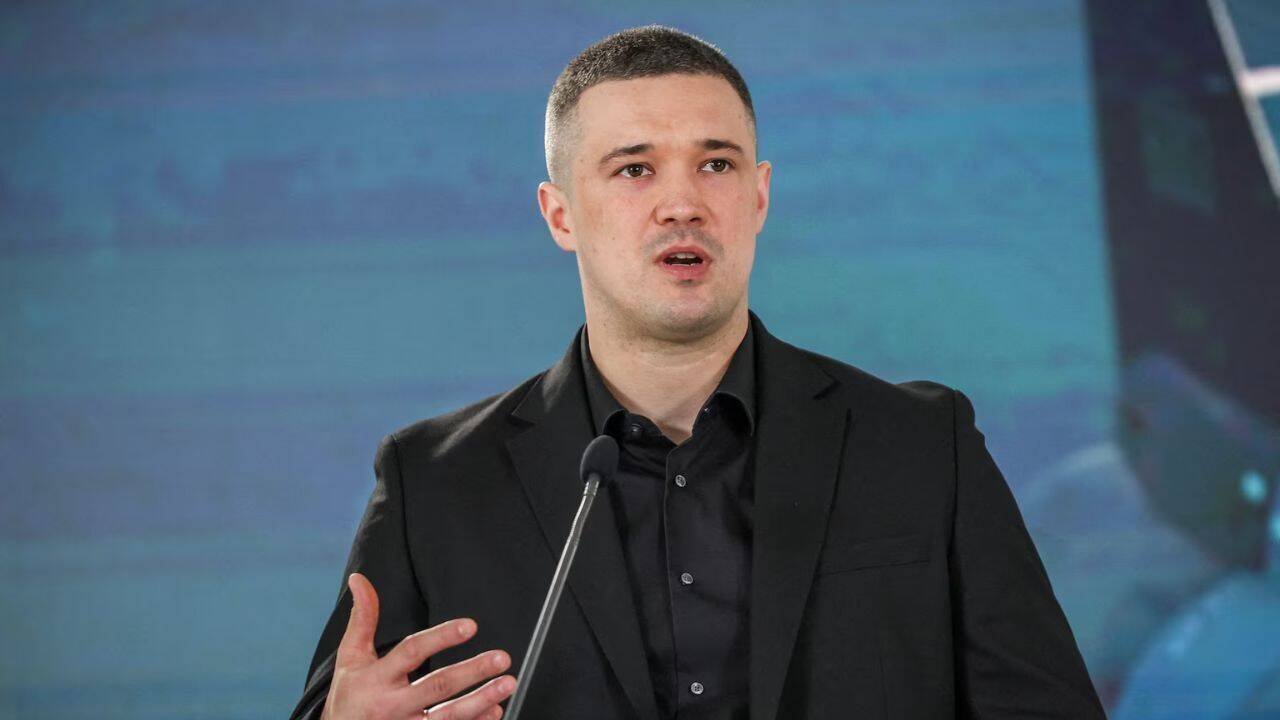
Kiev, Ukraine: President Vladimir Zelensky He destabilized his wartime government on Thursday, drawing thousands to the streets across Ukraine to protest against the ouster of his young defense minister. The defense minister is seen as an innovator in the country’s successful drone technology but has clashed with the traditional military establishment. As Ukraine’s fight against a full-scale Russian invasion approaches 4.5 years, personnel reforms, including a change of prime minister, could become a test of Zelensky’s political authority. Zelensky remained in office under martial law as wartime elections were banned, but he periodically reshuffled the government. The moves plunge Ukraine’s military leadership into an unwelcome crisis just as Ukraine’s campaign against Russia begins to bear fruit and Moscow launches relentless airstrikes. Ukraine’s emergency services said Russian missiles struck the capital Kiev overnight, killing two people and injuring five others, including a child. In making the changes, Zelensky cited friction between outgoing Defense Minister Mikhailo Fedorov and the commander of Ukraine’s armed forces, Gen. Alexander Silsky. “I just stated that if the two sides cannot solve the problem, I must solve it,” Zelensky told a news conference. Outgoing Defense Minister Seen as Modernization Driver Fedorov, 35, is seen as a dynamic modernization agent whose technical expertise is partly credited with a significant improvement in Ukraine’s military performance against Russia’s more powerful military in recent months. He is leaving the government after just six months in office. Fedorov appeared at the news conference wearing a dark T-shirt and jeans and accused Silsky of hindering necessary reforms because “warfare has completely changed” due to the emergence of new technologies such as drones. During his tenure, he limited the Russian military’s use of the Starlink satellite communications system, allowing Ukraine to better exploit its mid-range strike capabilities, giving Kiev a significant battlefield advantage. Fedorov said he was willing to work with Silsky, “but we came to a situation where all our initiatives started to be blocked.” “I personally don’t know how the war can be won under this arrangement (with Sielski as commander),” he said. Fedorov took to social media to highlight what he called his main achievement: redirecting funds earmarked for salaries toward medium-range strike capabilities, fiber-optic drones, reconnaissance systems and other technology. He pointed to expanded drone procurement, the Patriot missile defense contract, successful ballistic missile tests and sweeping changes in military procurement. But he acknowledged that he could not complete the organizational transformation of the Ministry of Defense “in line with NATO standards and common sense”, move all procurement to competitive tendering, and establish a culture of accountability. Silsky did not appear publicly but posted a message on Facebook thanking Fedorov and expressing hope that he would continue to serve Ukraine. “I hope he remains in the Ukrainian team,” Silsky said without elaborating. Zelensky said he was considering Interior Minister Ihor Kremenko as one of the candidates to succeed Fedorov. It’s unclear when lawmakers will vote on a new defense secretary. Zelensky described the difficult relationship between the Defense Ministry and the military on multiple levels, not just personal issues, and said both sides shared responsibility for the consequences. “Together we win, and we share responsibility for the chaos and public reaction,” Zelensky said alongside British Prime Minister Keir Starmer, who is due to make his final foreign trip before leaving office next week. Most young protesters support 60-year-old Fedorov Syrskyi, who initially organized the defense of Kiev in February 2022 and orchestrated a successful counteroffensive in the Kharkiv region seven months later. Born in 1965, he attended the Higher Military Command School in Moscow and later served in the Soviet artillery before the collapse of the Soviet Union in 1991. Western officials and analysts say Ukrainian forces massing under Fedorov have slowed the advance on Moscow’s front to a near standstill and attacked refineries and other energy infrastructure deep inside Russia, causing widespread fuel shortages. Despite this record, Zelensky decided to fire him, frustrating many. Fedorov led Ukraine’s digital transformation policy before becoming defense minister in January. He has earned his reputation by spearheading the rapid development and deployment of drone technology and launching multiple successful e-government platforms. As minister, he began fighting corruption, an issue of particular importance to Ukrainians who have repeatedly protested against it. He said in an interview that fighting corruption would mean harming the interests of groups that have long profited from projects within the ministry. He is seeking to overhaul weapons procurement to make it more transparent. He also promised comprehensive military reforms, saying the army had faced about 200,000 deserters and about 2 million evaders from military service. Protesters who took to the streets of Kiev and other cities in support of Fedorov, mostly young people, made vulgar remarks about current military commanders, chanting “Sirsky go away!” and “European troops serve European countries!” Kiev resident Bohdan Huriak said he was “deeply angry” about Fedorov’s withdrawal. “I’m not deeply involved in the internal political debate, but here’s a guy who showed results on the battlefield, and we saw the results, we felt the rise in fighting spirit and confidence in victory,” Huryak told The Associated Press. “And then, six months later, he was removed from office? Come on.” Russian military journalists and pro-Kremlin bloggers are interested in the controversy. Pro-Kremlin political analyst Sergei Markov described Fedorov’s comments as a “rebellion” against Zelensky. Colonel Pavlo Yelizarov, deputy commander of the Ukrainian Air Force, resigned following Fedorov’s dismissal. He said in his resignation letter posted on social media that this would weaken Ukraine’s air defense capabilities and lead to more deaths from Russian missiles and drone attacks. “I consider the dismissal of Mikhailo Fedorov to be a huge scourge for the country’s defense capabilities,” he wrote on Facebook. Head of state energy company Naftogaz becomes new prime minister Parliament overwhelmingly approved Serhii Koretskyi, president of state energy company Naftogaz, as the country’s new prime minister. In nominating Koretsky, Zelensky cited his record in the energy sector and said he was best prepared to guide Ukraine through another winter as Russia’s attacks on the power grid intensified. Unlike other senior government officials, the 48-year-old engineer did not rise through political parties, parliament or the civil service. He spent more than two decades running fuel and food businesses before being appointed to run some of Ukraine’s troubled state-owned energy companies and earning a reputation as an effective crisis manager who could turn them into profits. Zelensky has previously faced protests over his decisions. Mass demonstrations erupted in July 2025 when he fast-tracked passage of a law limiting the independence of the country’s anti-corruption watchdog. The outcry threatened his leadership for the first time since the Russian invasion, and he quickly reversed course and introduced legislation to restore the agencies’ independence.