

For many years, the Dubai-Sharjah-Ajman stretch has been one of the most congested commuter corridors in the UAE, affecting millions of travelers who commute between home and work every day.The problem is not small. Together, the three emirates form the largest urban agglomeration in the UAE, with more than 6 million residents and frequent cross-border commutes. Peak-hour traffic on major routes such as the Sheikh Mohammed bin Zayed Road (E311) is often slow to a crawl, and long delays are the norm.Now authorities say multi-layered transport reform is the only way to solve the problem, not just with more roads but smarter travel options.
Dh6 billion highway project
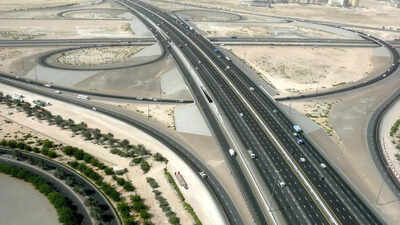
The centerpiece of the plan is the massive Dh6 billion federal highway project, often referred to as the “Fourth Federal Highway”.Key features include:
- 68 km long highway connecting Dubai, Sharjah and Ajman
- 6 to 8 lanes in each direction, significantly increasing capacity
- 10 major interchanges to reduce bottlenecks
- 4 flyovers to improve traffic flow at major intersections
The new corridor will connect existing major motorways such as the E11, E311 and E611, which are currently under significant pressure.Officials say the highway is designed not only to ease congestion but also to support future population growth and economic expansion across the northern emirate.
Bus Rapid Transit (BRT)
The plan relies on more than just expanding roads. A key shift has been the introduction of a high-capacity public transport system designed to move people more efficiently between the three emirates. The authority proposes to build around 10 major transport routes connecting Dubai, Sharjah and Ajman, with dedicated bus rapid transit (BRT) lanes to allow buses to bypass traffic congestion.These BRT systems will operate on dedicated corridors, ensuring faster and more reliable journeys, much like metro systems, but with greater flexibility and lower deployment costs. The network is expected to connect metro stations directly to major city centers, making transfers smoother for daily commuters. The wider aim is to reduce reliance on private cars, shorten commute times and lower carbon emissions, especially as the number of vehicles across the UAE continues to increase.
More than just roads and buses
The proposal was reviewed during the first meeting of the UAE Infrastructure and Housing Committee of 2026, chaired by Suhail Mohamed Al Mazrouei, Minister of Energy and Infrastructure. Officials stress that solving traffic congestion will require more than building new roads.In addition to infrastructure expansion, authorities are also looking at ways to manage growth in vehicle ownership while improving coordination between different transport modes, including road networks and public transport systems. The UAE also has a strong focus on long-term sustainable transport planning, signaling a shift in UAE policy towards a fully integrated intermodal transport ecosystem rather than relying solely on road expansion.
What does this mean for daily commuters?
The combined impact of these measures could be transformative for the millions of commuters who travel between Dubai, Sharjah and Ajman every day. Travel times are expected to improve as congestion eases on major routes, and faster, more reliable public transport can provide practical alternatives to driving.Over time, this could reduce rush hour stress on highways, make commuting less stressful and make travel across the emirate more predictable and efficient. Ultimately, the plan reflects a larger effort to rethink how people move between cities, focusing not only on adding capacity but also on creating a smarter, more balanced transportation system.


