
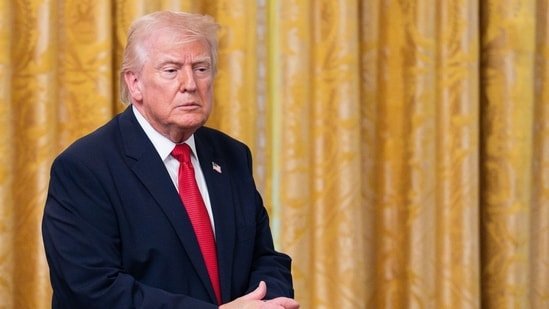
President of the United States Donald Trump has shifted from issuing sharp ultimatums to adopting a more cautious tone Strait of Hormuz. The change is largely driven by the reality that Iran continues to exert significant control over one of the world’s most important energy routes.

In the early weeks of the conflict, Trump repeatedly warned Iran not to disrupt shipping and threatened a strong military response if the flow of oil was disrupted. He even suggested that the strait would eventually “open up on its own.”
However, recent comments suggest a shift. According to Yahoo Finance, Trump admitted that Iran is already affecting traffic and even trying to charge transit fees. “They shouldn’t be able to do that, but they’ve done it a little bit,” he said.
He also pointed to limited cooperation during the talks, noting that Iran allowed a small number of oil tankers to pass through.
Also read: Trump extends deadline for Iran energy strike at ‘request’; report seeks ‘no pause’
Iran’s control over shipping is real
Despite pressure from the United States, Iran has managed to significantly restrict movement through the strait. Before the conflict, more than 100 ships passed through every day. Now, traffic has dropped dramatically, with only a handful of ships passing through.
Maritime data shows many ships avoid the route entirely, while others are selectively allowed to pass. Iran’s Revolutionary Guards even claim to have “complete control” of the waterway, which carries about a fifth of the world’s oil supply.
Shipping lines remain wary, with data showing traffic in the Strait of Hormuz down 90-95% since early March as attacks, mines and security threats keep most merchant ships at bay, according to analytics firm Kpler and shipping magazine Lloyd’s Register.
Also read: ‘Come on, Trump’: Poll shows how Republicans view US president’s Iran war approach
Why America can’t solve problems easily
According to CNN, U.S. officials privately admitted that reopening the strait was far more complicated than imagined.
“One of the central conundrums in this conflict is that the Iranians have real leverage … and there’s no obvious solution,” one intelligence official said.
Even in the United States and Israeli attack Targeting Iran’s capabilities, Tehran maintains a variety of ways to disrupt shipping, from mines and missiles to small boats and drones. These low-cost, imperceptible tactics make safe passage difficult to guarantee.
Geography also plays a role. The strait stretches nearly 100 miles, providing Iran with numerous locations along the coast from which to launch attacks or threaten ships.
Oil prices have surged above the barrel level, and some forecasts warn they could climb further if the crisis continues. The uncertainty also drives up shipping and insurance costs, further tightening supplies.
Also read: ‘Before it’s too late…’: Trump issues new warning to Iran ahead of peace talks
While the United States continues to work to counter Iran’s capabilities, officials acknowledge that a return to normal shipping depends in part on negotiations and de-escalation.
Currently, Iran’s ability to choke or control the Strait of Hormuz gives it enormous leverage, forcing Washington to recalibrate its approach.