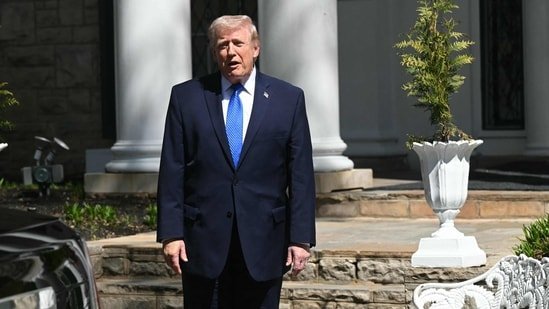
Less than 48 hours before the US-Israeli strike on Iran, Israeli Prime Minister Benjamin Netanyahu spoke by phone with US President Donald Trump about the reasons for launching a complex and far-flung war that the US leader had opposed. Both Trump and Netanyahu learned from intelligence briefings earlier this week that Iran’s Supreme Leader Ayatollah Ali Khamenei and his top deputies would soon meet at his compound in Tehran, leaving them vulnerable to “decapitation attacks” – a type of attack often used against the country’s top leaders by the Israelis but traditionally less frequently by the United States.
But new intelligence suggests the meeting has been moved up from Saturday night to Saturday morning, according to three people familiar with the matter.
The call had not previously been reported.
Netanyahu is determined to move forward with an operation he has been urging for decades, and he believes now may be a better opportunity to assassinate Khamenei and avenge Iran’s previous assassination of Trump, these people said. These include a murder-for-hire plot allegedly orchestrated by Iran in 2024, when Trump was still a candidate.
The U.S. Justice Department has charged a Pakistani man with trying to recruit people in the United States in a program aimed at retaliating for Washington’s killing of top Islamic Revolutionary Guard Corps commander Qasem Soleimani.
Sources said that at the time of the call, Trump had approved the idea of U.S. military action against Iran but had not yet decided when or under what circumstances the U.S. would intervene. said the sources, who requested anonymity to discuss sensitive internal deliberations.
For weeks, U.S. troops have established a presence in the region, prompting many within the administration to conclude that it was just a matter of when the president decided to move forward. Just a few days ago, a potential date was canceled due to bad weather.
Reuters could not determine the impact of Netanyahu’s arguments on Trump, who is considering issuing a strike order, but the call amounted to the Israeli leader’s closing argument to the U.S. president. Three sources briefed on the call said they believed that incident, along with intelligence indicating that the window to assassinate Iran’s leader was closing, was the catalyst for Trump’s eventual decision on February 27 to order the military to move forward with the epic fury. Netanyahu believes Trump can make history by helping to eliminate an Iranian leadership long reviled by the West and many Iranians. He said Iranians might even take to the streets to overthrow the theocratic system that has ruled the country since 1979 and has been a major source of global terrorism and instability ever since.
The first bomb attack occurred on the morning of Saturday 28 February. Trump announced Khamenei’s death that evening.
In response to a request for comment, White House spokesperson Anna Kelly did not directly respond to the call between Trump and Netanyahu, but told Reuters the military operation was intended to “destroy the Iranian regime’s ballistic missile and production capabilities, annihilate the Iranian regime’s navy, end their ability to arm proxies, and ensure that Iran can never acquire a nuclear weapon.”
Neither Netanyahu’s office nor Iran’s U.N. representative responded to requests for comment.
Netanyahu dismissed “fake news” claims at a press conference on Thursday, saying “Israel is somehow dragging the United States into the conflict with Iran. Does anyone really think anyone can tell President Trump what to do? Come on.”
Trump has publicly stated that the decision to strike was made by him alone.
Reuters reported that officials and others close to the two leaders spoke mostly on condition of anonymity given the sensitivity of internal deliberations, which did not suggest Netanyahu forced Trump to start a war. But reports suggest the Israeli leader is an effective advocate and that his framing of the decision — which included the opportunity to kill an Iranian leader who allegedly oversaw the operation to assassinate Trump — was persuasive to the president.
Defense Secretary Pete Hegseth said in early March that retaliation was at least one of the motivations for the operation, telling reporters that “Iran was trying to kill President Trump, and President Trump had the last laugh.”
Attack nuclear and missile target sites in June
In the 2024 campaign, Trump adhered to the “America First” foreign policy of the first administration and publicly stated that he hoped to avoid war with Iran and preferred to deal with Tehran through diplomacy.
But Trump began considering an attack after discussions over Iran’s nuclear program failed to reach an agreement last spring, according to three people familiar with White House deliberations. The first attack occurred in June, when Israel bombed Iran’s nuclear facilities and missile sites and killed several Iranian leaders. The U.S. military later joined the attack, and when the joint operation ended 12 days later, Trump publicly celebrated the victory, saying the United States had “destroyed” Iran’s nuclear facilities.
Months later, however, the United States and Israel resumed negotiations for a second airstrike aimed at striking more missile facilities and preventing Iran from acquiring the ability to build a nuclear weapon.
The Israelis also want to kill Khamenei, a long-time geopolitical nemesis who has repeatedly fired missiles at Israel and supported heavily armed proxy forces surrounding the country. These include the Hamas militant group, which launched a surprise attack from Gaza on October 7, 2023, and Hezbollah, which is headquartered in Lebanon.
On March 5, Defense Minister Israel Katz told Israel’s N12 News that Israel began planning an attack on Iran, but during a visit to Trump’s Mar-a-Lago estate in Florida in December, Netanyahu told Trump that he was not completely satisfied with the outcome of the joint operation in June, two people familiar with the matter said on condition of anonymity.
Trump has indicated he is open to another bombing campaign, but he also wants to try another round of diplomatic talks, the people added.
Two events prompted Trump to attack Iran again, according to several U.S. and Israeli officials and diplomats.
The U.S. capture of Venezuelan President Nicolas Maduro in Caracas on January 3 resulted in no American deaths and the overthrow of a long-time U.S. enemy, suggesting that ambitious military action may have few collateral consequences for U.S. forces.
Later that month, large-scale anti-government protests broke out in Iran, triggering a vicious response from the Islamic Revolutionary Guard Corps that left thousands dead. Trump vowed to help protesters but took no immediate public action. However, two Israeli officials who spoke on condition of anonymity said that privately, cooperation between the IDF and the US military’s Middle East Command (CENTCOM) has increased, with joint military planning taking place during secret meetings.
Soon after, during Netanyahu’s visit to Washington in February, the Israeli leader briefed Trump on Iran’s evolving ballistic missile program and pointed to specific sites of concern. He also laid out the dangers of the ballistic missile program, including the risk that Iran could eventually gain the ability to attack the U.S. mainland, three people familiar with the matter said.
The White House did not respond to questions about Trump’s meetings with Netanyahu in December and February.
Trump’s chance to make history
By the end of February, many U.S. officials and regional diplomats believed a U.S. attack on Iran was likely, but the details remained uncertain, two other U.S. officials, an Israeli official and two other officials familiar with the matter said.
Pentagon and intelligence officials briefed Trump on the potential advantages of a successful strike, including destroying Iran’s missile program, according to two people familiar with the matter.
Before Netanyahu’s call with Trump, Secretary of State Marco Rubio told a small group of senior congressional leaders on February 24 that Israel could attack Iran with or without U.S. involvement and that Iran could then retaliate against U.S. targets, according to three people familiar with the matter.
Behind Rubio’s warning was an assessment by U.S. intelligence officials that such an attack would indeed trigger an Iranian counterattack against U.S. diplomatic and military outposts as well as U.S. Gulf allies, three sources familiar with U.S. intelligence reports said.
This prediction turned out to be accurate. The attacks resulted in an Iranian counterattack against U.S. military assets that killed more than 2,300 Iranian civilians and at least 13 U.S. service members, attacks on U.S. Gulf allies, the closure of one of the world’s most important shipping lanes, and a historic surge in oil prices that has been felt by consumers in the U.S. and elsewhere.
Two other people familiar with Rubio’s briefings said Trump was also informed that the killing of Iran’s supreme leader might make Tehran more willing to negotiate with Washington, although that was highly unlikely.
One of the arguments Netanyahu raised in the call shortly before Trump issued the final order to attack Iran was the possibility of regime change, people familiar with the matter said.
As Reuters previously reported, this view is not shared by the CIA, which assessed weeks ago that if Khamenei was killed, he would likely be replaced by internal hardliners.
The CIA did not immediately respond to a request for comment.
After Khamenei was killed, Trump repeatedly called for an uprising. Iran’s Revolutionary Guards continue to patrol streets across the country as the war enters its fourth week and the region descends into conflict. Millions of Iranians remain holed up in their homes.
Khamenei’s son Mojtaba, considered more harshly anti-American than his father, was named Iran’s new supreme leader. (Reporting by Erin Banco and Gram Slattery; Additional reporting by Maayan Lubell in Jerusalem; Editing by Craig Timberg, Don Durfee and Daniel Wallis)