
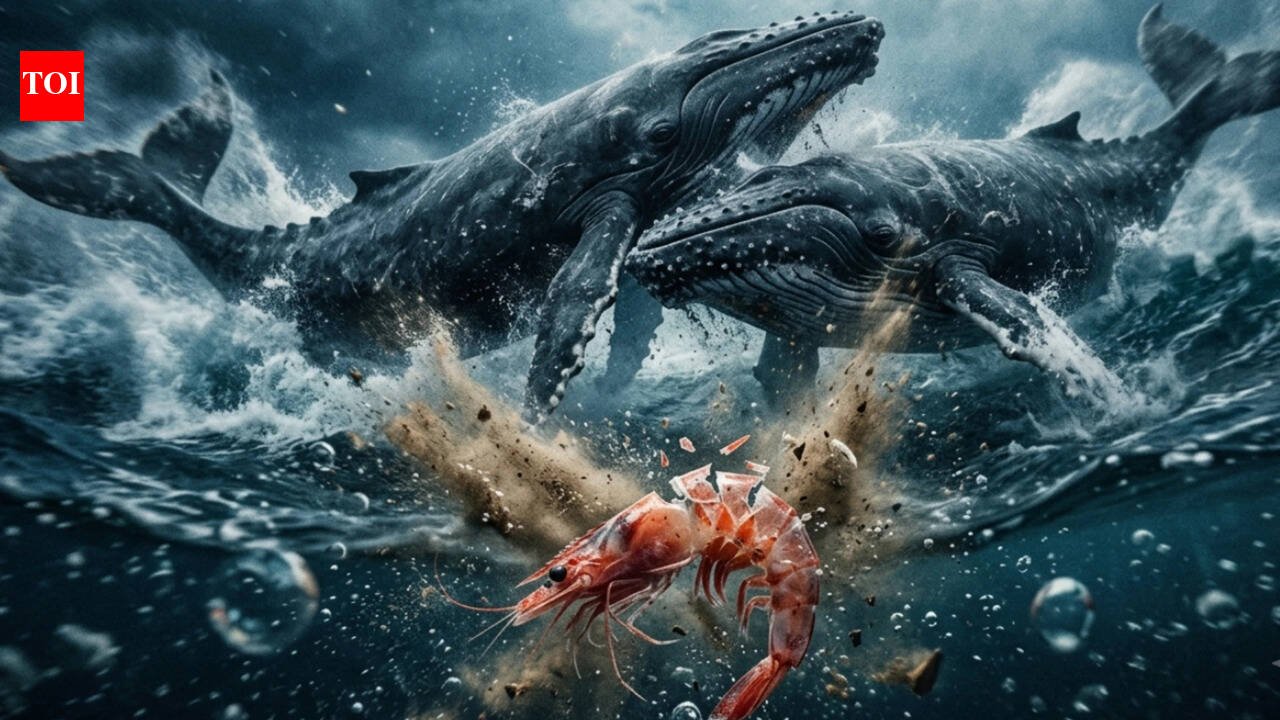
“When whales fight, the shrimp’s back is broken.”Just eight words can describe a truth that has shaped history, politics, the workplace, and even family life.Korean proverb Shrimp’s back explodes during fight with whale (Gorae ssaume saeu and teojinda) paints an unforgettable picture: Two huge whales get into a fight, and a limp and irrelevant shrimp ends up injured just because it happens to be nearby.Like many proverbs, it means more than its literal meaning. This reminds us that conflicts between strong men are rarely limited to the strong. Often, the people who pay the highest price are those with the least influence.Centuries after entering the Korean language, this proverb remains surprisingly relevant.
A simple image has powerful meaning
The literal translation of this proverb is this:“When whales fight, the shrimp’s back is broken.”In Korean, this proverb refers to the following situations: Powerful or influential people fight, while weaker, unrelated people suffer the consequences. It is often used when ordinary people suffer collateral damage in disputes beyond their control.The contrast between the giant whale and the tiny shrimp is very well thought out. One represents overwhelming strength; the other symbolizes vulnerability. The shrimp takes no part in the fight—it simply cannot escape its effects.Visual simplicity is one of the reasons for the phrase’s enduring popularity.
Proverbs Rooted in Korean Tradition
Unlike many famous quotes that can be traced back to a single philosopher or historical figure, this proverb belongs to Korea’s long oral tradition.Its exact origins are unknown, but scholars have been documenting it for centuries. period Joseon Dynasty (1392–1897),writer Hong Wanzhong incorporated this proverb into his seventeenth-century writings Sunodera (Xunwu Zhi), translating it into Classical Chinese as Whale fights shrimp to death (“When whales fight, shrimps die”). The existence of a written version suggests that the phrase was widely used in everyday speech before it appeared in literature.This is very common in Korean proverbs. Many stories originated from ordinary conversations among farmers, fishermen, merchants and villagers long before they were written down.
not just politics
This proverb is often associated with international relations because it neatly describes what happens when great powers compete.For centuries, the Korean Peninsula has existed between regional powers. As a result, South Korean commentators often quote this proverb to describe moments when conflict between great powers has left South Korea in dire straits. Modern newspaper editorials continue to use it when discussing diplomacy and geopolitics.However, limiting this proverb to politics misses its broader wisdom.It applies equally naturally to everyday life.Imagine two executives arguing over company strategy while employees face layoffs. Think of the children trapped in a painful divorce. Or consider a rival company that has become embroiled in legal action, leaving suppliers, customers, or small businesses in hot water.In each case, the “shrimp” was someone who was never asked to participate in the conflict.
Why this proverb endures
Many cultures have sayings about the weak suffering because of the strong. What makes this Korean proverb so memorable is its vivid imagery.Rather than explaining injustice in abstract terms, it creates a scenario that anyone can imagine.You don’t need to know Korean history to imagine the size difference between a whale and a shrimp. The imbalance is obvious. So does the result.This economy of language is one of the reasons why proverbs are passed down from generation to generation. A single image often conveys information more effectively than a lengthy explanation.
The philosophy behind this sentence
At first glance, this proverb seems pessimistic.But its deeper purpose is caution rather than desperation.It reminds listeners that power has consequences that extend far beyond the people who hold it. Decisions made by leaders, governments, executives and even parents ripple outward, affecting people who have little say in the matter.This proverb also encourages empathy.When looking at conflict, it requires us to look beyond the obvious winners and losers and notice those who bear the hidden costs. In modern discussions, this idea is often described as “collateral damage,” but a Korean proverb expresses the concept through a more memorable image.
Still relevant in today’s world
Even though this proverb is centuries old, it feels very current.Economic disputes between large companies can affect thousands of workers. A trade war could raise prices for the average consumer. Political polarization can divide communities. Even arguments that start on social media can spill over into the workplace, school, and home.The whales may have changed, but the shrimp remain.This continued relevance explains why Korean speakers still use this expression in news reports, conversations, and everyday comments. It’s concise, expressive, and easy to understand.
Courses beyond language
Every culture develops proverbs that capture universal experiences.Korean proverb Shrimp’s back explodes during fight with whale It’s a rare form of expression whose images effortlessly cross borders.It teaches us that power is rarely siled, conflict is rarely contained, and the smallest voices are often the first to feel the impact of decisions made by the largest players.Maybe that’s why this proverb has stuck around for hundreds of years.It’s not just about whales or shrimps.It speaks to a timeless reality: Whenever giants collide, it’s the little guys who are likely to bear the weight of the storm.