

A voter casts his or her vote at a polling station during the general election in Bangkok on Sunday, February 7, 2026. (AP Photo/Sakchai Lalit)

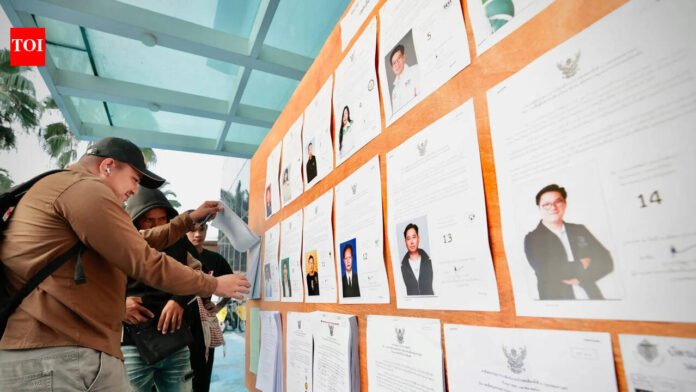
Voters view candidates listed on display boards before entering a polling station for the general election in Bangkok on Sunday, February 7, 2026. (AP Photo/Wason Wanichakorn)

Police and volunteers seal ballot boxes at a polling station ahead of the general election in Bangkok, Thailand, Sunday, February 7, 2026. (AP Photo/Wason Wanichakorn)

Police prepare for the general election at a polling station in Bangkok on Sunday, February 7, 2026. (AP Photo/Wason Wanichakorn)

Police and election volunteers prepare for the general election at a polling station in Bangkok on Sunday, February 7, 2026. (AP Photo/Wason Wanichakorn)
A voter casts his or her vote at a polling station during the general election in Bangkok on Sunday, February 7, 2026. (AP Photo/Sakchai Lalit)
Voters view candidates listed on display boards before entering a polling station for the general election in Bangkok on Sunday, February 7, 2026. (AP Photo/Wason Wanichakorn)
Police and volunteers seal ballot boxes at a polling station ahead of the general election in Bangkok, Thailand, Sunday, February 7, 2026. (AP Photo/Wason Wanichakorn)
Police prepare for the general election at a polling station in Bangkok on Sunday, February 7, 2026. (AP Photo/Wason Wanichakorn)
Police and election volunteers prepare for the general election at a polling station in Bangkok on Sunday, February 7, 2026. (AP Photo/Wason Wanichakorn)
A voter casts his or her vote at a polling station during the general election in Bangkok on Sunday, February 7, 2026. (AP Photo/Sakchai Lalit)
BANGKOK: Thai voters went to the polls on Sunday in a snap election seen as a three-way contest between progressives, populists and old-fashioned patronage politics. The fight for the support of 53 million registered voters comes against a backdrop of slow economic growth and rising nationalist sentiment. Although more than 50 parties are participating in the election, only three parties – the People’s Party, the Democratic Party and Pheu Thai – have the national organization and popularity to win the election. The 500 elected members elect the next Prime Minister by a simple majority. No clear winner is expected, with local polls unanimously showing that no one party can secure a majority, making a coalition government necessary. While the progressive People’s Party is seen as poised to win a majority, its reformist politics are not shared by its main rivals, who could exclude it by joining forces to form a government. Natthaphong Ruengpanyawut’s People’s Party is the successor to Kadima, which won a majority in the House of Representatives in 2023 but was forced to disband when conservative lawmakers blocked the formation of a government. The reformists softened their platform by continuing to promise sweeping reforms to the military, police and judiciary, appealing to young people and urban voters. Legal restrictions have allowed it to shelve demands for legal reform that imposes harsh penalties for criticism of the monarchy, while re-emphasizing economic issues. Softening its politics could weaken its core support, which was already in jeopardy because the last election positioned it exclusively as an alternative to the previous nine years of military-led governments, a situation it is unable to exploit effectively this time around. Meanwhile, the military’s reputation has been boosted by a surge in patriotism that emerged during last year’s border conflict with Cambodia, and its critical stance against the military could become a political liability, said Napon Jatusripitak, director of the Center for Politics and Geopolitics at the Thailand Future think tank in Bangkok. The Pujaitai party, led by current Prime Minister Anutin Chavilakul, is seen as the main defender and first choice of the royalist military establishment. Anutin has been prime minister since September last year after serving in the cabinet of former Prime Minister Paetongtarn Shinawatra, who was forced to step down over ethics violations in his handling of relations with Cambodia. In December, when he was threatened with a vote of no confidence, he dissolved parliament and called new elections. A subsequent border conflict with Cambodia allowed Anutin to reinvent himself as a wartime leader after his approval ratings initially sank due to floods and financial scandals. His campaign focused on national security and economic stimulus. Bhumjaithai is seen as the party most likely to form the next government, benefiting from an electoral strategy of old-style patronage politics and a machine adept at grassroots organizing in the vote-rich northeast. Thaksin’s political machine Pheu Thai Party is the latest political tool of billionaire former Prime Minister Thaksin Shinawatra, adopting the innovative populist policies of its predecessor, the Thai Rak Thai Party. The Thai Rak Thai Party was in power from 2001 to 2006, when it was ousted in a military coup. Thaksin-backed parties made several electoral comebacks but were eventually ousted by conservative-leaning courts and state regulators. It has softened its politics in the 2023 elections to return to power after being judged by the previously hostile royalist military establishment as an acceptable alternative to the more progressive Kadima party. The conservative court system acted on it anyway – ousting two prime ministers in two years and ordering Thaksin jailed on old charges. The party is currently campaigning on populist promises of economic recovery and cash handouts, and has nominated Thaksin’s nephew Yodchanan Wongsawat as its main candidate for prime minister. Sunday’s vote includes a referendum asking voters whether Thailand should replace its 2017 military-drafted constitution. The vote was not on the proposed draft but on whether to authorize Parliament to begin a formal drafting process, which would require a number of further steps to come to fruition. Pro-democracy groups see the new charter as a key step in reducing the influence of non-elected institutions such as the military and judiciary, while conservatives warn it could lead to instability.

Related articles
Recent articles