
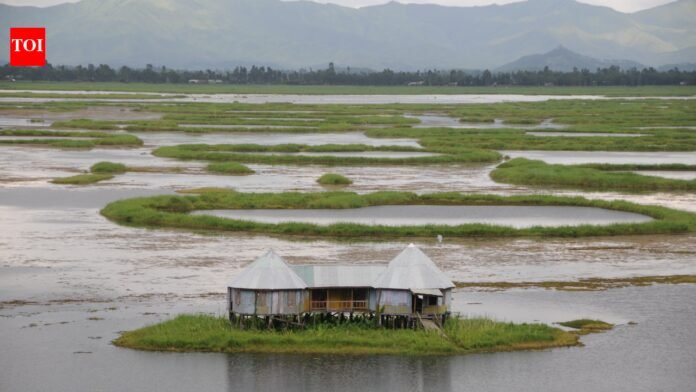
northeastern states Manipur Loktak Lake is a stunning freshwater body famous for its perfectly round floating islands called phumdis. The phumdis are made up of vast amounts of vegetation, soil and organic matter, creating extremely unique landscapes that can be seen from outer space. Loktak Lake is known as India’s “Floating Lake” and houses the world’s only floating national park, Kepuram Jyo National Park. In addition to its uniqueness, the lake is home to some rare wildlife such as the King Cobra, which is considered one of the longest venomous snakes in the world.
The secret behind the floating islands in Loktak Lake
There is no other lake in India like Loktak Lake. The lake covers an area of approximately 287 square kilometers and has natural floating islands known as phumdis, which are formed by the eventual accumulation of decaying vegetation, tree roots and organic matter.According to experts, from Terry, What makes phumdis special is their ability to float on lakes while being sturdy enough to be used as human settlements, fishing huts and even animal habitats. During the dry season, parts of the island sink to the bottom of the lake to absorb nutrients, and once the water increases, parts of the island rise.in an item consisting of UNESCOthe lake is globally recognized as a nutrient source due to its hydrological and ecological significance. The study refers to phumdis as “heterogeneous bodies of vegetation, soil and organic matter in various stages of decomposition.”Scientists have been studying the formation and movement of circular floating islands for decades. Their constant movement causes them to form an ever-changing landscape.
The world’s only floating national park
Keibul Lamjao National Park is located in Loktak Lake and is the only floating national park in the world. Found on a floating island, it is home to the endangered Sangai deer (commonly known as eyebrow deer).According to the Manipur Forest Department, Keibul Lamjao National Park is a “globally unique wetland ecosystem.” These floating grasslands are a habitat for the lake’s migratory birds, reptiles and aquatic animals.Scientists warn that changing hydrology and climate factors pose a threat to the Pumudi ecosystem, as if the floats become too thin, the animals that live in them could be at risk.Conservationists have made many appeals, such as from Wetlands International South Asiasustainably protect the lake ecosystem.
Loktak Lake and King Cobra Connection
One of the most interesting creatures found in the wetlands near Lake Loktak is the king cobra, whose scientific name is Ophiophagus hannah. King cobras live in forest and wetland habitats in some parts of India and Southeast Asia.The King Cobra is the largest venomous snake in the world, reaching a length of up to 5.6 meters. According to the agency, some individuals are up to 18 feet long Center for Advanced Research in Life Sciences, Department of Life Sciences, Manipur University. Therefore, it is considered one of the longest snakes in the world.Although the King Cobra is fearsome, it is not aggressive and usually avoids contact with humans. King cobras are important as predators because they control the populations of other snakes.The wetlands and lush vegetation surrounding Loktak Lake are a perfect habitat for reptiles, amphibians and aquatic animals, making it one of the most biodiverse places in India.Loktak Lake is one of the most wonderful natural wonders in India today because of its floating islands and ancient animals living under the mountains of Manipur.