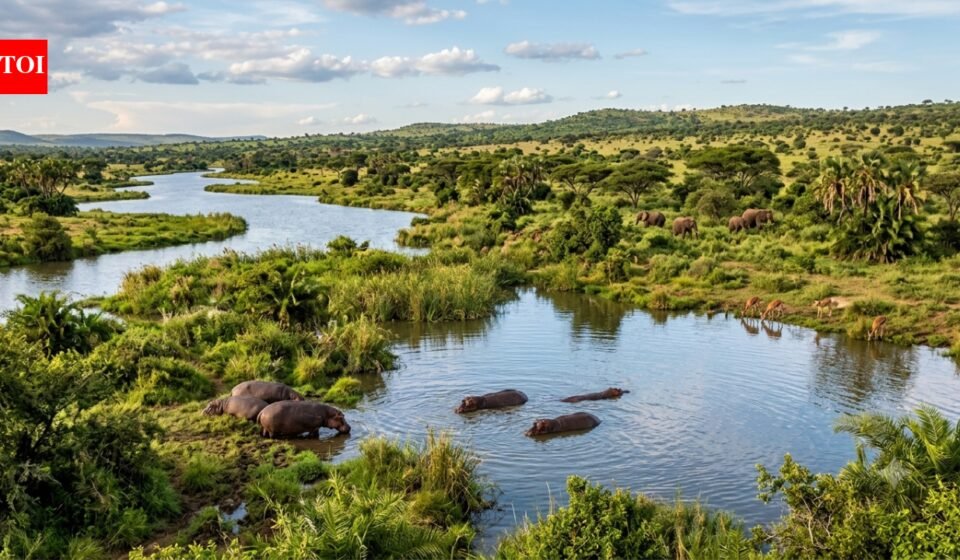
The Sahara Desert was once filled with rivers, huge lakes, and hippos. Scientists explain why it turns green every 20,000 years | World News

For most people, the Sahara Desert is the ultimate symbol of endless sand, sweltering heat, and one of the harshest environments on Earth. Geology, however, tells a very different story. Beneath the dunes are the remains of ancient rivers, vast lakes and ecosystems that once supported hippos, crocodiles and thriving human communities. Scientists now know that these dramatic shifts were not random events but part of natural climate rhythms that have reshaped North Africa over millions of years. New research, combining satellite findings and evidence preserved in ocean sediments, is revealing why the world’s largest hot deserts repeatedly turn green, how these fertile landscapes persist for thousands of years, and why predicting the next green Sahara is far more complex than simply counting another 20,000 years on Earth’s orbiting clock.
Why the Sahara Desert turns green every 20,000 years
According to various reports and MIT News (2019), wet periods in the Sahara typically occur approximately every 20,000 years. This number comes from the Earth’s long-term motion called axial precession, a gradual change in the direction of the Earth’s axis of rotation. The seasons change in relation to the Earth’s position around the Sun, as the Earth’s orientation slowly changes. At certain times, northern summers experience stronger sunlight because they occur when the Earth is slightly closer to the sun. This additional heating has consequences that go far beyond the effects of temperature itself. North Africa’s warm land contrasts even more with the surrounding ocean. This strengthens the African summer monsoon, allowing moist air to move farther north than it currently does. The rain reached what is now an almost completely dry area, supporting vegetation, rivers and lakes across large swaths of the Sahara.
How plants have helped the Sahara stay green for thousands of years
The first increase in rainfall is only part of the story. Once plants begin to spread, they begin to change their surroundings. The vegetation darkens the ground compared to the pale desert sand, allowing the surface to absorb more sunlight rather than reflect it away. Plant cover also helps the soil retain moisture while reducing dust particles entering the atmosphere. Lakes and wetlands further increase moisture through evaporation, creating conditions that support more rainfall.These interconnected processes underpinned the initial climate change. Rainfall does not appear briefly and then disappear again, but rather the landscape can remain moist for thousands of years while these natural feedbacks continue to operate.A 2023 modeling study led by Edward Armstrong of the University of Helsinki, in collaboration with colleagues from the Universities of Bristol and Birmingham, was published in Nature Communications titled: “The North African Humid Period of the Past 800,000 Years“, Some 230 humid phases in North Africa from around 800,000 years ago have been reconstructed using a newly developed climate model; this is the first time the models have matched the scale of “greening” that paleoclimate evidence shows actually occurred. Another study was published in Nature Communications titled “Correlation and anti-correlation between the East Asian summer monsoon and winter monsoon in the past 21,000 years” confirmed that wet periods recur in precessional cycles of about 21,000 years and identified a second key factor: large northern hemisphere ice sheets. When these ice sheets are large, such as during ice ages, they cool the atmosphere enough to suppress the West African monsoon, so favorable orbital timing alone does not guarantee a green Sahara.
Evidence goes back millions of years
The Sahara’s repeated transformations are not based on a single archaeological site or an ancient lake. Sediments recovered from the Atlantic Ocean preserve material washed or blown away from North Africa over millions of years. Layers rich in eolian dust indicate a dry climate, while sediments transported by rivers indicate a moist climate. The organic compounds preserved in these sediments also carry chemical signals related to ancient rainfall.The longest such record comes from a 2022 study led by Anya Crocker (then at the University of Southampton and now at Cardiff University), published in Nature Geoscience and titled “Astronomy controlled Sahara desert droughts since at least 11 million years ago‘. By analyzing dust and river sediments from an Atlantic drilling site, the team traced changes in astronomical rhythms between wet and dry conditions in the Sahara back to 11 million years ago, a record that far predates the oldest previously known terrestrial evidence of desert conditions in the region. Elsewhere, cores collected from the Mediterranean contain dark, organic-rich layers called sapropels. These phenomena develop when stronger river systems carry more fresh water into the ocean, changing conditions on the seafloor. Together, these records reveal the Saharan climate’s repeated alternations between green and dry. Although this pattern repeats, each wet phase developed under different global climate conditions. Some last longer than others, and the rain reaches different parts of the continent.
this The last green Sahara Far from the rainforest
According to the National Oceanic and Atmospheric Administration (NOAA), the most recent wet period, often called the African Humid Period, began after the end of the last ice age. Depending on the study site, its duration lasted from about 14,500 years ago to about 5,000 years ago, with the strongest widespread conditions occurring during much of the Holocene.The term “Green Sahara” may create the wrong impression. Large tracts of forest do not cover the desert from one side to the other. Instead, the region features ever-changing grasslands, wooded savannas, swamps, rivers, lakes, and scattered woodlands. Some areas remain relatively dry, while low-lying basins collect enough water to support extensive wetlands. Rainfall advances and retreats in varying patterns across this vast land, creating a patchwork of environments rather than a single unified environment.Satellite observations and geological surveys have even revealed traces of ancient river systems hidden beneath later sediments. One of the largest, known as the Tamanrasset River, was identified using Japanese radar satellite imagery, according to a report published in Nature Communications in 2015 titled “African wet spell triggers reactivation of large river system in Western Sahara‘. The buried channel stretches from Algeria’s Atlas and Khogar highlands to the Atlantic coast near Mauritania, and the study’s authors estimate that if it had sufficient flow, it would rank among a dozen of the world’s largest rivers.
Hippos and crocodiles are part of everyday life
Ancient rock art in the Sahara shows giraffes, elephants, cows and hippopotamuses. The images provide an important glimpse into the wildlife known to prehistoric communities, but archeology provides stronger physical evidence. Animal remains found from the site include hippopotamus bones as well as fish and turtles, suggesting permanent water supported a thriving aquatic ecosystem, and radiocarbon dating suggests the site was used by two successive cultures over approximately 5,000 years.The sequence documents environmental changes in great detail. As rainfall dwindled, fish became increasingly scarce and communities became increasingly dependent on domesticated livestock rather than aquatic resources.
The next Green Sahara is undateable
The Earth’s orbital cycle continues today, and precession will eventually again create conditions favorable to stronger sunlight in the northern summer. Even so, scientists can’t predict exactly when another large green Sahara will emerge.Orbital changes interact with many other parts of the climate system. Ocean circulation, atmospheric carbon dioxide, vegetation, dust levels, sea surface temperatures, and the presence or absence of large ice sheets all influence the extent to which the African monsoon expands; depending on Armstrong et al. Modeling work highlights that during past glacial periods, ice sheets alone were enough to halt this process. Modern human-driven climate change also means that, even if orbital geometries become favorable again, future conditions will not simply reproduce what they were like thousands of years ago.