
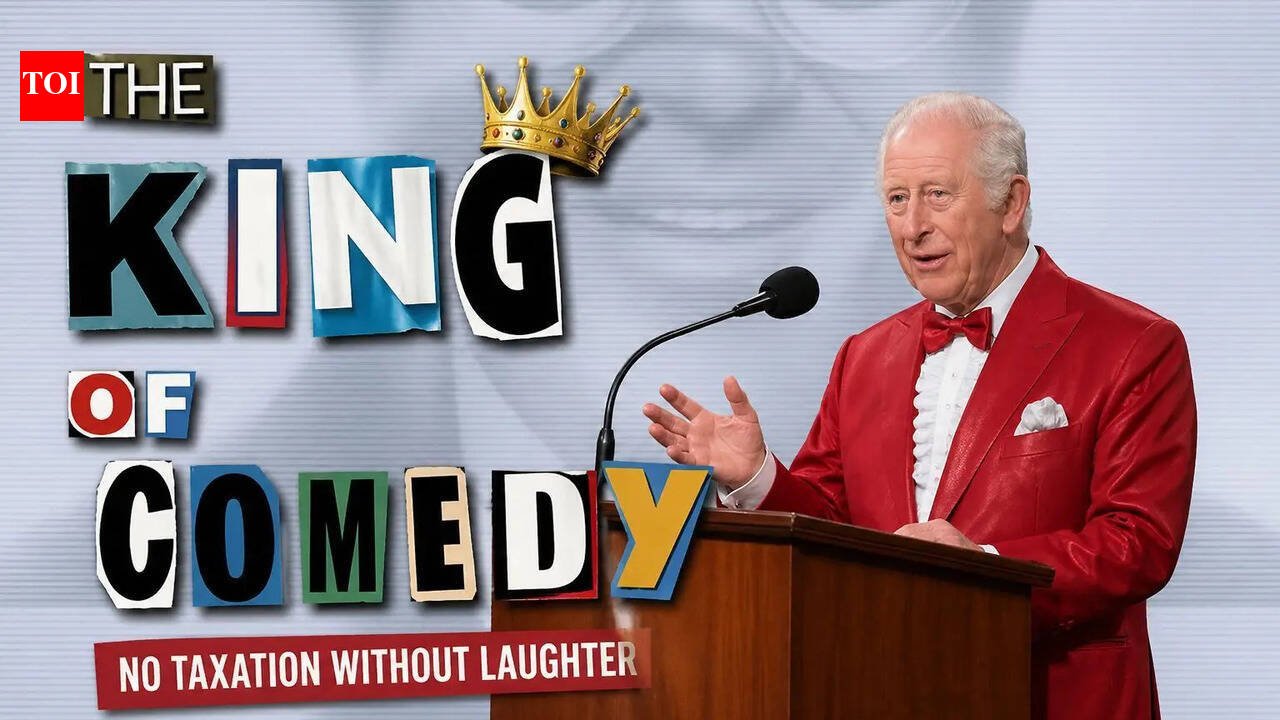
The city symbolizes a period in our shared history, or what Charles Dickens called “a tale of two Georges”: George Washington, the first president, and King George III, my fifth great-grandfather. “King George never set foot in America, and rest assured, I am not here for some dodgy rearguard action,” King Charles III said while standing in the U.S. Congress.It’s a laugh line. This is also a microcosm of the entire speech.Charles began with a joke about the king who lost America and the president who won it, just to gently reassure his audience that he wouldn’t come back to take back the colonies. It landed because it acknowledged the most embarrassing fact in British and American history and then defused it. But it also sets up something more interesting. A monarch representing one of the world’s oldest surviving institutions is reminding the world’s most powerful republic why it exists.Or so it seems.What Charles did next was quietly reinterpret the meaning of this established story. He did not challenge the American Revolution. He redefined it. “We didn’t always see eye to eye—at least at first,” he said later, referring to the founding battles between Britain and the United States. Although this sentence is said easily, it contains deeper implications. Disagreement is not the enemy of democracy. This is where it starts.This idea runs throughout the speech and is expressed almost entirely through humor. Charles jokingly spoke of the British parliamentary tradition of holding a member of Parliament “hostage” at Buckingham Palace to ensure the monarch’s safe return, adding that the guest had been treated so well recently that they didn’t want to leave. He paused, then added, “Mr. Speaker, I wonder if there are volunteers here today for this role?” Because what sounds like a quirky anecdote is actually a lesson in institutional drama. Britain has used wars, executions, and revolutions to resolve conflicts between monarch and parliament. All that remains today is the ceremony. Hostages are no longer hostages. The monarch is no longer to be feared. The system survives because everyone understands the limits, and those limits are maintained through performance and law.Charles never said this outright. He doesn’t need to. Every joke points in the same direction.The “Two Georges” line reminded America of a king out of power. The hostage joke reminds America of a monarchy that learned to live without power. Even his asides about his twentieth visit to Washington (his first as king) maintain a quiet continuity. The royal family exists not because it dominates politics, but because it has learned to stay away from politics.
This is the contrast in the speech.On one side are the constitutional monarchs, whose institutions have survived by delegating power to parliaments, courts and parliaments. On the other hand, modern presidents increasingly use the language of personal power, with leaders not only as heads of government but also as embodiments of political movements.Charles never made this comparison explicitly. He did it structurally.He called Congress a place of deliberation, not of giving orders. He spoke of the rule of law as the basis for prosperity. He spoke of the need for alliances, shared responsibilities, and patience in disagreements. Each of these ideas is stated aggressively, almost gently, but together they form a picture of how power should work in a democracy.Humor makes the picture clearer. By refusing to sound like a critic, Charles makes it harder to dismiss criticism.Even the history he quotes carries a quiet wisdom. He wasn’t just being charming when he described America’s Founding Fathers declaring independence “just the other day.” He compresses 250 years into a single moment, reminding viewers that history changes quickly and that institutions are more fragile than they appear. He wasn’t just being poetic when he talked about how the Scottish mountains and the Appalachians were once one and the same. He believed that separation, neither geographical nor political, would eliminate a common origin.There’s also a certain mischief in the way he quotes American voices to Americans. He quoted Lincoln as a reminder to America that actions speak louder than words. He quoted American ideals as if they were universal truths rather than national slogans. It’s a subtle way of holding up a mirror. The speech implies that if these principles are so important, then they must be practiced, not just memorized.This is where the history of the British monarchy itself creeps into the debate. The royal family survived not because it was always wise, but because it learned from its failures. It lost a civil war. It has lost a king. It lost its American colonies. It saw the collapse of other monarchies in Europe. At each stage, it adapts, retreating from power, accepting constraints, and transforming itself into something that can coexist with democracy rather than compete with it.The jokes in Charles’s speech were the final stage of this evolution. The king can now stand in the United States Congress and joke about losing America because the royal family no longer claims the authority it once fought so hard to maintain. It survives by acknowledging its past rather than denying it.That’s what makes this speech quietly disturbing.Once a theocratic monarchy, it has become accustomed to accepting its own limitations, even to the point of laughing at itself. A republic founded to reject monarchy became increasingly comfortable with a landscape of concentrated power. The roles are not reversed, but the contrast is more stark.Charles made no accusations. He did not issue the warning in dramatic terms. He tells a series of jokes, each leading to the same conclusion. The power to refuse restrictions does not last long. Institutions that respect limits endure.The line “Two Georges” begins the speech with history turned into humor. By the end, the humor returns to history. Without saying it outright, Charles hinted that the United States had gone to war against the king. The question now is whether it remembers why.