
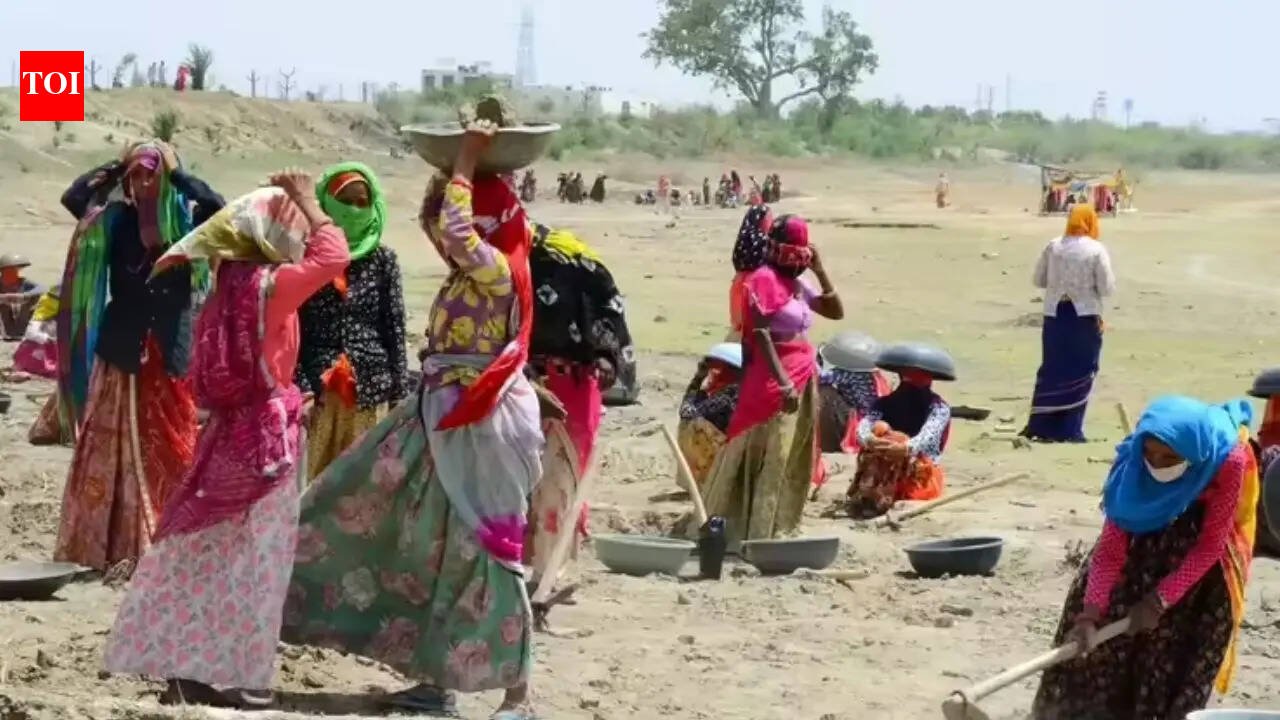

New Delhi: To implement the new rural employment framework, the Center on Monday notified July 1 as the effective date of Viksit Bharat – Rozgar and Ajeevika Mission (Gramin) Guarantee Bill, 2025. UPA era Mahatma Gandhi National Rural Employment Guarantee Act (MGNREGA), 2005 shall be repealed with effect from the same date.Under the new VB-G RAM G framework, every rural household with an adult member voluntarily engaged in unskilled manual labor will be entitled to guaranteed paid employment for 125 days in every financial year instead of 100 days under MGNREGA.The Ministry of Rural Development said this move marks a historic shift in India’s rural development framework. Union Minister Shivraj Singh Chouhan expressed confidence that this plan will become a milestone in realizing the determination to build “developed villages” and lay the foundation for a “developed India”.Chouhan noted that the rule-making process for the new bill is ongoing after extensive consultations with states. According to the ministry, the rules will be prepared soon and a public consultation will be conducted so that the public can be informed by July 1.The new bill will be implemented as a centrally funded scheme. The cost-sharing ratio between the Center and the states is 60:40, the cost-sharing ratio between the northeastern and Himalayan states is 90:10, and the Union Territories without a legislative body receive 100% central funding.Chouhan, however, assured of a seamless transition that would ensure that no employment opportunity would be deprived of any laborer during this transitional phase.“The ongoing work under MGNREGA as on June 30 should be preserved and seamlessly continued in the new framework, ensuring alignment with the provisions of Viksit Bharat G RAM G. The ministry said that all MGNREGA job cards that have undergone e-KYC verification before issuance of Gramin Rozgar Guaranteed Cards will remain valid under VB–G RAM G. So far, approximately 91% of approximately 120 million active workers have been verified.“Workers without job cards will not be denied employment simply because of incomplete e-KYC and state governments should continue to facilitate on-site arrangements for completion of e-KYC,” the ministry added.Under the law, states will have six months from the bill’s effective date to develop plans to ensure the law is implemented locally.However, it was learned from officials that plan templates have been shared with states and many states may have plans ready by six months.The central government has allocated Rs 95,692.31 crore for the financial year 2026-27, which is the highest allocation ever during the budget phase of the rural employment scheme. Including possible contributions from states, the total expenditure under the scheme is estimated to be over Rs 151 crore.Meanwhile, Congress reacted to the announcement on Monday, calling it “yet another lazy headline-grabbing exercise” and claiming that the only guarantees offered by the law were “extreme concentration” and “diminution of the bargaining power of rural labor.”Jairam Ramesh, Congress secretary-general for communications, posted on This is yet another lazy and eye-catching activity by a government that specializes in such activities. No details have been revealed yet, other than that they will be released soon. “He added: “If the alternative to MGNREGA is to be implemented from July 1, 2026, all operational details should have been announced by now. Public consultation and discussions with state governments on these details must be held in a meaningful way and not just as a formality.”“But there is no doubt. The only guarantee offered by VB-G RAM G is extreme concentration and weakening of the bargaining power of rural labour,” Ramesh added.The Congress leader further claimed that “the constitutional right to work and right to wages from rural families in India are being stolen.” He also shared a chart on ‘X’ listing the “four attacks on right to work by the Modi government”, claiming that the government had “attacked” the right to work, right to fair wages, panchayati raj and state finances through the VB G RAM G Bill.