On February 20, 2026, the Supreme Court overturned Donald Trump’s sweeping global tariffs in a 6-3 decision, a landmark ruling that reshaped the limits of the power of the American president. The decision was historic not only because it invalidated one of Trump’s most aggressive economic policies, but also because two justices he personally appointed joined the majority against him. The case quickly became a defining moment in the ongoing constitutional debate over the extent to which the president of the United States can exercise economic power without Congress.
what the court ruled
The case centers on whether Trump can use emergency powers under the national security law to impose broad tariffs on imported products. The Supreme Court ruled that the statute did not authorize such sweeping action. It held that tariffs were essentially a form of taxation and that the power to tax rested with Congress under the Constitution.Chief Justice John Roberts, writing for the majority, framed the case as a basic separation of powers issue. He warned that allowing the president to impose tariffs without explicit legislative approval would give the executive branch virtually unlimited power to reshape the economy.
Trump’s iconoclast appointees
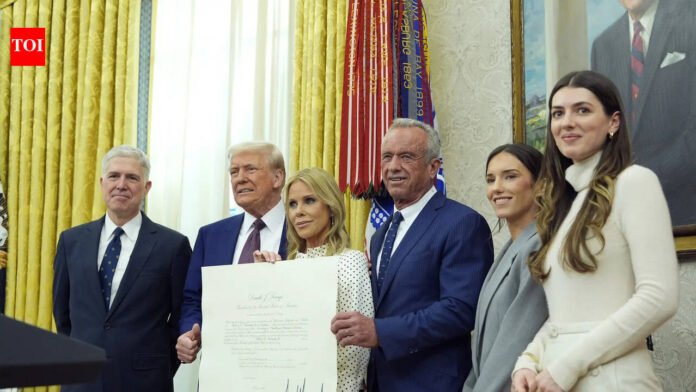
Two of Trump’s own nominees, Neil Gorsuch and Amy Coney Barrett, joined the majority in issuing stunning institutional condemnations.Gorsuch, who took office in 2017, has long advocated strict constitutional limits on executive power. In this context, he emphasized that major economic actions require clear authorization from Congress and cannot rely on vague statutory language. His views reflect a consistent judicial philosophy that prioritizes constitutional structures over political alignments.Barrett, Trump’s 2020 appointee, also sided with the majority. She agreed that Congress must give a clear mandate before the president can make decisions with huge economic consequences. Her vote is particularly important because she is widely considered one of the court’s most conservative members.
conservative divide
The ruling exposed deep divisions within the court’s conservative bloc. Chief Justice Roberts, although appointed by a Republican president, joined Gorsuch and Barrett in striking down the tariffs, forming a three-member conservative majority that opposed Trump.On the other hand, conservatives Clarence Thomas, Samuel Alito and Brett Kavanaugh dissented. They argue that Congress has given the president broad powers to regulate foreign commerce, and Trump’s tariffs are consistent with that tradition. Their dissents reflected a long-standing judicial approach favoring strong executive power, particularly on national security and foreign policy issues.All three liberal justices voted in the majority, making the final alliance a rare cross-ideological alliance driven more by constitutional interpretation than partisan ideology.
political influence
The ruling prompted an angry response from Trump, who publicly criticized the judges who opposed him, including his own nominees. Within hours, he said he planned to impose new tariffs under alternative legal authorities, stressing that the political battle over trade powers was far from over.
Why the ruling is important
Aside from trade policy, the decision is widely seen as one of the most significant limits on presidential power in decades. It reinforces the constitutional principle that economic taxation power remains firmly in the hands of Congress, even during national emergencies.The decision also highlights broader philosophical differences within the conservative legal movement over how far executive power should extend.
bottom line
The Supreme Court’s tariff ruling is more than just a legal setback for Donald Trump. It was a decisive constitutional moment that reaffirmed Congress’s authority over taxes and revealed that even the president’s own appointees can end up siding with institutional limits on political loyalty.