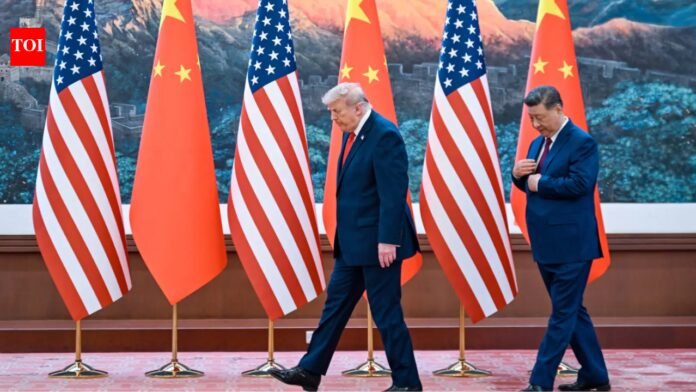
The White House on Sunday released a fact sheet for U.S. President Donald Trump’s visit to China, outlining deals on trade, investment and the Iran crisis but making no mention of Taiwan, even though the issue dominated Trump’s meeting with Chinese President Xi Jinping.According to the briefing, the two countries agreed to establish new “U.S.-China Business Council” and “U.S.-China Investment Committee” mechanisms to manage bilateral economic and investment issues.The document stated that Trump and Xi Jinping agreed that Iran “cannot possess nuclear weapons”, called for the reopening of the Strait of Hormuz, and agreed to “not allow any country or organization to collect tolls.”The White House also said that Trump will receive Xi Jinping in Washington later this year and that the two countries will support each other in hosting the G20 and APEC summits.
Trade, rare earths and Boeing deal highlighted
China will address U.S. concerns about shortages of rare earth minerals and critical materials, including yttrium, scandium, neodymium and indium, the fact sheet said.It also announced that China had approved the first purchase of 200 Boeing aircraft for Chinese airlines, saying it was the first major commitment to U.S.-made Boeing aircraft since 2017.Additionally, China has pledged to purchase at least $17 billion worth of U.S. agricultural products annually in 2026, 2027 and 2028, in addition to its previous soybean commitments in 2025.The White House further stated that China has restored market access to more than 400 U.S. beef plants and resumed poultry imports from states where the U.S. has lifted bird flu restrictions.
Despite leading negotiations, Taiwan ignored
While the fact sheet emphasized “strategic stability” and economic cooperation, there was no mention of Taiwan, even though it was reportedly one of the central issues during Trump’s trip to Beijing.Xi Jinping warned Trump during the talks that mishandling Taiwan could push the United States and China into conflict. However, Trump avoided publicly discussing Taiwan while in Beijing.After leaving China, Trump acknowledged that he and Xi Jinping “talked a lot about Taiwan” and said he was reconsidering a previously approved U.S. weapons program for Taipei over Xi’s objections.In an interview with the media after the summit, Trump also described the possible sales of billions of dollars in arms to Taiwan as a “negotiation bargaining chip,” sparking concerns in Taiwan.
“Strategic Stability” Framework
The White House fact sheet said the two sides agreed to establish a “strategic and stable constructive relationship” based on “fairness and reciprocity.”Chinese officials describe the framework as a new model for managing relations between the world’s two largest economies over the next three years, focusing on cooperation and managing differences.The visit also included extensive discussions on the Iran conflict and global energy security. Trump claimed that Xi agreed that the Strait of Hormuz must remain open and that Iran should not possess nuclear weapons, even as Chinese officials publicly insisted that the concerns of all parties should be taken into account when resolving the crisis.