

NEW DELHI: Generative artificial intelligence (GenAI) is fast becoming part of the learning routine for Indian children, but so are deep misunderstandings about the practical uses of the technology. The Bharat EdTech Survey 2025 released by Central Square Foundation on Wednesday showed that 35% of children who already use edtech are using GenAI tools for learning, even though nearly three-quarters of children who know about GenAI mistakenly believe that these tools are just internet search engines. The survey, conducted between July 2025 and January 2026 and covering 12,500 families and 2,500 teachers in 10 states, shows that GenAI adoption is no longer experimental for children from low-income families: 96% of children use it multiple times a week and 69% use it every day.
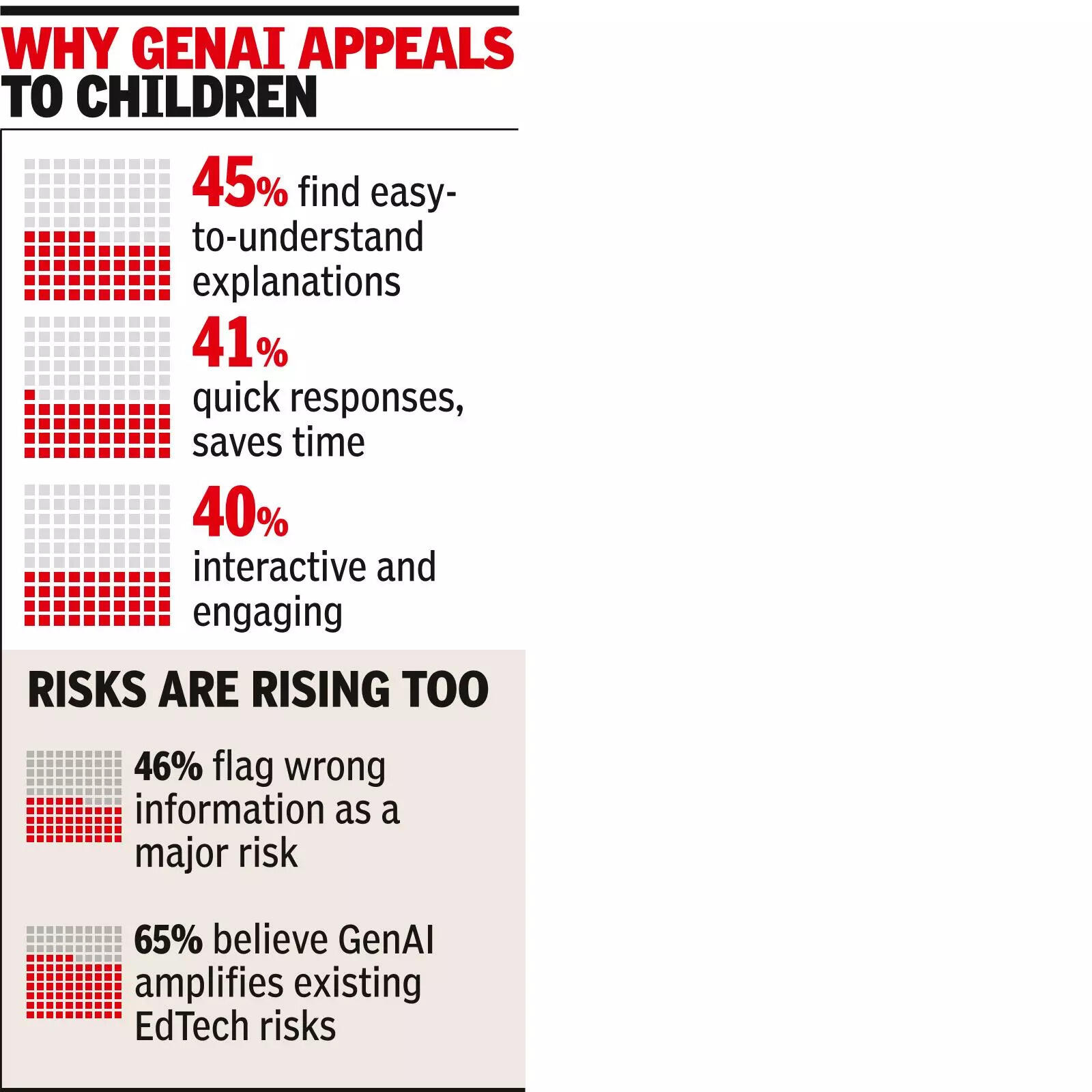
Why GenAI appeals to kids
However, understanding lags far behind usage. While 85% of children who are aware of GenAI say they understand how it works, 72% equate it to a search app, blurring the lines between probabilistic responses generated by AI and verified online information. This gap is critical, as 46% of respondents flagged “misinformation” as a major risk associated with edtech and GenAI use, while also worrying about overuse. The report shows that children mainly use GenAI for school-related activities, with 73% of children relying on it to solve questions and practice, 48% of children use it to learn new skills or language translation, and 32% of children use it to prepare for exams. Key draws are easy-to-understand explanations (45%), time-saving quick responses (41%) and interactive formats (40%), features that make GenAI particularly attractive among families where adult academic support may be limited. However, experts warn that frequent use without basic AI literacy may amplify the risks. The New Delhi-based NGO said the findings highlighted the urgent need to move beyond access and adoption metrics.


 is fast becoming part of children's learning routines in India, but a deep misconception about w.)