

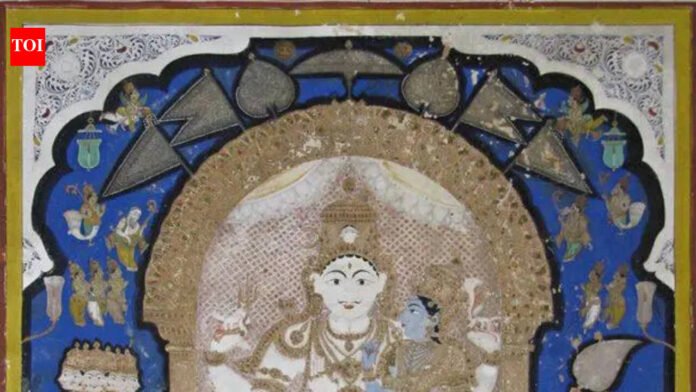
The Surpur style of painting is an artistic tradition endemic to the Kalyana Karnataka region, which consists of seven districts in northeastern Karnataka. Artist and history enthusiast Rehaman Patel said it is about 400 years old. “It emerged during the reign of Bedar Nayak, who ruled the Surpur kingdom from 1636 to 1858. The Surpur kings, starting from the founder Raja Gaddi Pidda Nayak and his successors like Hasarangi Pamanayaka, Immadi, Venkatappa Nayak and Mummadi Devendra Venkatappa Nayak all encouraged this art form in their courts,” he said.He said this tradition reached its peak during the regime of Raja Nalvadi Venkatappa Nayak who ruled the kingdom from 1843 to 1858. “After 1858, the art form lost its patronage,” he added. The roots of original Surpur (or Sholapur) painting are a fascinating blend of survival, royal patronage and a unique “hybrid” aesthetic. Shorapur or Surapura is a historic town in Yadgir district, famous for its role in the resistance to British rule. Surpur’s paintings did not appear out of thin air and were most likely the result of an artist fleeing a collapsing empire to find a new home in North Karnataka.“The paintings are believed to have gained popularity in the region after a group of painters migrated to the region following the disintegration of the Vijayanagar Empire after the Battle of Talikota in 1565,” says the online encyclopedia managed by the Museum of Art and Photography (MAP), Bangalore. According to the MAP website, this style of painting is very similar to the Mysore and Tanjore styles, including the use of plaster, bright colors, and decorations such as gold leaf and semi-precious stones. The fusion of styles may be traced back to the turbulent years following the Battle of Talikota. When the Vijayanagar Empire collapsed, its master artists scattered, looking for new courts to support their craft. Mysore probably welcomed some, Tanjore others, and an important group eventually reached Surpur.Supur paintings were originally murals or miniatures painted on white paper, wood, and other surfaces. “Natural paints, stones, leaves and soil are used to make the miniatures. These are brought from Rajasthan. Now they are also done with acrylic paints on canvas, usually in the size of 6×8,” said Rehaman. He added that although the Nayak people preferred their portraits and iconography of their deities, scenes from Ramayana and Mahabharata were also given priority in the works of their time.Banaaiah Garudadri is considered the master of Surpur painting and the chief artist in the court of Raja Venkatappa Nayaka. His works are exhibited in various museums. “Scholar Jaya Appaswamy recognized his legacy in her work. The style of Surpur shaped by Garudadri was a fusion of Deccan, Mughal and South Indian aesthetics, distinguished from the traditions of Mysore and Thanjavur through its spiritual depth and unique visual language,” Rehaman noted.In 1967, the second Banaiah Garudadri was posthumously awarded the National Master Craftsman Award by the President of India.Artist Vinod Raghuveer said senior artists such as Vijay Hagargundagi have studied Surpur art for decades. “Although restricted to a few artists, Surpur’s paintings still hang in the Sara Jung Museum in Hyderabad, the Jaganmohan Palace in Mysore and the National Museum of Crafts in Delhi.”The Office of Development Commissioner (Handicrafts) will launch a coffee table book on Surpur paintings in 2025.
Surpur Paintings: A 400-Year-Old Heritage of North Karnataka

WEB DESK TEAMhttps://articles.thelocalreport.in
Our team of more than 15 experienced writers brings diverse perspectives, deep research, and on-the-ground insights to deliver accurate, timely, and engaging stories. From breaking news to in-depth analysis, they are committed to credibility, clarity, and responsible journalism across every category we cover.
Related articles
Recent articles
