
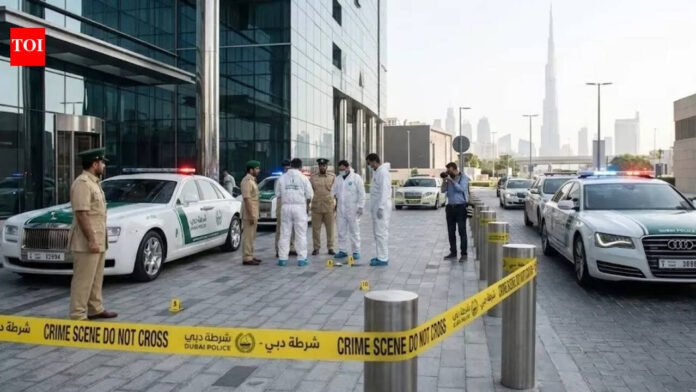
Dubai once again steps into the future of law enforcement. The Dubai Police General Directorate of Forensic Evidence and Criminology has officially integrated “digital twin” technology into its investigative toolkit.This cutting-edge system creates an accurate, high-definition virtual replica of a physical crime scene. By using advanced 3D scanning and laser mapping, detectives can now move around a digital version of a room or outdoor area with millimeter accuracy. This means that the original environment is “frozen in time,” allowing investigators to examine every corner of the scene without actually being there.
Dubai police use artificial intelligence technology to solve hit-and-run problem
In a high-profile example of 21st century policing, Dubai Police used its new digital twin technology to overturn the initial conclusion of a bridge fall involving a delivery rider. What initially appeared to be a suicide quickly turned into a hit-and-run as investigators digitally reconstructed the scene. Using highly detailed 3D modeling and virtual reality tools, police discovered the rider’s motorcycle was hit from behind by another vehicle, causing him to fall off the bridge. The getaway driver left no trace at the scene, but digital twin analysis provided clear visual and scientific evidence to rewrite the narrative and reclassify the case as a crime rather than a tragic act of self-harm.This isn’t the system’s only success. Digital twins also addressed structural collapse investigations involving basement parking facilities. Advanced modeling revealed the seemingly mysterious failure, which was the result of repeated water leaks that caused the concrete supports to weaken over time. By simulating load stresses with scientific precision, police can pinpoint the exact mechanism of collapse.
What is “digital twin” technology?
Unlike traditional forensic methods that rely solely on physical evidence and witness statements, digital twins use cutting-edge technology to build a virtual replica of a crime scene. The system combines 3D scanning, artificial intelligence and real-time data analysis into a unified interactive digital environment. Investigators can revisit this virtual scene at any time to examine evidence from multiple angles, test hypotheses, and even simulate possible sequences of events, all without physically returning to the scene. These models are auditable, transparent, and designed to support data-driven decision-making, making them particularly valuable in courtrooms where evidence must withstand rigorous scrutiny.The digital twin process unfolds in three stages: first, the scene is digitally recorded in detail; then the data is refined and enhanced; and finally, advanced analytics tools produce intelligent models and outputs that help investigators understand what exactly happened.According to a Dubai Police project manager, the digital twin system has clarified nearly 85 incidents since its launch. By virtually walking through these scenarios, investigators can reduce errors, speed up analysis time, and provide stronger, more reliable forensic conclusions during the judicial process.
Smart policing in the UAE
The digital twin initiative is not only innovative but also award-winning. The technology received a 7-star rating and was named the Best Innovation Project at the International Best Practice Competition (IBPC) 2025, and won the UAE Smart Government and Digital Transformation Creative Award 2025.The senior police engineer stressed that digital twins are part of a wider strategy to embed technology and artificial intelligence into all aspects of law enforcement in Dubai. The goal is to make criminal investigations faster, more accurate and more consistent with modern digital realities.This initiative is in line with leadership directives to position Dubai Police as a global leader in technology-driven enforcement, a vision supported by investments in artificial intelligence, virtual reality and data analytics.