
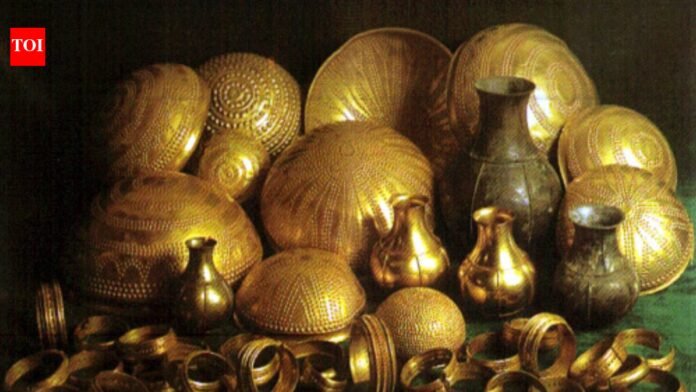
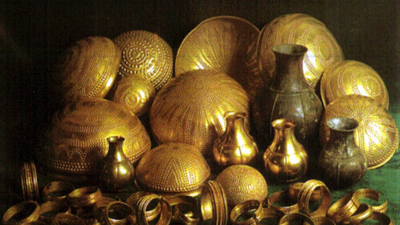
Nestled in the sun-drenched plains of the province of Alicante, the quaint Spanish town of Villena guards the secret that connects earth and sky. Back in 1963, workers excavating a gravel pit stumbled upon the Vilena Treasure, a dazzling hoard of more than 60 Bronze Age artifacts weighing nearly 10 kilograms, mostly gleaming gold bowls, bracelets and bottles. What is truly remarkable about this discovery is that two pieces, an iron bracelet and a pommel, were cast from meteorite, a rare metal that fell from space about a million years ago. The collection dates to 1400-1200 BC and hints at ancient people’s reverence for the cosmic gift, long before the advent of iron-making technology on Earth. Today, the treasures gleam at the Archaeological Museum of Vienna, inviting visitors to ponder how Bronze Age craftsmen turned stardust into jewels.
The Viennese Treasure: one of Europe’s richest prehistoric treasury
The Vienna Treasure is one of the richest prehistoric gold finds in Europe, second only to the royal tombs of Mycenae in Greece. Archaeologists unearth meteorite iron in Vilena treasure? By researchers Salvador Rovira-Llorens, Martina Renzi and Ignacio Montero-Ruiz and José María Soler García from the National Archaeological Museum, Diriyah Gate Development Authority (Saudi Arabia) and the Historical Institute of the Spanish National Research Council (CSIC) Found near a dry river bed, they included 59 gold objects, three silver bottles, an amber gold button and those mysterious iron pieces. There are no nearby sites that match its style, sparking debate about its origins, possibly as a ritual offering or elite grave goods. Experts marveled at the craftsmanship: the intricately embossed gold ornamentation on the vessel imitated a leather bag, demonstrating the advanced technology of the Late Bronze Age. “These two pieces of iron are of great value,” noted Ignacio Montero-Ruiz of the Institute of History of the Spanish Research Council. The collection visited museums in Spain before returning home, a testament to its cultural influence.
Iron meteorite from ancient Spain
Scientific investigation published in the journal Archeology sheds light on the origins of space. Mass spectrometry analysis by Salvador Rovira-Llorens of Spain’s National Archaeological Museum and Martina Renzi and Ignacio Montero-Ruiz of Saudi Arabia’s Diriyah Gate Development Authority showed high levels of nickel, a hallmark of meteorites and unlike iron found on Earth. The corroded C-shaped bracelet and gilded pommel predate the Iron Age by centuries, proving that ancient people used this “celestial iron”. “Who made these materials and where they were obtained are questions that still need to be answered,” added Montero-Ruiz, emphasizing the mystery. The meteorite likely fell nearby, witnessed by stargazing people who valued the metal’s otherworldly luster as a status symbol. This delays evidence for the use of meteorites in Iberia, challenging the timeline of early metallurgy.
Velena remains the keeper of the cosmic legacy
Verena itself adds charm to the story. This town of 35,000 people has a medieval core, topped by the 12th-century Atalaya Castle, which was built by the Almohad Empire as a refuge for Muslims. Wander the streets and admire the Renaissance architecture and festivals, but the archaeological museum is the star, displaying a treasure trove of Bronze Age tools. For history lovers, Vienne offers a unique connection between the past and the universe. Visiting feels like stepping into the story of the ancient Spaniards who molded stardust into eternity. Plan a trip to the center of Alicante – space treasures await you in this humble gem.


