
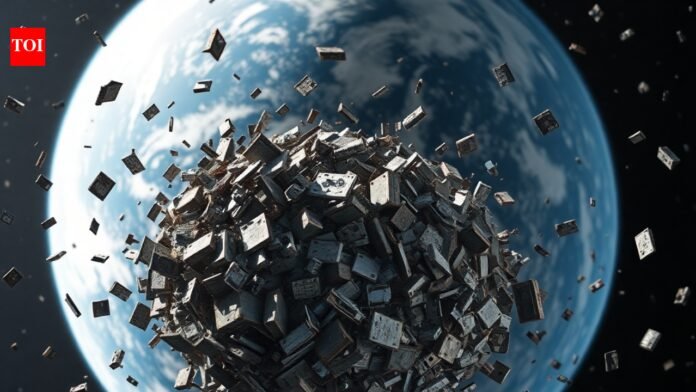

A new phase of the space race is unfolding above Earth, but its effects may not stay there. Satellite launches have increased dramatically recently, driven largely by commercial megaconstellations designed to provide global broadband and other data services. Currently, there are nearly 15,000 active people on Earth satellitemany designs only last a few years before replacement. When they malfunction or reach the end of their service, operators typically direct them back into the upper atmosphere, where they burn. This approach is intended to reduce space debris in low orbit. Researchers began studying the effects of repeated burning on atmospheric chemistry, ozone stability and long-term climate processes that have not yet been fully mapped.
this new space race Under construction crematorium For satellites above the earth
According to published in dialoguemost decommissioned satellites are deliberately deorbited so that they disintegrate upon re-entry. Engineers describe this as disposability. The idea is simple. Hardware is not supposed to survive a drop.But when thousands of objects burn every year, the process no longer seems trivial. Scientists studying upper atmospheric aerosols discovered metal particles associated with spacecraft in 2023. Aluminum is widely used in satellite frames. When burned, aluminum oxide particles are formed. They can remain suspended at high altitudes for long periods of time.In most cases, the exact mix of materials inside commercial satellites is not publicly detailed. This makes modeling difficult. Researchers are making estimates. Uncertainty itself is part of the worry.
Plan for 1 million satellites will change the scale
In early 2025, space exploration technology corp. Applying to the Federal Communications Commission for approval to significantly expand its Starlink network. The proposal outlines the addition of up to 1 million satellites, which the document says will support future artificial intelligence data infrastructure.The current Starlink V2 mini-satellite weighs approximately 800 kilograms. Subsequent versions are expected to be heavier. The proposed V3 model would again be larger, closer in mass and structure to a small aircraft.Each satellite eventually re-enters. Using assumptions similar to those used in earlier atmospheric studies, the researchers estimate that one million satellites could release nearly teragrams of aluminum oxide into the upper atmosphere over time. This number is juxtaposed with the emissions from rocket launches themselves, which already contribute to upper atmosphere heating and ozone layer loss.The chemistry at these altitudes is complex. Small particles can change how heat is absorbed and how ozone reacts. These models are still being refined.
Orbital collision risk has risen
Pressure is not just atmospheric pressure. In low Earth orbit, evasive maneuvers are becoming commonplace. The Institute for Outer Space Research maintains a collision clock. It is estimated that if active avoidance is stopped, a collision could occur within days.Experts have long warned about Kessler syndrome, a cascading effect in which debris from one collision triggers others. More satellites increase the statistical likelihood. Insurance markets are watching closely. So do state regulators.Not every satellite burns up completely upon reentry. Some debris reaches the surface. Recent assessments indicate that the likelihood of casualties from falling debris over a five-year cycle is high and could approach 40 percent as the constellation expands. The risk also extends to aircraft.