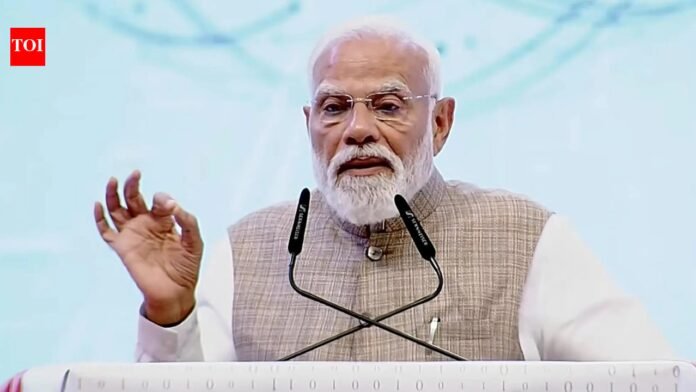
NEW DELHI: Prime Minister Narendra Modi on Thursday played down the country’s energy crisis triggered by the ongoing conflict between joint US-Israeli forces and Iran. Speaking at the NXT Summit, the Prime Minister indirectly targeted those “trying to create panic” and claimed they were exposing themselves to the public by doing so.“We have to work collectively to put national interest first and fulfill our responsibilities. There is a lot of talk about LPG. Some people are trying to create panic. They want to push their own agenda,” PM Modi said. “At this time, I don’t want to make political comments about them. But I can say with certainty that by doing this they are not only exposing themselves to the public, but they are doing great harm to the country,” he added.The Prime Minister said the government is prioritizing self-reliance in the energy sector to ensure that the country does not have to be completely dependent on foreign energy sources.“To ensure that we do not have to be completely dependent on foreign energy, the focus in the energy sector is on self-reliance. Till 2014, the country had only 140 million LPG connections. Today, this number has more than doubled to Rs 33 crore. In 2014, the country had only 4 LNG terminals,” PM Modi said.“Today, their number has also doubled. Today, no country is immune to the impact of this global crisis that has arrived. More or less, everyone is a victim of this crisis. India is also sparing no effort to deal with this crisis,” he added.The Prime Minister also said that the government is making every effort to ensure that the burden of the situation caused by the war does not fall on Indian citizens.“The Indian government has always made every effort to ensure that the burden of the situation created by the war does not fall on Indian citizens,” he said.“This time, too, we will make every effort to ensure that the impact of the war on the lives of the country’s farmers and citizens is minimized,” he added.Concerns about a shortage of liquefied petroleum gas are starting to spread across the country as escalating conflicts in the Middle East disrupt global energy supply chains.The closure of the Strait of Hormuz in Iran’s retaliation for U.S.-Israeli attacks triggered panic buying, long queues at LPG agents and gas stations, and forced restaurants and small businesses to switch to alternative cooking methods.Sujata Sharma, joint secretary in the petroleum ministry, said the government decided to allow partial sale of commercial LPG to meet one-fifth of the demand as it took certain measures that helped boost domestic LPG production by 28 per cent and developed some alternative sources overseas.“The state has to identify the beneficiaries,” she said.As panic buying escalates, the government extended the LPG refill ordering window for rural customers to 45 days from the 25 days set for all customers last week, itself replacing the previous 21-day limit. She said the move was aimed at managing demand and ensuring equitable distribution amid ongoing disruptions to energy supplies caused by the crisis in West Asia.The increase in the monthly quota of kerosene issued to states is the first in more than a decade, temporarily reversing the government’s stated goal of phasing out kerosene, which besides being heavily subsidized is also used in petrol adulteration.
‘Some people are trying to create panic’: PM Modi downplays LPG crisis; targets opposition

WEB DESK TEAMhttps://articles.thelocalreport.in
Our team of more than 15 experienced writers brings diverse perspectives, deep research, and on-the-ground insights to deliver accurate, timely, and engaging stories. From breaking news to in-depth analysis, they are committed to credibility, clarity, and responsible journalism across every category we cover.
Related articles
Recent articles