
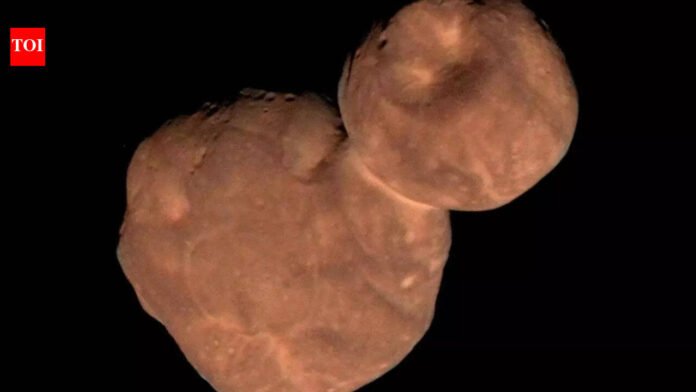
Ever wonder how those strange, floating “snowmen” end up stuck in the deep freeze of the Kuiper Belt beyond the orbit of Neptune? These oddly shaped double-lobed rocks, called contact binaries, like the famous Arokos binaries, appear fragile, but they have survived for billions of years without collapsing. Astronomers have been searching for answers for years.Enter Jackson Barnes, a bright graduate student at Michigan State University. He built the first computer simulation to show that these weird planetesimals formed naturally from rotating clouds of pebbles collapsing under their own gravity. No magic required, just physics at work in the cosmic dust. The mystery is solved.
How Gravity Creates a ‘Snowman’ World in Space
There is a frozen wonder beyond the asteroid belt: the Kuiper Belt, a large icy remnant from the birth of the solar system. These include “snowman” stars and fragile two-lobed contact binary stars such as Arokos. These strange shapes connect together like cosmic snowballs and have astronomers baffled. How can they survive billions of years without falling apart? For years, the mystery persisted. Then Jackson Barnes, a graduate student at Michigan State University, cracked the problem. His groundbreaking computer simulations revealed that these objects formed naturally from pebble clouds in the early solar system. Gravity causes clouds to collapse, creating these lumpy binary structures naturally, without the need for collisions. This breakthrough rewrites our understanding of planet formation. It shows that gentle gravitational processes can shape tough survivors in the cold void, hinting at similar worlds orbiting other stars. The secrets of the Kuiper Belt continue to be revealed, one simulation at a time.
Michigan State’s breakout; Jackson Barnes leads the way
Researchers at Michigan State University (MSU) have revealed the simple yet elegant phenomenon behind it: gravitational collapse. Graduate student Jackson Barnes developed the first computer simulation showing how these two-lobed “contact binaries” arise naturally from pebble clouds.Old models viewed colliding planetesimals as fluid-like blobs merging into smooth spheres and could not recreate contact binaries. Using high-performance computing, Barnes simulated objects retaining their structural integrity and settling gently upon contact.
Expert insights from Professor Seth Jacobson
“If we consider that 10 percent of planetesimal objects are contact binaries, then the process that formed them is not uncommon,” said Seth Jacobson, senior author of the paper and an assistant professor of Earth and environmental sciences at Michigan State University. “Gravitational collapse is very consistent with what we observe.”
The science behind floating ‘snowmen’: Understanding the process of defining gravitational collapse
As the Dictionary of Astrobiology describes it, gravitational collapse is “the collapse of a region of matter under its own gravity, such as the collapse of the dense core of an interstellar cloud during the process of becoming a star.” This occurs when local self-gravity overwhelms restoring forces, such as thermal air pressure or turbulence.In protoplanetary disks, millimeter-sized pebbles in pebble clouds accumulate through flow instabilities. Then, self-gravity causes collapse and the birth of planetesimals. Barnes’ model captures this brilliantly.
Real World Observations: Arrokoth and New Horizons
Binary star encounters gained fame in January 2019 when NASA’s New Horizons spacecraft flew by a binary star in the Kuiper Belt. Known as “Ultima Thule” (later officially known as “Arrokoth”), it stunned scientists with its double-leaf “snowman” shape. The spheres are scattered throughout the Kuiper Belt and neither shatter upon impact nor collapse individually, suggesting they formed gently.
Details of breakthrough simulations published in monthly notifications
Writing in the Monthly Notices of the Royal Astronomical Society, Barnes and colleagues detail 54 simulations of an initial pebble cloud containing 105,105 particles, each with a radius of about 2 kilometers (1.25 miles). This low-resolution setting reflects the reality that a real pebble cloud may contain particles up to 10241024 mm in size.
Key findings: Orbitals dance to spirals
The team found that in some cases, two small planetesimals from the pebble cloud entered a common orbit. They gradually spiral inward, reaching speeds of 5 meters per second or less before contact. A two-lobed shape is formed, and upon contact, the particles actually settle and merge into a two-lobed planeteme, or “contact binary.” “Some of the contact binaries in our model are strikingly similar to Arrokoth,” said Barnes.Previous simulations of gravitational collapse ignored particle contact physics, predicting that collisions between smaller planetesimals would create a single spherical object. Barnes’ innovative model explains how pebbles rest and stick, explaining the complete “snowman” shape.
Impact on the origin of the solar system
This work is a transformative view of planetesimal formation. The 10% of contacting binaries among Kuiper Belt objects indicate that gravitational collapse in pebble clouds is common, creating “rubble piles” that can persist for billions of years. It is consistent with the low-density, loosely bound structure of Arokos observed by New Horizons.Similar shapes are also seen in near-Earth asteroids, which means this process occurs on a solar system-wide scale. Future missions could test these predictions.
Future simulations and observations
Higher-resolution pebble cloud models powered by advanced computing are expected to provide deeper insights. In the coming days, telescopes like the James Webb Space Telescope may discover more contact binaries in the distant disk.Jackson-Barnes’ simulation not only solves the “snowman” puzzle, it also redefines how planetesimals and ultimately planets emerge from cosmic dust.