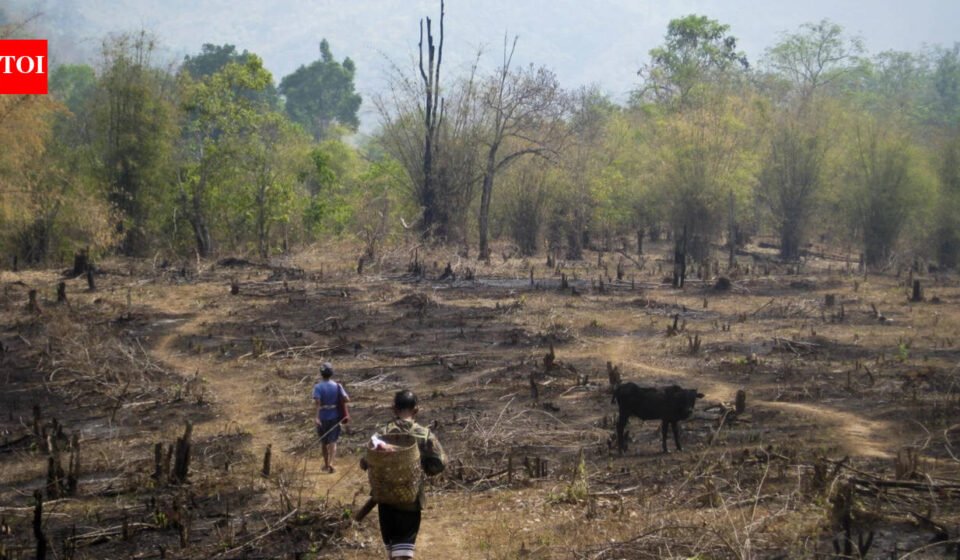
Slash-and-burn agriculture is blamed for destroying rainforests, but a study of 18,000 forest patches found community rules can limit clearing and allow trees to return

Slash-and-burn agriculture is blamed for destroying rainforests, but a study of 18,000 forest patches found that community rules can limit clearing and allow trees to return.The study, published in the Proceedings of the National Academy of Sciences, shows that unwritten social rules in small communities control land use and provide food while protecting long-term forest health.The global study was led by Sean Downey, associate professor of anthropology at The Ohio State University. It looks at rotational agriculture, one of humanity’s oldest farming methods. For about 10,000 years, villagers in warmer climates cut down small patches of trees and burned dry branches to water the soil and grow crops until the land needed a rest.Many critics have long argued that the practice destroys entire rainforests, but satellite images and computer models show a different story.
CJP Jantar Mantar Protest Updates
How unwritten rules protect trees
The research team brought together experts in anthropology, physics, mathematics and satellite imagery to study agricultural sites in Central and South America, sub-Saharan Africa and parts of Asia. They trace how people chose land and shared daily tasks.In traditional villages, farmers cannot clear land on their own and need help from their neighbors. Reliance on local help has resulted in smaller farmland areas.“If a farmer asks for too much, say a 20-acre (8-hectare) field instead of a 2-acre (0.8-hectare) field, there will be fewer people willing to help,” Downey said.Without adequate help, farmers cannot clear large tracts of land. Over time, this unwritten social rule teaches everyone to demand smaller plots of land, thus keeping deforestation low.This shared sense of right and wrong guides daily actions. This process is in line with the work of Nobel Prize-winning economist Elinor Ostrom, who demonstrated that small towns can protect shared nature through peer pressure and refusal of help, rather than relying on official laws or police.“Until now, there haven’t been many formal models that show how small, rotating communities can manage land without top-down rules,” Downey said.When farmers work together according to these local practices, the forest develops a mosaic pattern and avoids permanent damage.
The patchwork forest in the border area
Downey began paying close attention to Belize in the early 2000s. Satellite maps show clear differences on the country’s border with Guatemala. On the Guatemalan side, large tracts of forest have been completely cleared for cattle ranching. On the Belize side where Mayan villages live, the map is covered with a healthy mix of small fields and growing trees.In Belize, farming steps follow a simple pattern. Farmers clear a small area and then allow the wood to dry. Burning dry wood puts carbon back into the soil, acting as a natural fertilizer.Crops such as corn are planted when rainfall begins and harvested for a year or two until the soil loses its strength. The field was then set aside to give the forest time to regrow.“It’s a cyclical pattern of mutual exchange of agricultural labor that helps regulate social norms of land use, as well as fire and ecosystem services that restore fertility to cleared forest patches,” Downey explains.
Cleaning up small areas helps wildlife
Research shows that this type of farming does not automatically damage the soil. Clearing small areas can actually bring in a greater variety of plants and animals than leaving old forest untouched at all.“When you create rotational patches, you create new ecosystem niches during the fallow phase where different species thrive, and ultimately the entire landscape has higher levels of biodiversity than mature forest alone,” Downey said.Clearing too much land can turn dense forests into open grasslands. However, the breaks between small harvests provide new places for a variety of plants and wildlife to grow.
Helping rural communities protect their land
These findings provide clear ideas for global climate policy and environmental protection. They show that legal prohibitions and government laws often ignore the role that local customs already play.“Policy makers concluded that small-scale rural communities have the capacity to manage community forests in a sustainable way and that they need support to use their own customary practices to solve problems,” Downey said. “The situation in Belize is different from the situation in Africa or Indonesia.”
More information about slash-and-burn farming
Slash-and-burn, or shifting cultivation, is an ancient agricultural technique used by approximately 200 to 300 million people worldwide, primarily in tropical forest regions. The process begins during the dry season when farmers clear small patches of forest trees and wild vegetation. This cleared material, known as “slash”, is left on the ground to dry and then burned when the rainy season arrives. The resulting ash layer acts as a rich natural fertilizer, delivering essential nutrients such as potassium, calcium and phosphorus into tropical soils. In addition, the high heat generated by the flames kills weeds, fungal spores and harmful pests in the topsoil, allowing crops such as corn, rice and cassava to thrive without synthetic chemicals.Because tropical soils quickly lose their fertility, crops can often only be harvested for two or three years on freshly burned land. Once the soil becomes low in nutrients, farmers abandon the land and leave it “fallow” for 5 to 20 years. During this period of rest, native seeds take root and sprout, deep roots draw minerals from the ground, and natural wild vegetation returns to fully replenish the soil. When given long enough rest periods, this crop rotation allows forest soils to recover naturally, allowing farming families to return to the same plot of land decades later without permanently damaging the surrounding land.