
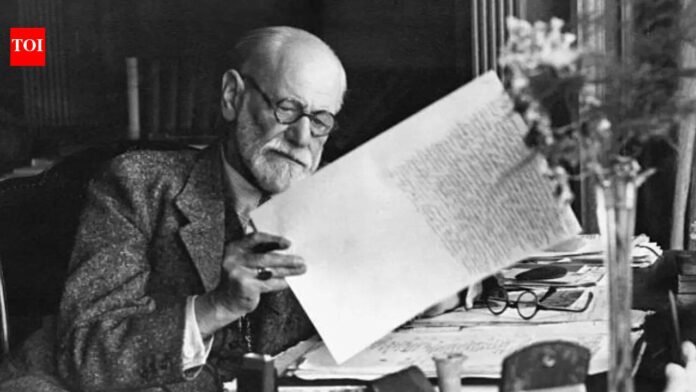
Freud’s quotations continue to appear in online feeds, quotation pages, and brief opinion columns, often stripped of any wider interpretation. It travels well because it’s short and a bit disturbing. There’s no clear moral guidance in it, just a comparison that feels unfinished. This quote is often thought of as a reflection on virtue and behavior, although it is more suited to psychological discussion than moral storytelling. Freud’s work is often associated with hidden desires and unconscious thoughts, so readers tend to associate this statement with those broader themes. However, this sentence itself does not provide a fixed conclusion. It leaves a gap between imagination and action and asks the reader to think about what separates the two in real human behavior without directly saying it.
Sigmund Freud’s Quote of the Day
“Good men are content to dream about what evil men do in real life.”
What is the meaning behind the quote? sigmund freud
The meaning of this statement is not entirely moral, nor is it entirely psychological. This suggests that being considered a moral person is not necessarily without difficulties or strong thoughts. Instead, these thoughts may remain in the mind, where they are experienced but not acted upon. In contrast, so-called villains are described through actions, expressing similar inner impulses in the real world.This reading shifts attention from labels to processes. What matters is not just what comes to mind, but what survives the internal filtering that precedes the behavior. This filtering is anything but simple. It is shaped by fear of consequences, personal boundaries, social rules, and sometimes just timing. Freud’s framework, at least as the phrase is commonly understood, is located near that chaotic space where thoughts are still forming and have not yet moved into action or restraint.There is also a quieter meaning. Imagination becomes the preserve of impulses without influencing behavior. It’s not good or bad, just part of how the mind manages itself when conflicting thoughts arise simultaneously.
Inner life and behavior develop on separate trajectories
Human behavior does not follow a straight path from thought to action. It tends to change, pause, change direction, and sometimes stop altogether. Thoughts can appear and disappear without leaving any trace in behavior. In other cases, it may linger in the mind longer and be resolved internally, then go away on its own.Freud’s psychological perspective often focused on this uneven movement within the psyche. This quote reflects the sense of separation between what is experienced internally and what is ultimately visible externally. People can carry around ideas that never turn into actions, and those ideas don’t always define what they do in the real world.This gap is not unusual. This is part of ordinary spiritual life. Most decisions are not the immediate reflection of thought but the result of internal negotiations that are not entirely visible even to the person experiencing it. This sentence occupies a space in which behavior is only the final stage of a longer internal process that remains largely hidden.
imagine as internal processing space
Imagination plays a quieter role in how people deal with their inner impulses. It allows thoughts to exist without becoming actual actions. Freud’s broader view of the mind often viewed imagination and dreams as part of normal mental processing rather than as something separate or unusual.Imagination can show up in small and mundane ways in everyday life. Reactions to a situation may manifest psychologically before they are spoken or not at all. A scene may be replayed in the mind without any intention of action. These moments are fleeting and often forgotten, but they are part of the way the brain handles stress, curiosity, or conflict.In this sense, “dreaming” in the quote refers to more than just sleep. It points to a wider inner space where thoughts can exist safely without consequences. This space becomes important when certain impulses cannot or should not be translated into action in the external world.
Moral labels become blurred from a psychological perspective
When this statement is examined from a psychological perspective, the moral category begins to become unstable. The ideas of good and evil become more difficult to separate cleanly. Both were described as having inside experience. The difference is what happens next.Freud’s work often avoided simple moral classifications, focusing instead on changes in internal processing. People differ in how they manage their impulses, not necessarily in whether those impulses exist. Some thoughts are contained, some are redirected, and some become actions. This range makes behavior more situational rather than fixed.This does not eliminate moral judgment, but it complicates it. Behavior is still visible and accountable, but it may not represent the complete internal situation. The sentence gets caught up in this tension without resolving it.
Freud’s broader views on unconscious influences
Freud’s psychological theories are often associated with the idea that not all mental activity is conscious. The unconscious part of the brain contains material that is not directly accessible, but still affects reactions, emotions, and decisions in indirect ways.In this case, the sentence can be read as pointing to internal material shared between individuals, even if it appears behaviorally different. It is not meant to be cookie-cutter, but it does suggest that inner life is broader than outer action.This broader framework makes behavior look less like a single decision point and more like the result of multiple internal pressures that are not always visible. Thoughts, memories, emotional responses, and learned patterns all influence how a behavior is ultimately formed or not formed at all.
Modern life and the split between private thought and public self
In modern settings, the difference between inner experience and outer expression is easily observable. People present themselves in controlled ways in professional settings, social interactions and digital spaces. The content displayed is frequently filtered and adapted.At the same time, internal thought remains unstructured. It can shift quickly and doesn’t follow the same rules as public behavior. This creates a gap between a person’s outward appearance and their private experience.Freud’s observation is consistent with this reality because it does not assume that outer behavior entirely reflects inner life. Rather, it shows that there is always more to internal processes than meets the eye. This statement does not need a modern context to make sense, but modern life makes this separation more obvious in everyday life.
Misreading this sentence as a simple moral judgment
This statement is often viewed as a straightforward moral comparison, but this interpretation is limited. Freud’s broader approach to psychology did not reduce people to fixed moral categories. It focuses more on internal changes and psychological structure.Another common misconception is to think of imagination as intention. From a psychological perspective, imagining something does not automatically mean wanting to take action. Mental activity can be experimental, symbolic, or temporary, without any connection to behavior.It is also important not to interpret this statement as a denial of responsibility. Actions still matter because they impact others in real and measurable ways. This quote is more about what existed before the action rather than removing the consequences of the action itself.
Other quotes from Sigmund Freud
- “Unexpressed emotions don’t go away. They get buried alive and emerge in a different way.”
- “Dreams are often the royal road to the unconscious.”
- “When we love, we are never so helpless against pain.”
- “Most people don’t really want freedom because freedom involves responsibility.”
- “Looking back, struggle is often the most impactful period of life.”