
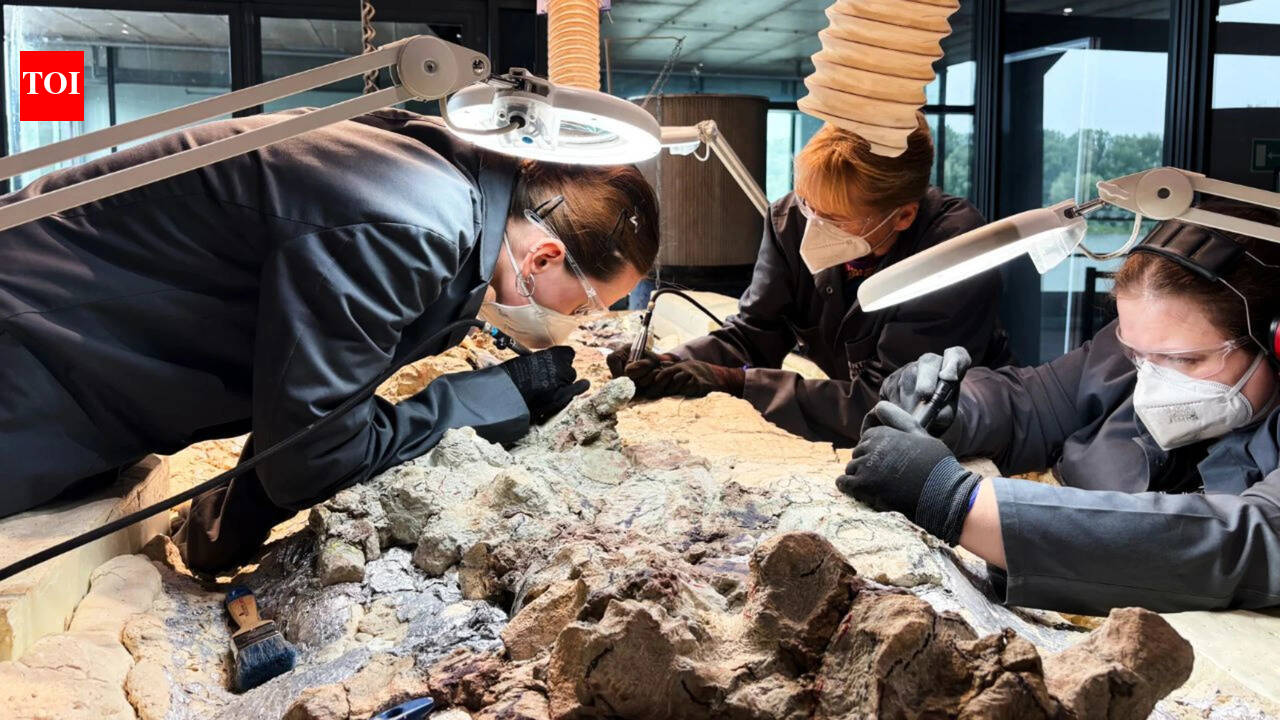
A massive 1,300 kilogram (2,865 pound) fossil skeleton discovered in southern Poland is currently being hewn from solid rock by more than 2,000 public volunteers.The unusual public science project is taking place in a special glass-walled laboratory on the ground floor of the Copernicus Science Center in Warsaw, the Associated Press reports. Museum visitors often stop on the other side of the glass wall to watch volunteers wearing goggles use special tools to clean fossils. Children pointed excitedly while parents looked at the massive creature the bones once belonged to.Meticulous cleaning requires great attention. Each bone had to be removed millimeter by millimeter from the surrounding rock using a small pneumatic chisel. The tool’s fine needles gently pry open the hard stone, while special ultraviolet light reveals the precise line where fossilized bones end and rock begins.The project relies entirely on ordinary citizens, not expert geologists or fossil scientists. These helpers include managers, cleaners, tattoo artists, and local people working in many non-scientific jobs. After receiving basic training, volunteers are provided with safety equipment and participate in a supervised two-hour chipping class.Volunteer team leader Tatyana Kozyk shared the deep feelings of helpers working with old bones.“I imagined these bones had been buried underground for 240 million years, and I was the first person on Earth to touch them,” Kozik said. “I’m still trying to wrap my head around the experience.”
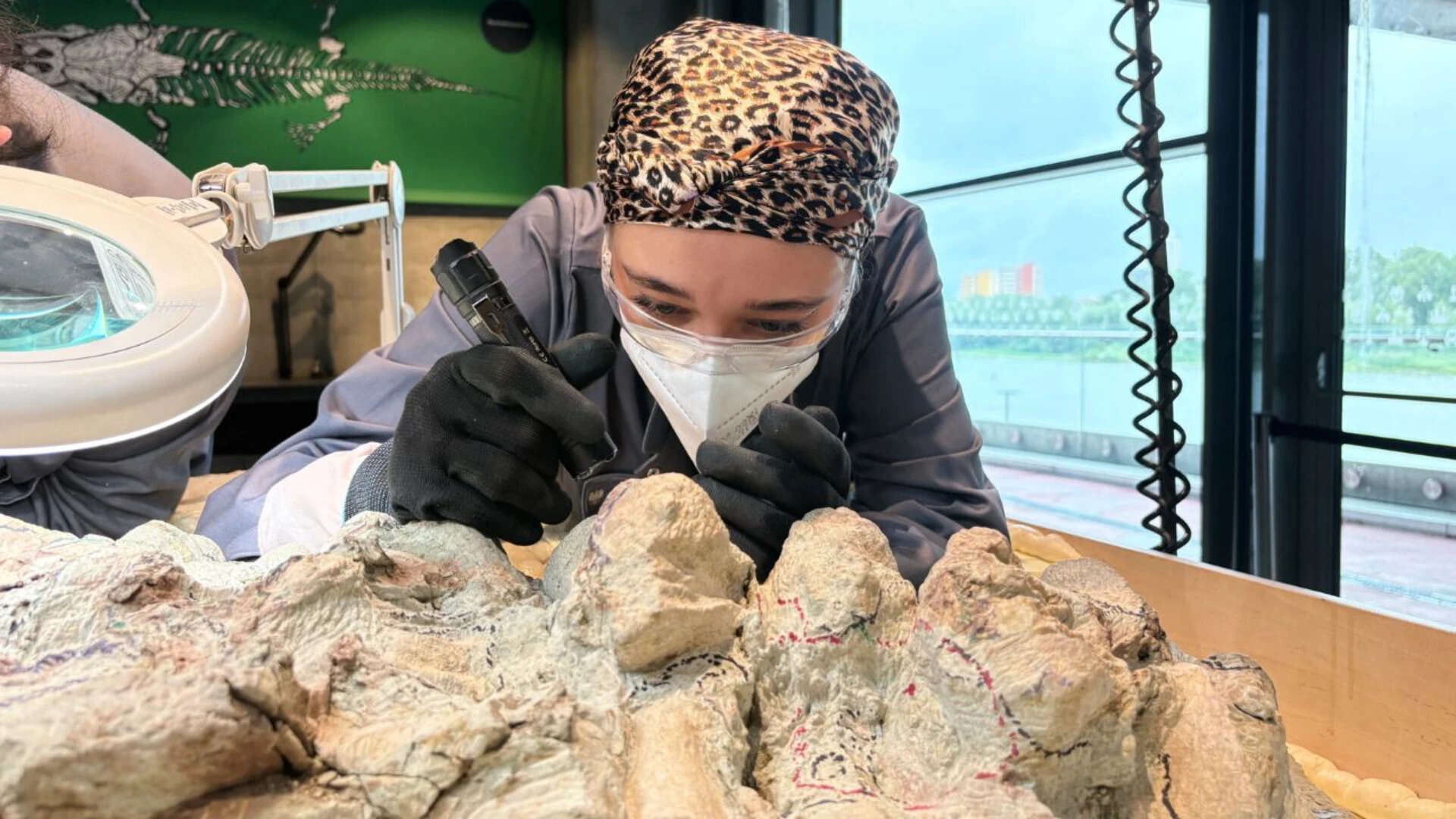
Volunteer coordinator Tatiana Kozik cleans the mastodon skeleton
Digging up ancient giants
The skeleton belongs to a Mastodon, one of the largest known amphibians. The animals lived during the Middle Triassic period about 240 million years ago, when the first dinosaurs were just beginning to appear, and they lived in the Earth’s waters long before they dominated land.It lives as an underwater ambush hunter, eating mainly fish and smaller amphibians. It grew to nearly six meters (20 feet) long and had a broad, flat head, long, powerful jaws and sharp fangs. Although its body looks similar to modern crocodiles, it actually belongs to an entirely different group of vertebrates.The fossil was discovered in southern Poland in 2023 by fossil expert Tomasz Sulej, professor at the Institute of Paleontology of the Polish Academy of Sciences, and his colleague Wojciech Pawlak from the School of Geology of the University of Warsaw. Knowing how much effort it would take to clean up the fossils, the pair came up with a plan to invite the public to help.Once cleanup is complete, it will be the largest mastodon skeleton on display in a museum in the world. Although other mastodon fossils have been found in places such as Germany and Russia, these were typically only about 2 to 3 meters (6.5 to 10 feet) long.Sulegui pointed out that the huge scale and good conditions of this discovery have unique scientific value and are expected to reveal completely new facts about how this species lives and grows.“The structure of the body is different from what we have known so far,” Sulegui said. “This is completely new information to the scientific community.”
Lessons from Earth’s Past
For those who work with bones, the experience provides both a spiritual break and a rare connection to deep history. Dorota Serafin, a 51-year-old manager from Warsaw who volunteers on the project, said studying the bones of ancient animals was a “relaxing, philosophical, even mystical” experience.Seraphine plans to return for more work sessions and eventually take her family to see the finished display when the completed skeleton is unveiled to the public, which organizers expect to happen around October or November.In addition to the excitement of clearing ancient history, those involved in the project say the mastodon sheds useful light on changes in the Earth. This giant aquatic animal lives in Earth’s rivers and lakes right after the largest mass extinction event in history, proving just how powerful life on Earth can be.As people worry about the dramatic impacts of climate change today, Sulej noted that the mastodon story carries a message of lasting strength.“The fact that mastodons persisted after mass extinctions shows one thing, nature can always manage,” Sulegui said. “Humanity cannot destroy life on this planet. Nature and life will always find a way to survive.”