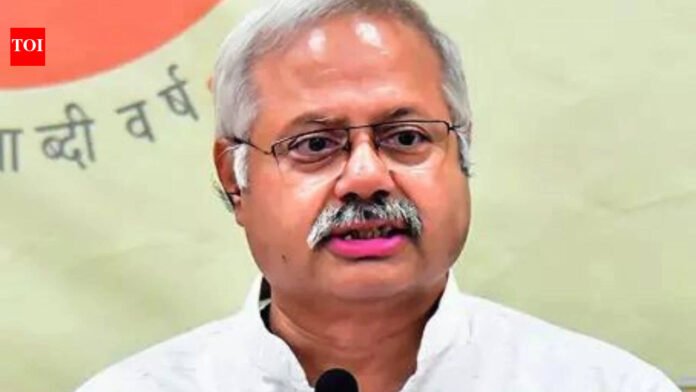
Ambekar framed RSS’s approach to caste through social harmony rather than structural antagonism (File Photo)
New Delhi: Drawing a clear line between welfare and politics on caste data, RSS national advocacy chief Sunil Ambedkar said the Sangh supports caste census but opposes its use to “divide society” even as he outlined the organization’s stance on key debates on caste reforms and women’s participation and equivalence with the BJP.In an interaction with TOI, Ambekar elaborated on the RSS’s approach to caste through social harmony rather than structural antagonism. “If mutual affection increases and discrimination disappears, even big problems can be solved. If there is disharmony, even small problems can turn into big conflicts,” he said.He said access to temples, crematoriums, water sources and public places should be open to all and RSS volunteers were involved at the local level to resolve such issues. He pointed out that institutions like Vidya Bharati, Vanvasi Kalyan Ashram, Ekal Vidyalaya and Seva Bharati are part of a wider outreach network, adding that leadership is increasingly coming from marginalized communities, including women.On women’s participation, Ambedkar defended the parallel structure of the Rashtriya Sevika Samiti, saying it reflected the RSS Shakha model. At the same time, he acknowledged the need to expand the role of women, noting that women’s participation in decision-making and outreach is increasing through a coordination mechanism called ‘Mahila Sambandh’. He also proposed the centenary theme of “Kuttum Prabodhan” to encourage families to support women in public life.Regarding the caste census, he reiterated that although the RSS supported the welfare census, it was against political abuse. “Democracy requires representation, but politics should not pit one community against another,” he said, arguing that social solidarity can counter divisive mobilizations. Despite polarized views, “we see unity on the ground,” he said, citing gatherings such as the Kumbh Mela and the consecration of the Rama temple.Talking about the RSS-BJP equation, Ambedkar said the Sangh remains a social organization focused on “nurturing individuals” with swayamsevaks working across sectors, including politics. He stressed that organizations operate independently while describing India’s framework as “society-centric”, in contrast to the state-centric model of the West. While political parties function within the electoral cycle, he said the RSS plays a role in the longer term vision of civilization through ‘Lokmat Jagran’.Responding to criticism linking Hindu nationalism to democratic backsliding, Ambedkar dismissed this premise, describing Hindu culture as “unified” and rooted in ideas such as “Vasudhaiva Kutumbakam”. He believes that India’s civilized spirit can enable the coexistence of diverse societies and strengthen democracy.Addressing concerns about discrimination against Northeasterners, he said the term “racial discrimination” was a misnomer, blaming past tensions on historical distortions and limited interaction. He said the exchange program reduced misunderstandings and called for sensitive handling of such issues.On global conflicts, Ambedkar said India should be guided by peace and principles and the government takes decisions based on strategic assessments.