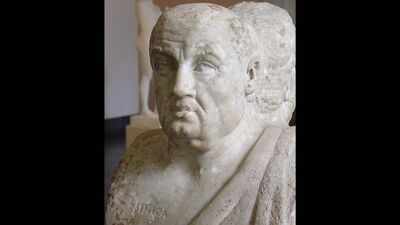
Seneca spent years siding with one of the most dangerous men in history. As mentor and advisor to the Roman Emperor Nero, he paid close attention to what happened when a powerful man unleashed his wrath. Execution on a whim. Overnight, friends turned into enemies. The entire court was on thin ice. He saw time and time again that an angry person often did more harm to himself than anyone else could do to him. So when Seneca wrote that uncontrolled anger often hurts us more than the thing that triggered it, he wasn’t theorizing from a quiet study. He’s reporting from the front row.
Quotation of the day by Seneca
“Anger, if left unchecked, often does more harm to us than the cause of the anger.”
Seneca: The Man Who Really Wrote Anger
This was not a stray line that was thrust upon Seneca later. He wrote an entire book about it called On Anger, which is one of the clearest things anyone has ever written about this emotion in the ancient world.Seneca was a Stoic, a school of Roman and Greek thinkers who believed that reason, rather than raw emotion, should guide life. For the Stoics, anger was not a harmless vapor. It’s closer to a state of temporary insanity, a state in which a normally sane person would never choose to say or do things while sober. In “On Anger,” Seneca breaks down this emotion piece by piece, asking where it comes from, what its cost is, and how one can get it back under control. This sentence is the core of the entire project and can be boiled down to one sentence.His verdict was blunt. He once wrote, My anger is more likely to hurt me than your mistakes.
What does Seneca really mean?
This idea upends how we usually think about being wronged. When someone hurts or insults us, we focus all of our attention on them and the offense. Seneca asks us to look back and see what anger itself has done to us.His point is about injury and time. The initial damage is often minimal and disappears quickly. Rude comments last a second. A little bad traffic, a little snub, a little careless words. But our anger surrounding it can last for hours, days, and sometimes even years. We relive it, dwell on it, lose sleep over it, let it sour our moods and poison our other relationships. Meanwhile, the people who wronged us usually forget about the whole thing and move on with their lives. As Seneca noted, our anger almost always outlasts the harm that causes it.So this sentence is actually a kind of self-defense. Staying angry doesn’t punish the other person. It punishes you. You become the primary victim of your own anger.
A philosopher who lives among monsters
What makes Seneca worth listening to is that his sermons were not delivered in the context of a quiet life. His world was completely consumed by the rage he had warned against.Born in Spain, he rose to the top of Roman society before being exiled for years on charges he denied. He was later recalled to mentor the young Nero and for a time became one of the most powerful and wealthy men in the empire, trying to rein in the brutal emperor. Ultimately, this intimacy destroys him. Accused of conspiring against Nero and ordered to end his own life, he faced this cruel order with unusual coolness, according to surviving records.It’s worth being honest here. Seneca was a complex figure, and not without flaws. Critics of his time and later noted the disparity between the simple, restrained life he admired and the vast wealth he amassed while serving tyrants. He preaches calm and lives in chaos and compromise. But this contradiction is part of the reason why his writing about anger rings so true. This is not advice from someone who has never tested it. It comes from a man who had good reason to be angry, a man who lived in cruelty and fear, and who still believed that giving in to his anger was a trap.
Why modern science supports him
More than two thousand years later, research has quietly proven Seneca right about self-mutilation.Anger can cause a real physical storm within the body. Heart rate increases, blood pressure rises, and stress chemicals flood the body. Do this every now and then and the body will shrug. This response is one of ongoing, simmering resentment that is associated with real harm, including heart stress and a generally more anxious, unhappy life. Anger also affects the kind of accurate judgment Seneca describes. It narrows the scope of our thinking, makes us more impulsive, and makes us believe that we are right in the moments when we are least able to think straight.In other words, angry people pay twice the price. Once inside the body, through all the wear and tear, back into the decisions they made when anger was dominant. The injury that started it all is often the smallest part of the bill.
How to Stop Anger from Burning You
Seneca was practical, not preachy. He offers real ways to loosen the grip of anger that still work.
- Ask who the anger actually hurts. The offense is usually short-lived, but the anger you harbor can ruin your entire day. People who have wronged you are often gone. Note that you are the one who is still burning and a lot of heat is radiating out of it.
- Please wait for some time before reacting. Seneca believed that time will reveal the truth and that many of the things that irritate us turn out to be smaller than they first appear. A brief delay tends to reduce anger to its true, often modest, size.
- Call small things small. Many of the things that make us angry are just annoyances rather than real harm. Refuse to turn mild annoyance into emotional devastation. Naming it something trivial in general takes away its power.
- Pursue the power of calm, not coldness. Seneca did not tell anyone to hold back their anger and remain silent. He hoped that reason would regain control of the situation. Once the heat dissipates, it’s clear to deal with the real problem.
Why Seneca believed anger hurts the angry person most
It’s strangely comforting to me to know that a man in the heart of the Roman Empire, surrounded by and ultimately destroyed by his enemies, could still do such simple things. Anger felt like power in that moment. It feels like standing up for yourself. Seneca had real reasons for his anger, and watching it consume those around him, he saw through the illusion. Anger won’t hurt them. It hurts you.He’s not asking anyone to be a doormat or feel nothing. He was displaying an act of quiet self-respect. His age-old advice is worth a try the next time someone wrongs you and things heat up. Don’t give them the power to ruin your day on top of something they’ve already done. The harm is caused by them. Anger is what you need to calm down.