
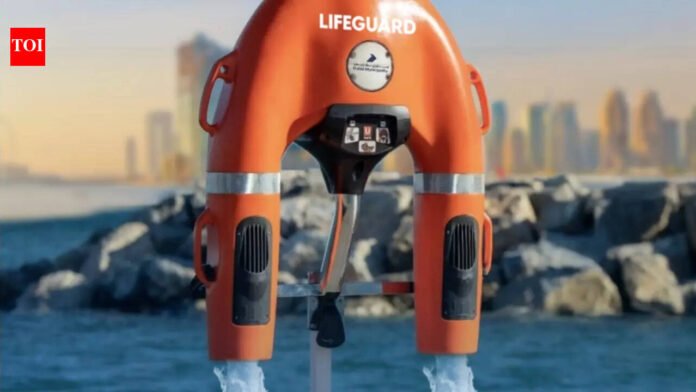
Dubai is once again leveraging cutting-edge technology to enhance public safety, this time along its coastline. For the first time in the region, authorities are introducing water rescue robots and aerial water rescue drones at public beaches to assist lifeguards and respond to maritime emergencies faster. The move reflects the emirate’s wider strategy to combine artificial intelligence and robotics with traditional security systems to protect residents and tourists enjoying its popular beaches.The system is part of a new technology-driven coastal safety framework that integrates advanced robots, drones, surveillance tools and trained lifeguards into a single response network designed to prevent drowning incidents and improve rescue efficiency.
Dubai’s water rescue robot: first in the region
Authorities described the initiative as the first deployment in the field middle Eastmarking an important milestone in the use of artificial intelligence technology to ensure beach safety. At the heart of the new system is a remotely controlled water rescue robot designed to swim far faster than human lifeguards can swim. The device is self-propelled and capable of operating in rough sea conditions while towing the victim safely back to shore. The robot can travel five times faster than traditional lifeguard rescues, significantly shortening response times in emergencies. Equally impressive is its strength. The machine has a towing capacity of up to 500kg, allowing it to assist multiple swimmers or support rescue teams when performing complex maneuvers in the water. For lifeguards, this means dangerous rescues can now begin without immediately putting human rescuers in danger.
Meet “Fly” lifebuoy ‘: Dubai’s aerial water rescue drone
Complementing water robots are aerial water rescue drones, sometimes referred to as “flying lifebuoys.” Drones act as eyes in the sky for beach security teams. Equipped with a live camera, it can quickly fly over large coastal areas, identify swimmers in distress, and transmit live video to lifesaving stations.Once a potential emergency is detected, the drone can:
- fly directly to the victim
- land on water
- Provides immediate floating support
By giving swimmers something to hold on to until rescuers arrive, drones can buy valuable time and ultimately potentially save lives. An aerial view can also help lifeguards more accurately assess situations, allowing them to coordinate rescue operations more precisely.
Dubai Integrated Smart Security System
Rather than replacing lifeguards, robots and drones are designed to support and augment human rescue teams. Dubai’s new system integrates multiple elements into a coordinated network:
- water rescue robot
- Aerial surveillance and rescue drones
- Teams of lifeguards stationed along the beach
- Centralized monitoring system
This comprehensive model enables authorities to monitor vast coastal areas and respond quickly to emergencies – even during the peak tourist season when beaches are crowded. Officials say the technology is particularly valuable in complex rescue situations where time is of the essence and sea conditions could pose risks to rescuers.
Technology serving Dubai’s public safety
Dubai Municipality officials said the initiative reflects a proactive approach to security driven by innovation. Authorities stressed that the goal was not only to speed up rescues but also to conduct preventive surveillance. Real-time aerial surveillance helps lifeguards detect potential hazards early, including:
- strong current
- Swimmer drifts too far from shore
- Swimming area is too crowded
This system can significantly reduce accidents by identifying risks before they escalate into emergencies.
Protecting one of Dubai’s most popular attractions
Dubai’s beaches attract millions of visitors every year, making it one of the emirate’s most important leisure destinations. Municipally managed public beaches include popular locations such as:
- Umm Suqim beach at night
- Jumeirah Beach area
- Amazha Beach Park
These attractions are open year-round and are especially busy during holidays, weekends, and the winter tourist season. With thousands of people entering the water every day, maintaining high safety standards is vital to the city’s tourism industry and overall public welfare.
Part of Dubai’s smart city vision
The deployment of rescue robots and drones is fully in line with Dubai’s long-term vision to become one of the most technologically advanced cities in the world. Over the past decade, the UAE has invested heavily in smart technology in public services, including:
- Artificial Intelligence Powered Traffic Management
- Smart police station
- Autonomous delivery robot
- Drone-assisted emergency response
Beach safety is the latest area to benefit from digital transformation. By integrating robotics into daily services, Dubai aims to create future-proof public spaces that prioritize safety, efficiency and quality of life.
Global trend: Technology saves lives
Dubai is not the only country exploring robotic solutions for water rescue. Around the world, coastal safety authorities have begun trialling robotic lifeguards and rescue drones to improve response times. Some devices can get to victims faster than traditional methods and can operate in hazardous conditions where human rescuers might become stranded. However, Dubai’s new system stands out because it combines multiple technologies into an integrated beach safety network, rather than deploying separate tools separately. For lifeguards, the technology offers several advantages. Robots can reach swimmers in distress before lifeguards enter dangerous waters. Drones can quickly spot emergencies and guide rescue teams to the exact location. Live video allows lifeguards to assess the situation before launching a rescue operation. Large areas of coastline can be monitored more effectively.Simply put, this technology provides additional protection for swimmers and rescuers. The authorities believe the new system will significantly improve the safety of Dubai’s beaches while reinforcing the emirate’s reputation as a global leader in innovation. By combining human expertise with robotics and artificial intelligence, Dubai is creating a next-generation coastal safety model that could influence beach management strategies around the world.