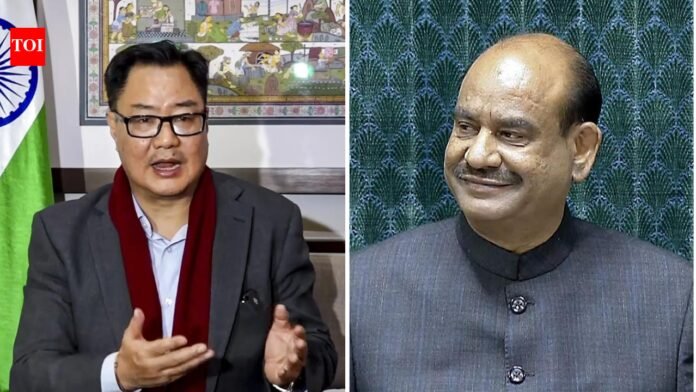
New Delhi: Union Minister for Parliamentary Affairs Kieron Rijiju It said on Sunday that the debate and voting on the no-confidence motion against the Speaker of the Lok Sabha will be held on March 9.“On March 9, we will debate the no-confidence motion against the Speaker in the Lok Sabha,” Rijiju told news agency PTI.
“The rule is to start the discussion on the first day. There will be a vote after the debate,” he added.Additionally, news agency ANI cited sources as saying that a fast-track review would be conducted in accordance with regulations.Previously, MPs submitted a no-confidence motion against the bill. About Birlasigned by 118 MPs. Opposition MPs claimed it was an act of “blatant partisanship” and the opposition leader was not allowed to speak.However, this is not the first time that the opposition has expressed no confidence in the chairman. In early 2024, the opposition filed a similar motion against Jagdeep Dhankhar, then Chairman of the House of Federation and Vice-President.History also records at least three instances since independence of no-confidence motions being tabled to remove the Speaker. The first was in 1954 against the first Lok Sabha Speaker GV Mavalankar, when MP Vigneshwar Misra claimed that the Speaker was unfair.In 1966, opposition MPs moved a motion against Speaker Sardar Hukum Singh, led by Madhu Limaye and chaired by Deputy Speaker SV Krishnamoorthy Rao. On April 15, 1987, the opposition MPs moved a third motion asking CPM MP Somnath Chatterjee to remove Speaker Balram Jakhar, and Deputy Speaker Thambi Durai presided over it. The motion was rejected by the House of Representatives.What was Nehru’s message to the MPs when the opposition moved a no-confidence motion against Speaker GV MavalankarThe first time this happened was on December 18, 1954, when the opposition tabled a resolution to remove the then Speaker, Mavalanka. More than 50 members stood in support, and debate took place before recognition was granted.first prime minister of india Jawaharlal NehruIn 1954, during the debate on the opposition resolution to remove Speaker GV Mavalankar, the message to the MPs was that they were not bound by any whip or directive and that all legislators had to consider the issue “irrespective of party affiliation”.He urged Lok Sabha members not to view the issue from a party perspective but as a matter of dignity of the House.It was a lively debate, with the opposition, although limited in numbers, lashing out at Nehru and accusing the Speaker of partisanship.Nehru, intervening in the debate, said: “If I may, I want to address the House in my capacity and in my capacity as the Leader of the House, not as the leader of the majority party, not as the leader of the majority party. As far as this majority party is concerned, I want to tell them that none of them are bound by any whip or any instruction: let them vote as they wish.” This is not a party issue. This is an issue that should be considered by the House, by everyone, regardless of party affiliation.““So let us try not to see this as a party issue but as an issue for members of the House because of course this matter affects the Honorable Speaker, but it affects the high dignity of the House as a Parliament and it affects the first citizen of this country, the Speaker of the House,” he added.The then Prime Minister said that what is said about the Speaker and what is done about the Speaker affects every one of us who calls ourselves a member of the House.“I hope members recognize this because I have been sad and very sad since this matter was raised in the House. We have known the Speaker for many years and we have seen him perform and some of us may not see him quite the same as others; that is possible,” he said.“As it happens, some of us don’t particularly like his decisions or his rulings. It’s one thing to not like or disagree with a ruling or even, if I may say so, to be a little annoyed by what happened. These things happen. But it is a completely different matter to challenge the sincerity of those who uphold the honor of the House,” Nehru said.“I am not saying that it is not possible to move a motion against the Speaker at all. Of course, the Constitution provides for this. No one questions the right of the Opposition or any member of the House to move this motion. I do not deny that right because it is constitutionally conferred. The point is not the legal right but the propriety; the desirability of doing so,” he said.Nehru then vehemently defended the speaker and lashed out at the opposition for questioning his sincerity.With an absolute majority of more than 360 members in Congress, the resolution was defeated by a voice vote.