
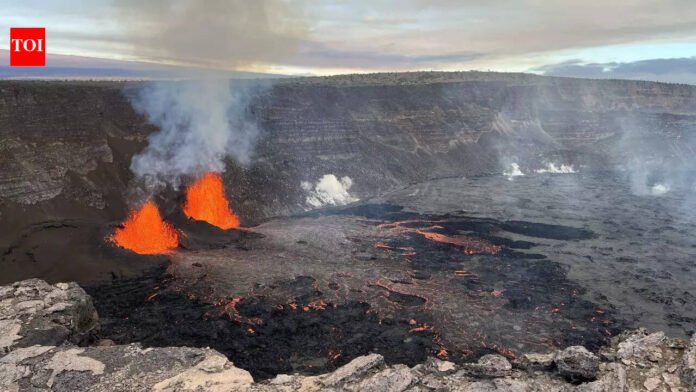
Nature occasionally reminds people of how powerful it is. That reminder came again this week on the Big Island of Hawaii, where the Kilauea volcano began spewing huge geysers of lava into the sky. The eruption looked almost unreal, with red-hot lava flows reportedly reaching nearly 1,000 feet high, creating a spectacular sight above the summit crater. For visitors and residents to view from a distance. But the sight soon gave rise to practical concerns.Ash and glassy volcanic debris began falling in nearby areas, prompting officials to close parts of Hawaii Volcanoes National Park and part of a major highway. Scientists say such an eruption is not entirely unusual for Kilauea, which has been active on and off for more than a year. Still, lava fountains of this size tend to attract attention.
Kilauea volcano shoots giant lava fountain into sky for 43rd time
The latest campaign began early Tuesday morning. Surveillance cameras run by scientists showed bright red lava spewing from vents inside the summit caldera of Kilauea. Two separate fountains rise into the air, sending glowing streams upward along with thick smoke and volcanic gases. According to reports, the height of the fountain is about 300 meters. This is approximately the height of many urban high-rise buildings.To those watching the live broadcast online, the scene looked almost cinematic. The bright red lava contrasts with the darker volcanic landscape. Experts said the eruption marked the 43rd eruption in the current eruption cycle, which began in December 2024. This number alone demonstrates Kilauea’s persistence. Lava remains in Kilauea’s summit crater, according to scientists monitoring the volcano. The crater is located within Hawaii Volcanoes National Park, a park designed to safely contain volcanic activity. Because of this containment, homes and buildings outside the park are currently not threatened by flowing lava. Residents of the Big Island are familiar with volcanic eruptions, but large geysers still draw attention whenever they erupt.
What are the concerns after volcanic ash and volcanic debris fall?
Even if the lava remains contained, the eruption can cause problems in other ways. In this case, falling debris becomes a major problem. Volcanic eruptions throw ash and glass shards into the air. Scientists call this material volcanic ash. Eventually, the debris falls back to the ground.Some landed in nearby neighborhoods and on roads near parks. Authorities decided to temporarily close an area near the summit of Hawaii Volcanoes National Park. Officials also partially closed Highway 11, an important highway for residents and tourists traveling around the island. Local officials explained that falling debris could pose a safety risk to drivers and pedestrians.
- Health issues caused by volcanic ash
Volcanic ash may look soft or dusty, but experts say it can cause irritation. County officials noted that ash can affect the eyes, skin and respiratory system. People who already have respiratory problems may feel the effects more strongly. Volcanic ash can also cause unexpected household problems.Many homes in parts of the Big Island collect rainwater for daily use. Volcanic debris can clog these water collection systems or contaminate stored water. Officials said previous eruptions left enough ash on rooftops that cleaning crews had to help residents remove it.
- Emergency shelters open as precautionary measure
Local authorities took another precautionary step by opening temporary shelters at area gyms. The shelter is provided for residents or visitors affected by road closures or falling debris. Officials reported that no one was using the shelter shortly after it opened.This may indicate that people nearby are cautious but calm. Many residents of the Big Island have experienced volcanic activity before and tend to follow official guidance carefully. Still, emergency planning is important whenever a volcano is active.
No. 43 Kilauea volcano eruption : Affected areas
A rare ash warning issued during Kilauea volcano’s 43rd eruption primarily affects parts of Hawaii’s Big Island, particularly areas close to the volcano and downwind communities where ash and debris (tephra) are falling.
directly affected areas
These locations are experiencing the heaviest ash and debris fall:
- Hawaii Volcanoes National Park (Kilauea Peak Region)
- Volcano Golf Course Community
- Kilauea Army Camp
- Uēkahuna Lookout and nearby summit areas
These locations received some of the largest volcanic ash and thick ash accumulations, forcing closures and evacuations.
Visible volcanic ash in nearby communities
Fallen ash, small shards of volcanic glass, and “Pele’s Hair” (thin strands of volcanic glass) have also been seen in several nearby residential areas:
- Volcano Village
- Mauna Loa Estate
- Royal Hawaiian Estate
Residents in these communities reported debris falling on rooftops, roadways and open spaces.
Areas with lighter volcanic ash
According to the National Park Service and other reports, wind-borne ash has reportedly spread further across the island, reaching:
- mountain view
- glenwood
- Hilo
- Hawaii Paradise Park
- Hāmakua Coast (north of Hilo)
In these places, the ash is usually lighter but still noticeable.
Infrastructure affected
In addition to residential areas, several important locations were disturbed:
- Highway 11 (approximate mile markers 24-40) is temporarily closed due to falling volcanic debris and ash slipping on the road.
- Summit areas and trails at Hawaii Volcanoes National Park are closed for safety reasons.
Who should be really cautious
People who need attention include:
- People living near volcanoes
- Visitors to national park areas
- Drivers using roads near mountain tops
- People with asthma or respiratory disease
What makes Kilauea one of the most active volcanoes in the world
Kilauea is widely considered one of the most active volcanoes on Earth. It has experienced numerous eruptions over the past few decades. U.S. Geological Survey scientists continue to monitor the volcano using cameras, sensors and satellite data. These tools track seismic activity, gas emissions and ground motions. Even with modern monitoring systems, accurately predicting how long a volcanic eruption will last remains difficult. Some episodes end within a few hours, while others last several days. Experts say it’s not entirely clear how long the current lava fountains will last.For observers, the eruption was a powerful reminder of the forces shaping the planet. Lava, ash, and shifting ground may appear destructive at times, but they also aided in the construction of the island itself. The Hawaiian landscape exists largely because of this volcanic activity.