
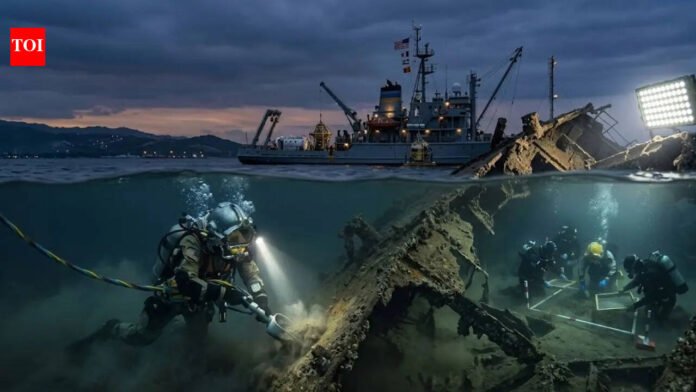
In December 1944, 80 years after the sinking of the hell ship Daitama Maru, DPAA conducted a daring, multi-year recovery expedition in the Philippine Sea. In December 1944, the Japanese Hell Ship was unknowingly bombed by the United States, causing more than 1,600 prisoners of war to sink with the ship. About 250 Americans are still missing. USNS Salvor is home to Navy divers and forensic anthropologists conducting rescue efforts at 90 feet in zero visibility and tangled in scrap metal. This work, authorized under the Sunken Military Ships Act, represents the United States’ commitment to provide the most thorough explanation possible for soldiers who endured the harshest maritime conditions of the Pacific War.
The Tragedy of Hell Ship Dairomaru
According to U.S. Navy history, in December 1944, one of Japan’s notorious “Hell Ships”, the Daimidorimaru, carrying more than 1,600 Allied prisoners of war, was attacked by the USS Hornet aircraft carrier. American pilots, unaware that their compatriots were trapped in dark and suffocating cargo bays, launched 17 separate air strikes over three days. Records from the Naval History and Heritage Command describe chaos and madness on the lower decks as extreme dehydration and suffocation took a toll until the ship finally came to a halt at the bottom of Subic Bay.
Pentagon High-precision search for 250 missing Americans
The Department of Defense Prisoner of War/Prisoner of War Accounting Agency (DPAA) has dispatched a specialized team to the Philippine Sea to begin the complex process of unearthing the Dairyoku Maru. Fifteen divers aboard the rescue ship USNS Salvor were working at a depth of about 90 feet, trying to recover the remains trapped for more than 80 years, specifically the 250 missing Americans. The site is a “rough steel mass” covered by large areas of river silt, resulting in near-zero underwater visibility and requiring high-precision forensic dredging to separate biological evidence from the wreckage.
Legal protection under the Sunken Military Craft Act
Salvage efforts are strictly regulated by the 2004 Sunken Military Vessels Act (SMCA), which gives the United States “protected sovereign status” over its sunken military vessels and the remains of its service members, regardless of the waters in which they are located. This federal law ensures that the Big Green Pill is a protected site and prevents any unauthorized salvage or robbery. The mission is a formal diplomatic partnership with the Philippine government and is intended to fulfill the policy of “the fullest possible identification” of missing persons.