Paleontologists identify a new coelacanth species from a 150-year-old fossil in London World News

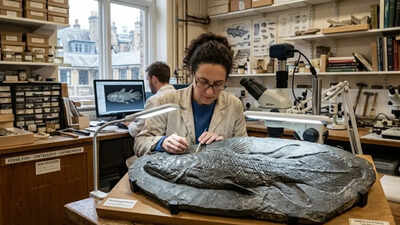
London’s Natural History Museum has discovered a previously unknown coelacanth species (Macropoma gombessae) from fossil remains dating back about 150 years. The new coelacanth is important because it helps fill a huge evolutionary gap of about 50 million years in the coelacanth, one of the world’s most recognized “living fossils.”Former University of Portsmouth paleontology student Jack L. Norton re-evaluated the fossil while examining a historical collection he had been studying for several years, according to research published by the University. To explore the internal anatomy of this ancient coelacanth fossil without damaging it, researchers from the University of Portsmouth and the Natural History Museum used advanced X-ray computed tomography (XCT) technology to examine the internal structure of the coelacanth fossil in an unprecedented way. The discovery highlights the enormous scientific potential that exists in museum collections around the world and provides further evidence of how modern technological innovations are changing our view of ancient groups and showing us the complexity of evolutionary processes that have been overlooked for the past century.
found one New species of coelacanth Fossils from 150 years old
The University of Portsmouth points out that a specimen called Macropoma gombessae was discovered in the Galter Formation in southern England and dates to the early Cretaceous period. The fossil has been in museum collections for more than 150 years and was only recently discovered to be the missing link in the family Latimeriidae, the modern coelacanths. Gombessa is the Comorian name given to the modern coelacanth by local fishermen and is where the name comes from.
X-ray computed tomography revolutionizes discovery
The specimen was identified using a technique called X-ray computed tomography (XCT), which allows scientists to examine the specimen without damaging it, create a 3-dimensional image of the specimen and view the specimen’s internal features at high resolution. The fossil was then compared directly to similar specimens from a different genus and found to have distinct enough anatomical features to classify it as a new species. This also provides a sample of the coelacanth’s evolutionary history.
Revealing internal anatomy with advanced imaging
The researchers used X-ray computed tomography (XCT) to reanalyze the fossil (a non-destructive method) by three-dimensional visualization of the material and internal structure of the specimen; therefore, they could perform comparative analysis of the specimen with known lineages to verify any unique anatomical features of the specimen relative to other fossils; these results suggest that the fossil represents a new coelacanth species and help understand its evolutionary history.