Home Blog Page 691

Tommaso Cioni, Annie Guthrie’s home raided: What is Luminol? Have you used it before?

0

Nancy GuthrieNBC host Savannah Guthrie’s 84-year-old mother disappeared overnight from her home in Tucson, Arizona, a week ago. Agencies including the FBI and the Pima County Sheriff’s Department have launched a search to find any information about Nancy’s disappearance. Amid reports of a new ransom note, investigators returned on Saturday, February 7 Anne GuthrieNancy’s eldest daughter and her husband Tommaso Cioni.

Annie Guthrie and her husband Tommaso Cioni (Facebook/Jolene Marie)

Delegates spent nearly three hours at the residence, arriving after sunset and leaving before midnight, Parade magazine reported. Shortly thereafter, X entered into a lively discussion about luminol, a chemical reagent used in forensic identification of trace amounts of biological material. Authorities were allegedly seen leaving the premises with bags containing evidence, which they had collected with approval from authorities. Anne and Tommaso. Additionally, a former FBI agent clarified whether the team may have used Luminol at Anne’s residence.

Also read: Savannah Guthrie vs Annie Guthrie Net Worth: Who is Richer? A comparison of their assets and properties

What is Luminol? Was Luminol used on Annie Guthrie’s property?

In a recent interview with Parade Magazine, former FBI agent Bryanna Fox discussed Nancy Guthrie’s The kidnapping case has escalated into one of the most high-profile criminal investigations in recent years.

In an interview with the publication, Fox clarified that Luminol is used at potential crime scenes to reveal traces of evidence that may not be visible to the naked eye. Luminol is commonly used in forensic investigations to help investigators identify body fluid residues, including blood, saliva and urine. Regarding his role, Fox said: ” [luminol] It is a fluorescent blue light. You need to use it in complete darkness. Basically, how it works is you shine light on it, and when it comes into contact with some kind of biological substance (could be blood, urine, or saliva), it appears iridescent. “

However, the use of luminol does not mean that the location is considered a primary crime scene. So far, authorities have confirmed whether luminol was used on Annie Guthrie’s property.

Fox added that every seemingly unimportant blemish, cut and crack was scrutinized and re-examined for any clues that might aid the investigation. “I wouldn’t think there was any deeper meaning other than they just wanted to document everything. You never know what’s going to be important. You never get the chance to look back on it later.”

Are Annie Guthrie and Tommaso Cioni suspects in the case?

Anne Guthrie She and her partner are currently undergoing additional tests as part of the investigation. Authorities have conducted two searches of their home. NewsNation reporter Ashleigh Banfield made the explosive claim that Tommaso Cioni is being considered a potential suspect in the 84-year-old’s disappearance. However, law enforcement representatives refuted the claim, clarifying that they had neither verified nor endorsed the claim.

‘This is the status of the book’: Former Army Chief MM Naravane reacts to memoir controversy; shares publisher’s statement | India News

0

'This is the status of the book': Former Army Chief MM Naravane reacts to memoir controversy; shares publisher's statement
Congressman Rahul Gandhi holds the unpublished “Four Stars of Destiny” by former Army Chief MM Naravane

New Delhi: Former Indian Army Chief Manoj Mukund Naravane, whose unpublished memoirs have triggered a major political controversy, on Tuesday backed a statement on the matter by his publisher Penguin Books.“This is the state of the book,” Naravane wrote on X, sharing a screenshot of Penguin’s statement.

‘Both Naravane or Penguin are lying’: Rahul Gandhi reacts to publisher’s statement on memoir

Gen (retd) Naravane’s reaction came a day after the Delhi Police lodged an FIR over the release of his book “Four Stars of Destiny”. Opposition leader and MP seeks to quote excerpts from unpublished memoirs Rahul Gandhi In the House of Representatives on February 2, it was blocked by the Finance Minister, causing controversy.

‘Not true’: Frisco Indian restaurant owner faces charges for hiring only students with F-1 visas

0

'Not true': Frisco Indian restaurant owner faces charges for hiring only students with F-1 visas

An Indian restaurant in Frisco, Texas, has been targeted multiple times by a group calling themselves the Texas Investigation Team. The group claims that Frisco’s Bollywood Pizza only hires Indian students on F-1 visas, which is essentially illegal. To support their accusations, they impersonated aIndian caller named Ravi and called restaurants looking for work. It became clear from the conversation that the restaurant employs F-1 visa students and pays them in cash or Zelle. Following that call, a video has now been released showing the same team visiting the pizzeria and requesting a meeting with the owner to ask him to comment on the allegations. “This is not true,” said the man identified in the video as store owner Omprakash Thota. The man also denied knowing anything about the previous viral call. He was also accused of moonlighting and working at Bank of America, which he denied.

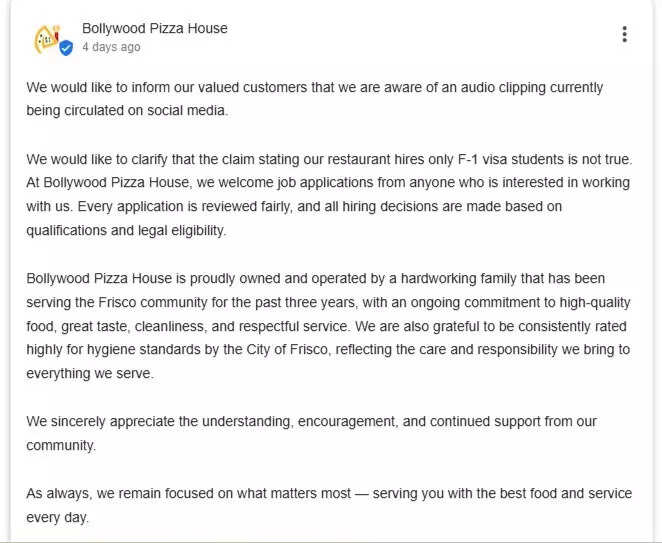
Bollywood Pizza Parlor Official Statement

Bollywood Pizza House has issued a statement denying the accusation that it only hires F-1 students.

The Indian restaurant released an official statement after the video went viral and said they would be recruiting job applications from anyone interested in working with them. “We would like to clarify that the statement that our restaurant only hires F-1 visa students is not true,” the statement said. “At Bollywood Pizza House, we welcome anyone interested in working with us to apply for a job. Each application is reviewed fairly and all hiring decisions are made based on qualifications and legal qualifications.”“Bollywood Pizza House is owned and operated by a hard-working family that has been serving the Frisco community for the past three years, always striving to provide high-quality food, great taste, cleanliness and respectful service. We are also pleased to receive unanimously high marks from the City of Frisco for sanitation standards, which reflects the care and responsibility we have for everything we serve,” the statement read.

Can F-1 students work in restaurants?

F-1 students may only work in college campus cafes. After the first year, they can work in a field related to their subject, something restaurant jobs mostly don’t qualify for.

French President Macron to visit India from February 17 to 19: MEA | India News

0

French President Macron to visit India from February 17 to 19: MEA
Emmanuel Macron and Narendra Modi (file photo)

New Delhi: French President Emmanuel Macron will pay an official visit to India from February 17 to 19, the French Ministry of External Affairs (MEA) announced on Tuesday.This will be Macron’s first visit to India since January 2024, when he attended the annual Republic Day celebrations as the chief guest. In February last year, Indian Prime Minister Narendra Modi visited France. “The two leaders will discuss strengthening bilateral cooperation in a wide range of areas as contained in the Horizon 2047 roadmap. In addition, the two leaders will also discuss regional and global issues of mutual interest, including cooperation in the Indo-Pacific region,” the MEA said in a statement. statement. “The two leaders will also jointly launch the Indo-France Year of Innovation in Mumbai, which both countries will celebrate in 2026. On February 19, President Macron will attend the Artificial Intelligence Impact Summit in New Delhi. “Meanwhile, ahead of Macron’s visit, the Defense Acquisition Council (DAC), chaired by Defense Minister Rajnath Singh, is scheduled to meet to consider several large defense procurement proposals. The most important of these is the proposal that 114 products made in France may be granted the Acceptance of Necessary (AoN) Rafale fighter jet The cost is Rs 325 crore.Also read: Ahead of Macron’s visit, the DAC is likely to meet next week to approve the deal to buy 114 Rafale fighter jetsAbout 80% of the 114 Rafale fighter jets planned to be purchased under the agreement are planned to be manufactured in India.

Aviator sunglasses, ‘For Sure’: Emmanuel Macron receives wine inspired by Davos speech |

0

Aviator sunglasses, 'For Sure': Emmanuel Macron receives wine inspired by Davos speech

french president Emmanuel Macron He’s not just swirling, sniffing and sipping at the Paris Wine Show – he’s bringing a dash of Davos swagger with him.This is the first time a head of state has visited the Paris Wine Fair since Macron’s Socialist predecessor François Hollande made an appearance in 2015.Macron received gifts during a visit to one of the industry’s biggest gatherings, including a bottle labeled “For Sure” and wearing a pair of aviator sunglasses – a reference to his viral speech in Davos earlier this month, AFP reported.“That’s great,” he said with a smile.After inspecting a bottle of fine Chinese wine, he stressed that the country “knows how to produce” – another concern for French producers.French and European wines are also affected by US President Donald Trump’s 10% and 15% tariffs on European alcoholic beverages in 2025.Beverage exports to the United States, France’s biggest destination for wine, fell 20% last year to 3.2 billion euros, according to French customs data.“One of the key points is to export effectively in Europe, defend (French wine) internationally when attacked by aggressive behavior and then go out and win new markets,” Macron said.He pointed to high potential in India, Canada and Brazil, all three countries included in the recently negotiated EU free trade agreement.For the first time, the Paris Wine Show has also opened a dedicated area for no- or low-alcohol wines and spirits, underscoring the importance of the growing demand from teetotalers.The wine and spirits industry supports 600,000 jobs in France and generates approximately 32 billion euros in revenue annually, half of which comes from exports.

Is India less worried about Donald Trump than the West? Here are the findings | India News

0

Is India less worried about Donald Trump than the West? The survey said this

Even though most people in the western world are right Donald TrumpAfter returning to the White House, India’s reaction was completely different. The Munich Security Report 2026 presents the Indian public’s view of U.S. President Donald Trump, characterized by relatively high approval of his policies, growing concerns about U.S. economic coercion, and declining confidence in the need for U.S. global leadership.About 38% of Indian respondents believe Trump’s policies are good for India, and about 36% believe these policies are good for the world. These levels of consent are significantly higher than in Canada, France, Germany and Japan, where consent levels generally remain in the low teens

Report content

According to MSI, India ranked among the most favored countries when respondents were asked whether “Donald Trump’s policies are good for our country” and “good for the world.”The report noted that compared with the Western public, Indian respondents were less critical of Trump and more likely to express conditional or partial support for his approach, even if there is still uncertainty about its global impact.While India has relatively few negative views on Trump’s geopolitical impact, the report documents greater concerns about its economic policies. The Trump administration imposed a 50% tariff on India. With the recent India-US trade deal, the additional 25% tariff was reduced to 18%.The report said that between 2024 and 2025, the United States’ risk score for India increased by 18 points, the largest increase among India’s risk scores. Despite this increase, the United States does not rank among India’s top perceived threats. China remains a higher concern, while Russia is seen as relatively low risk.The findings are based on the Munich Security Index (MSI), which surveys public attitudes in the G7 and major global South countries.

The era of “wrecking ball politics”

The report sees Trump as a central figure in the era of “wrecking ball politics”, characterized by challenges to multilateral institutions and the post-1945 liberal order. In the case of India, the report underscores long-standing suspicions of the Western “rules-based order,” which policymakers criticize for selective application and double standards.The report cites External Affairs Minister S Jaishankar’s assessment that from the perspective of the Global South, the existing order often appears “anarchic and full of double standards”. Against this backdrop, the report suggests that Trump’s challenge to existing institutions is not generally viewed negatively in India.

Shanghai has been sinking for decades, but something unseen underground is slowing it down | World News

0

Shanghai has been sinking for decades, but something unseen underground is slowing it down
The city of Shanghai is sinking (Image source: Canva)

Scientists have warned for decades that Shanghai, one of the world’s largest and most densely populated coastal megacities, has been slowly sinking due to the way humans use the land beneath it. This problem is not new. According to reports, historical records show that parts of Shanghai have dropped by more than 2 meters over the past century due to over-pumping of groundwater and soft, compressible urban soil. Subsidence makes the city more likely to experience flooding, rising sea levels and damage to infrastructure.But even as it all sinks, Shanghai isn’t suddenly falling apart or disappearing. Engineers and officials have found ways to slow the rate at which the ground is sinking. They have begun taking steps such as reducing groundwater pumping, extracting water into deeper aquifers, and replenishing aquifers with treated surface water rather than allowing the land to dry out as water is pumped. These actions act like invisible supports beneath the city, arresting and slowing subsidence.Parts of Shanghai are still sinking, but the average subsidence rate has dropped significantly since its peak in the mid-20th century. Understanding how and why this happens requires digging deep into the underground, porous sediments and human-managed water systems that together determine the risks and responses in this megacity.

What causes cities like Shanghai to sink?

Shanghai sits on the flat, soft sediments of the Yangtze River Delta. Sedimented over thousands of years, these sediments contain layers of silt, clay and sand that behave like a sponge when loading or unloading water. When these tiny pore spaces fill with water, they help support the weight of the buildings, roads and soil above them. However, when too much fluid is withdrawn, the supporting pore pressure decreases and the sediment compacts under its own weight. This process causes land subsidence, or surface subsidence.In the early and mid-20th century, rapid industrial development and population expansion led to Shanghai pumping out large amounts of groundwater. People extract water for industry, agriculture and growing urban needs. This, combined with the weight of high-rise buildings, resulted in land subsidence rates reaching or exceeding 10-15 centimeters per year in some areas in the late 1950s and early 1960s.The subsidence phenomenon is not unique to Shanghai. Other cities, including Mexico City and Long Beach, California, have experienced similar land subsidence as fluids are pumped from below the surface. In each case, the behavior of fluids in underground sediments plays a central role in whether the ground sinks, rises, or remains stable.

Invisible support: How water injection works

If removing water causes sediment compaction, scientists and engineers ask a simple question: What would happen if we put some liquid back in? Cities began trying to inject water into depleted aquifers and old oil or gas fields, rather than treating the water table as drainage. Injecting water under pressure increases pore fluid pressure in the sediment, providing additional support and reducing compaction rates.In Long Beach, California, a water injection program started in the late 1950s helped reduce land subsidence in the area from as much as 9 meters to much lower levels. Engineers use treated seawater and formation water injected through hundreds of wells to slow the compaction of depleted layers. The scheme is widely cited as one of the first large-scale applications of liquid injection to control subsidence.Shanghai takes a related but slightly different approach. Authorities have gradually reduced over-pumping of groundwater, diverted water to deeper strata, and installed recharge wells to inject treated river water underground. As a result, the once-rapid rate of subsidence has slowed to about one centimeter per year in recent decades. That doesn’t mean cities are rising again, but it does mean the rate of decline has slowed significantly.

Why reducing settlement is important

For a coastal city like Shanghai, even a few centimeters of ground movement can have a big impact. Land subsidence, along with rising sea levels due to climate change, makes flooding more likely, damaging infrastructure such as subways and roads, and raising flood prevention costs. In real life, every centimeter less settlement gives planners and engineers more time to improve drainage, strengthen levees, or rethink how infrastructure is built.But experts caution that fluid injections and artificial replenishment do not cure the disease. Much of the compression that occurs before these practices begin is almost permanent. Scientific studies of subsidence in places like Mexico City show that even if groundwater is allowed to rise, the ground rarely returns to its original height.Risks associated with fluid injection also include the potential to reactivate faults or trigger small seismic events if water is added too quickly or inappropriately. As a result, modern projects rely on detailed monitoring systems, including GPS, satellite radar and borehole instruments, to track minute changes in surface and underground pressures.

The future of Shanghai and other sinking cities

Many low-lying megacities in China and elsewhere face similar challenges. Historical records show that since the early 20th century, central Shanghai has sunk by more than two meters due to the dual effects of groundwater extraction and urban development.Government agencies and researchers are now carefully monitoring ground movements and integrating lessons from other cities to manage subsidence. Techniques such as artificial recharge and careful groundwater management are becoming part of wider urban planning strategies aimed at reducing long-term risks.While Shanghai has not yet completely sunk, its experience and that of other sinking cities shows that invisible processes beneath our feet can shape the fate of entire metropolises. As sea levels continue to rise and cities continue to grow in size, understanding and managing these processes remains a key priority.

No-confidence motion against Om Birla: India group ally TMC refuses to sign notice; wants to discuss first | India News

0

No-confidence motion against Om Birla: India Group ally TMC refuses to sign notice; wants discussion first

New Delhi: Trinamool Congress leader Abhishek Banerjee On Tuesday said his party had “no problem” signing the no-confidence motion against Lok Sabha Speaker Om Birla, but insisted the opposition should first express its displeasure to the Speaker, including suspending eight MPs. Speaking to reporters at the Parliament House, Banerjee said the Speaker should be given a chance to respond before the opposition moves a resolution calling for his removal. Although the opposition parties submitted a notice earlier in the day accusing Birla of “blatantly partisan” behavior, the TMC chose not to sign off on the move, PTI reported.“The All India Trinamool Congress had no problem signing the no-confidence motion against the Speaker. All 28 MPs will sign the agreement,” Banerjee said. “However, before moving the no-confidence motion, we would like all India Group partners to sign a letter to the Speaker highlighting the four points on which the argument is based. ” Citing the suspension of eight MPs, Banerjee said the opposition could appeal for reconsideration and give the Speaker “two to three days” to respond. “If the Speaker fails to act or fails to provide satisfactory answers to these four questions, a motion of no-confidence can be tabled after three days,” he said. Opposition parties, including the Congress, Samajwadi Party and DMK, submitted notices to Lok Sabha general secretary Utpal Kumar Singh through Congress leaders Gaurav Gogoi, K Suresh and Mohamed Jawed. The resolution accuses Bella of acting with “blatant partisanship” and making “blatantly false” accusations against members of Congress. The TMC leader said his party wanted Parliament to function normally and questioned the repeated prorogations of the House. “We want the House to function normally but the federal government does not seem to be doing so,” Banerjee said, adding that it was also the speaker’s responsibility to ensure smooth proceedings.According to sources, around 120 MPs from political parties including Congress, DMK, Samajwadi Party, Shiv Sena (UBT) and NCP (SP) signed the notification.

The age of artificial intelligence: Are we really getting smarter or dumber? |India News

0

The age of artificial intelligence: Are we really getting smarter or dumber?

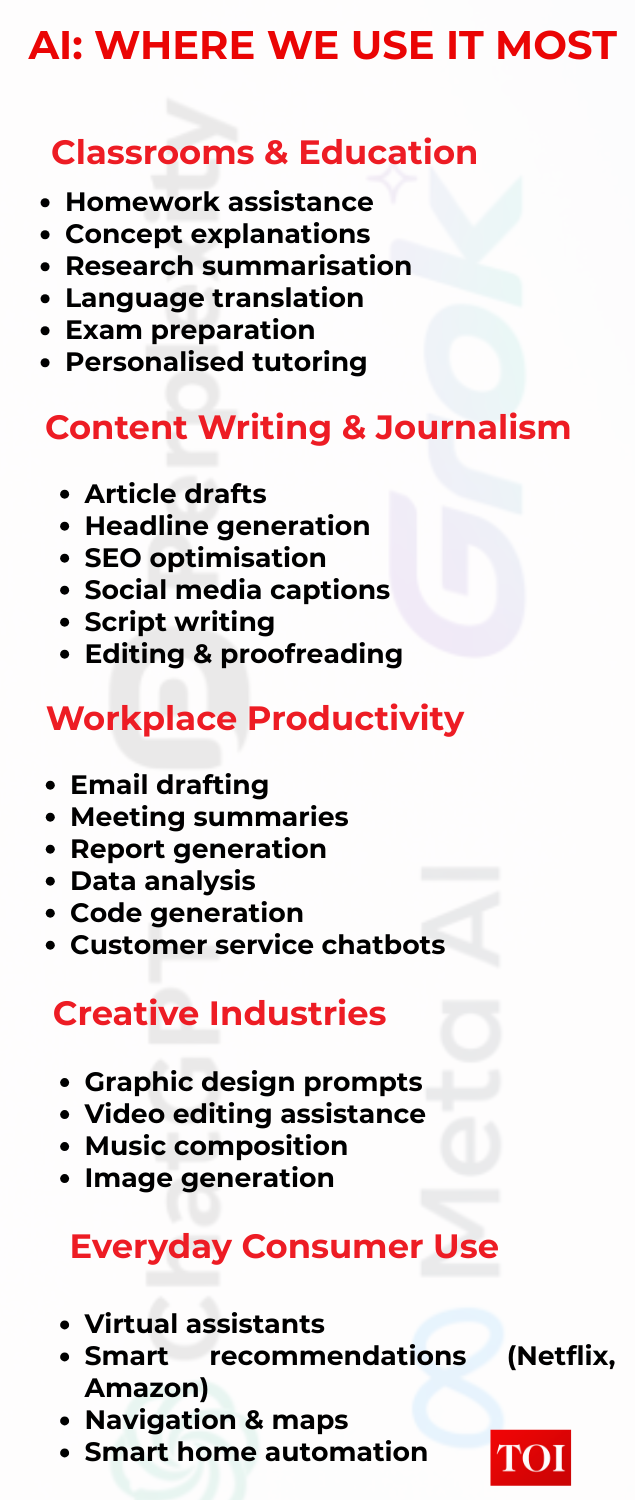
Today, artificial intelligence has become a handy tool. It helps us think faster and clearer in chaotic moments and often provides a sense of control in a chaotic digital world. For many people, AI tools such as ChatGPT, Grok, Perplexity and others are no longer optional aids but daily companions.There was a time when being stuck meant slowing down. The answers can only be found by looking through books, libraries, interviews/conversations and research. The process can often be frustrating, but it forces people to participate. People must independently conduct research, connect ideas, challenge assumptions, and draw conclusions. Critical thinking is not an optional skill that can be outsourced.Today, a prompt can generate an answer instantly. Tasks that once took hours now take just minutes. There is no denying that quantitative productivity has improved. But speed comes with a trade-off. When answers are readily available, there is less need to solve problems. However, it is in this struggle that critical thinking becomes sharper.

.

So, let’s take a deeper look at how AI can shape critical thinking and problem-solving skills.

Application of artificial intelligence in the classroom

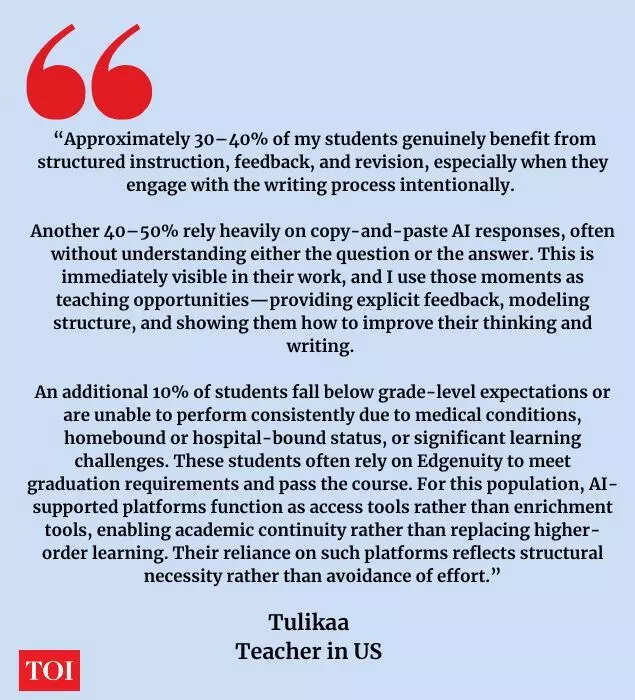
When we talk about artificial intelligence, we must start from the period when critical thinking develops – school age. At this point, children not only learn facts, but also how to ask questions, analyze, argue, and draw conclusions.For those from the pre-artificial intelligence era, going to school meant long hours reading textbooks, handwriting notes, calling classmates to do homework, and more recently, browsing the internet. The process can be frustrating at times, but it requires effort and thought.School age looks very different these days. A single prompt on ChatGPT, Meta AI or similar platforms can generate structured answers in seconds. Papers, abstracts, explanations of complex concepts – all are available almost instantly. The efficiency is undeniable. But the core question remains: If AI is thinking, are children still learning how to think?When used correctly, AI can act less like a shortcut and more like a mentor. It can explain difficult questions, simplify dense topics, generate practice questions, or provide feedback on writing structure. For students who are hesitant to ask questions in class, AI can provide a non-judgmental space to clarify doubts. In this sense, it may democratize access to academic support.Although there is a risk of passive consumption. When students copy answers without thinking, they may complete the assignment without grasping the underlying concepts.Tulika, a high school teacher in Georgia, USA, explained this. “When students turn to AI tools when they are struggling rather than independent study, I view it as a neutral tool whose impact depends entirely on student intent and instructor guidance. In my experience, AI does not eliminate critical thinking; rather, it exposes the divide between students who want to learn deeply and those who are content with average results,” she said.She further said that she also sees positives in the use of artificial intelligence as long as people remember to limit it to helping assistants.

.

As an Indian-American teacher in the United States, Tulikaa offers another perspective, coming from a different culture and finding AI helpful in understanding her students and the overall environment. Although she emphasized that “artificial intelligence tools such as MagicSchool, Nearpod, ChatGPT (including teacher-centered GPT), Perplexity, etc. support planning and idea generation, they cannot replace teaching understanding. AI-generated lessons are only effective if the teacher understands the standards, the students, and how to give clear, actionable instructions. Responsible use of AI has broadened my learning horizons, enhanced course design, and helped me direct instruction toward clearer learning goals. “From a teacher’s perspective, 13-year-old Mishika Gupta also shared the negative impacts of AI but wasn’t entirely convinced of its accuracy. Sharing her personal experience, she said: “Unlike most of my classmates, I don’t use AI to do or help me with homework because I feel I can’t trust it yet. I’ve seen it fail to give the correct answers many times. For example, I couldn’t understand my Spanish homework, asked for help, and found that the translation was incorrect.She also sees the impact it has on her peers, adding: “I feel like AI is being misused by a lot of people my age. They use it every day for homework. Most of my classmates are so addicted to ChatGPT that they don’t even try to answer the questions, they just copy whatever it asks without even reading it. I feel like it stifles creativity in kids my age. Some of them actually chatted with it like it was their good friend. They share their feelings with it and ask it to solve their life problems.Her mother, Dr. Shu Qi, also supports her daughter’s idea and hopes that she will maintain this belief. Contrasting her school days with today, she said: “AI tools have become an integral part of today’s young people’s lives. I see them using them not only as a tool to help with homework, but also as friends, mentors and confidants.”“I think the joy of sifting through multiple library books, magazines or research articles to research a topic is something the current generation will never experience. This process also allows us to broaden our worldview, understand a topic from different perspectives, and gain insight into the minds of subject matter experts. All the hard work put into this task ensured that we completed it with pride and a huge sense of satisfaction,” she added.When asked to give advice to her daughter about using artificial intelligence, she emphasized being aware of its limitations.

.

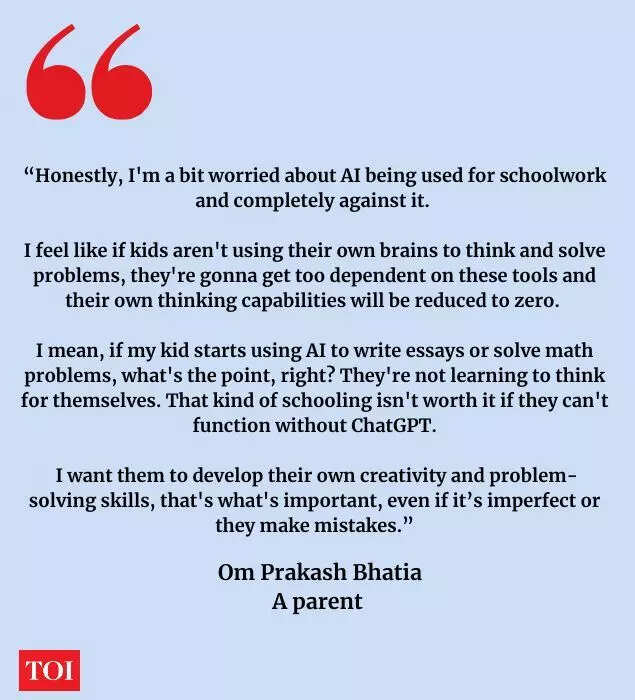
Meanwhile, another parent, Om Prakash Bhatia, has reservations about artificial intelligence, saying it is killing children’s creativity.

.

Therefore, the AI ​​and homework debate is not black and white. Artificial intelligence can expand the scope of explanations, support struggling learners, and help educators improve teaching. At the same time, uncontrolled dependence can undermine efforts, undermine conceptual clarity, and can lead to erroneous conclusions in the absence of validation.Ultimately, the question is not whether AI will invade the classroom; It already has. The real challenge is not just teaching children how to use AI, but how much to use it.

Artificial Intelligence in Content Writing: Efficient or Superficial?

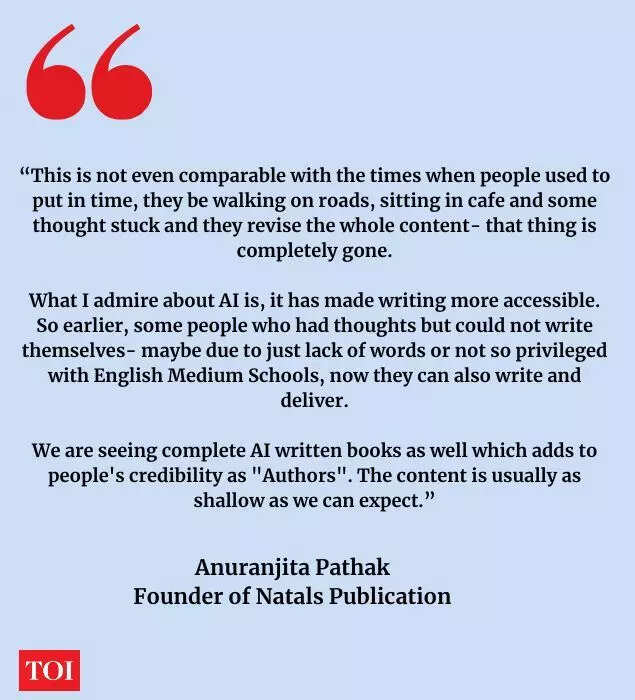
One of the areas where artificial intelligence is widely used is content writing. In newsrooms, PR offices, the publishing industry, the question remains: How can humans compete with machines that can generate content in seconds?Artificial intelligence has undoubtedly accelerated production. It can draft blogs, summarize reports, suggest titles, and even mimic tone of voice. But writing is more than just grammatically correct sentences. It touches on lived experience, subtext, cultural differences and emotional connections. While AI can simulate empathy and construct narrative arcs, it doesn’t feel urgency, sadness, irony, or joy; it fakes it.This becomes even bigger as AI moves from short-form content to long-form storytelling. From self-help manuals to novels, books are increasingly being drafted in part or entirely by artificial intelligence. The bigger question, therefore, is not whether AI can write books, but whether readers will value efficiency over originality, simulation over the human voice.Anuranjita Pathak, founder of Natals Publications, raised concerns about this. “I have been in this industry for over 6 years and have met many excellent writers and editors. The delivery time of content/novel has been greatly shortened. I know someone who spent 4 years writing a book – the depth of these 4 years cannot be written by artificial intelligence. So the original thought and critical depth must have declined.”Elaborating on her stance, she added, “Now people are using AI to brainstorm – ‘give me 5 plot twists’, ‘write a table of contents for an HRMS book’.”She shares her frustrations when dealing with AI writings and talks about how non-AI writings can have depth and complexity.

.

Can we trust artificial intelligence?

In reality, the AI ​​still tends to refer to Donald Trump as “former president” and make up its own citations when asked for research, and accuracy is an issue.There are many examples of AI making up its own information or distorting facts. One example from Deloitte even made headlines when a report was discovered to have been produced using artificial intelligence.last year, Deloitte faces controversy Scrutiny is growing over the Australian government’s use of generative artificial intelligence in preparing the document after errors were discovered in a report, including falsified references and incorrect court citations. After the incident came to light, Deloitte agreed to provide a partial refund to the Australian federal government and released a revised version of the report that corrected the inaccuracies.Therefore, it becomes important to reiterate that AI has the ability to override our logical brains and lull humans into a false state of safety until it is caught or becomes too robotic to connect with humans.

The story of artificial intelligence

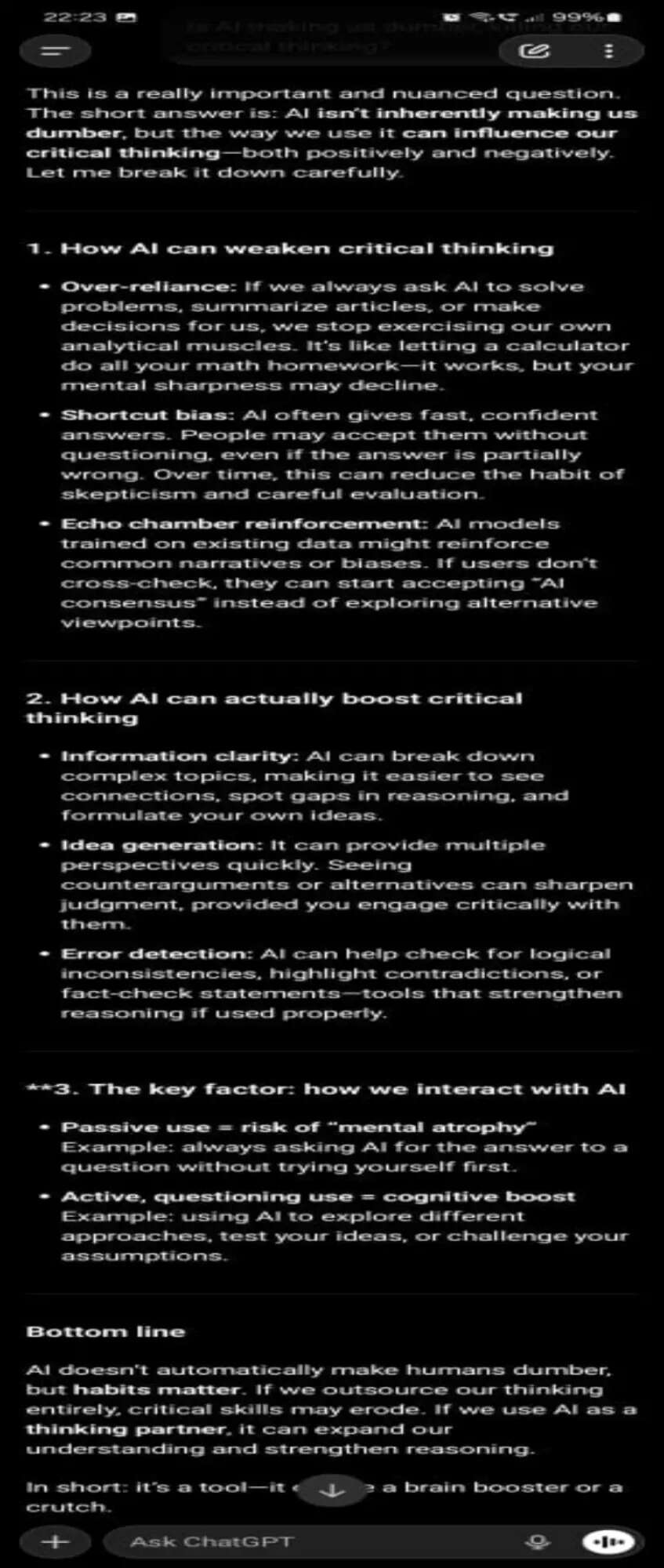
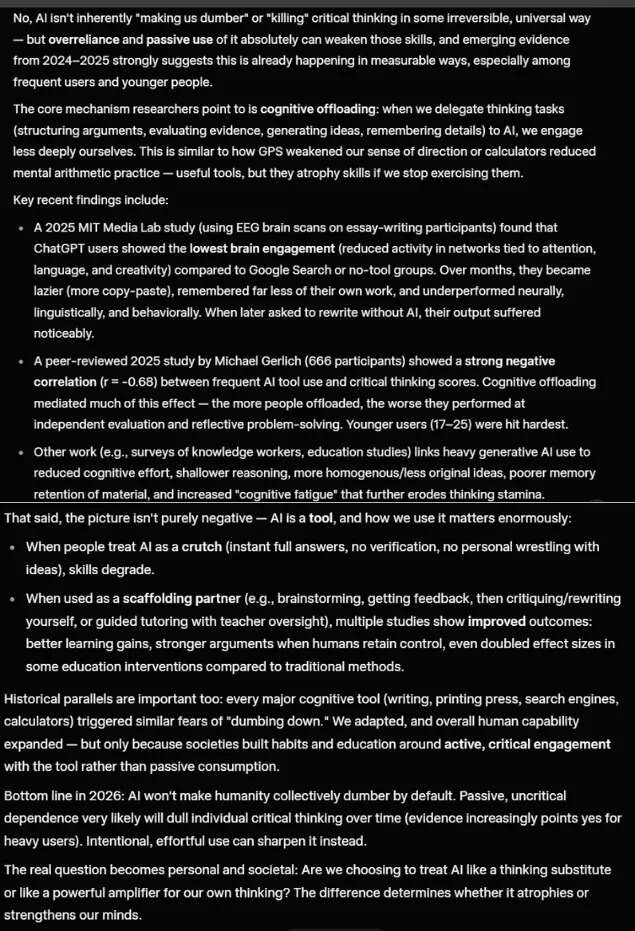
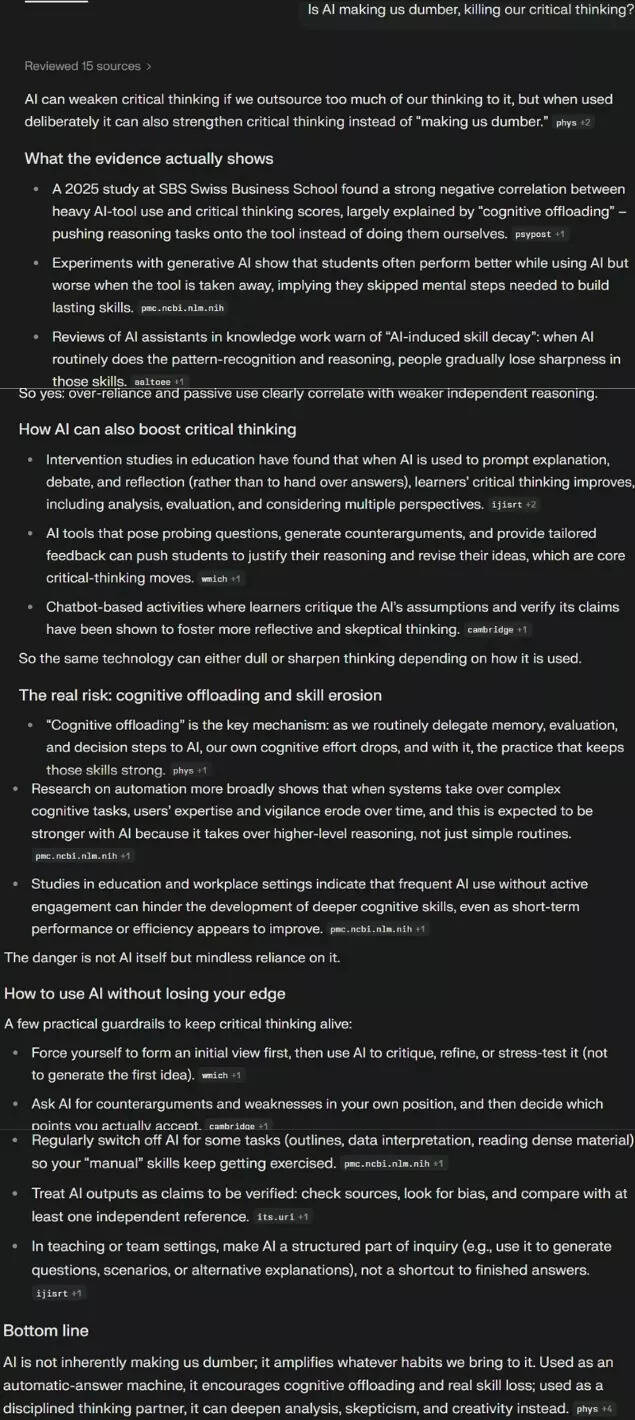
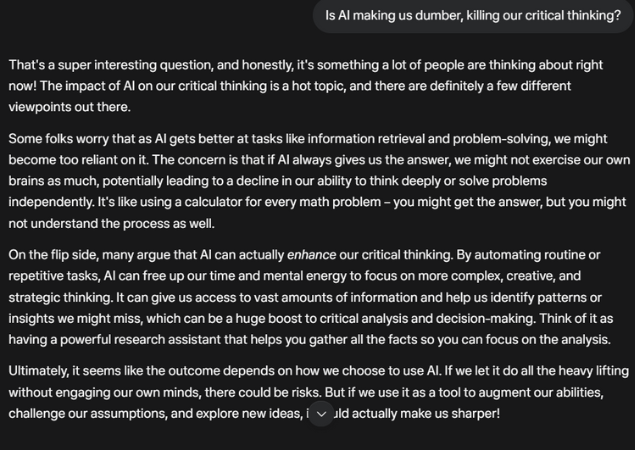
Since we’re talking about artificial intelligence, it’s also important to hear what the robots have to say.So let’s see if ChatGPT, perplexity, Grok and Meta AI believe “Is AI making us dumber and killing our critical thinking?

  • ChatGPT: Commonly used bots also highlight an important aspect of the discussion, which is that AI itself is not important, but how it is used determines whether it will have an impact human mind. “It’s a tool – it can be a brain booster or a crutch,” it says.
Chat GPT

  • Grok: Grok is adamant that “AI is not inherently ‘making us dumber’ or ‘killing’ critical thinking in some irreversible, pervasive way.” However, this also draws attention to the way in which core questions are used in decisions. It also cites some research (unsubstantiated; used only for context in this article) to explain its stance.
Gronk

  • Confusion: Confusion also gives a balanced view. Like the others, it lists pros and cons. “AI can weaken critical thinking if we outsource too much of our thinking to it, but if used intentionally it can also enhance critical thinking rather than ‘make us dumber’,” it said, citing various sources (not confirmed and used only in the context of this article)

Puzzled

  • Meta AI: It doesn’t give a clear answer, but it gives different perspectives, pointing out both sides of the argument, while also highlighting the intent and usage that will really determine whether AI makes us dumber. “There may be risks if we let it do all the heavy lifting without using our own minds. But if we use it as a tool to enhance our abilities, challenge our assumptions, and explore new ideas, it can actually make us sharper!” it says.
meta-artificial intelligence

Allies or obstacles; the choice is ours

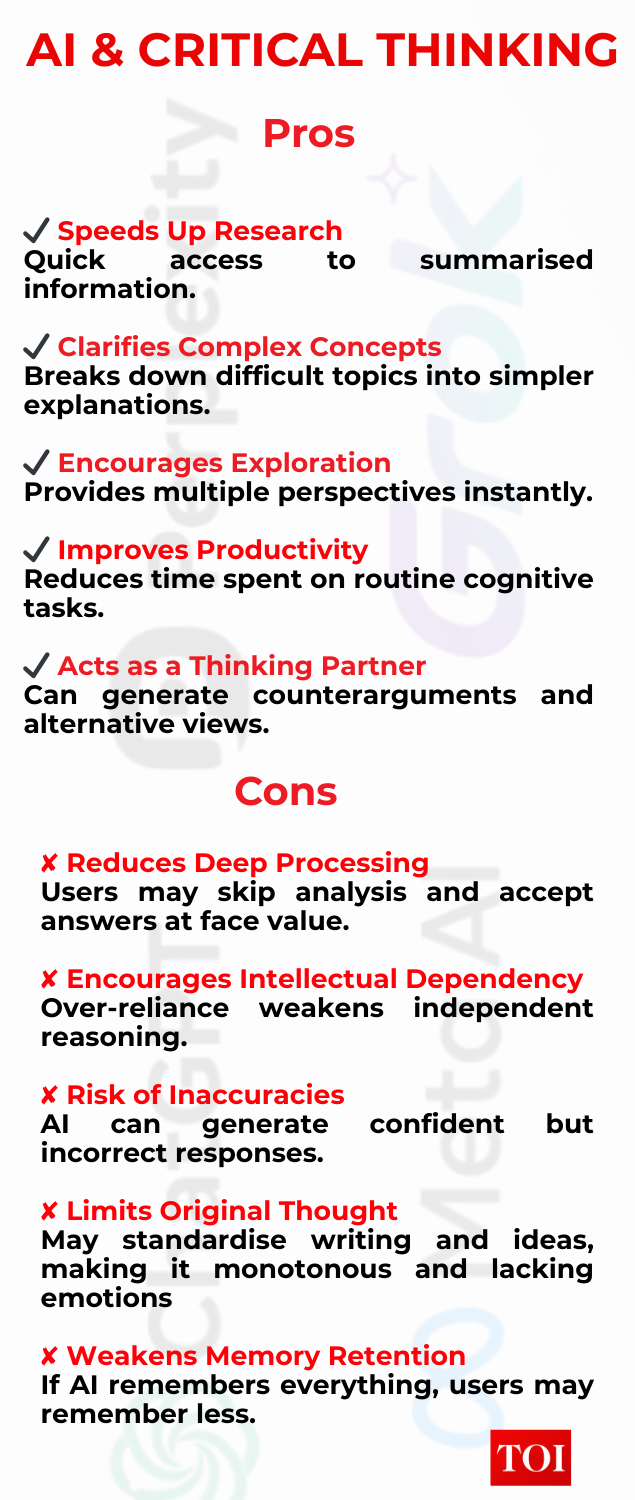
Looking at the insights from humans and robots, it’s clear that AI will have an impact on the human mind beyond just the use of AI. In fact, it depends on how we choose to use it. By itself, it is a neutral tool.If you rely blindly on it, you risk stifling creativity, problem-solving, and independent thinking.On the other hand, if used responsibly, AI can enhance human intelligence. It can help organize ideas, provide new perspectives, simplify complex concepts, and inspire creative solutions that we may not have considered on our own.

.

The key is balance, treating AI as a helper rather than a substitute for the original idea, a partner rather than a substitute.In fact, we are not smarter or dumber because of AI, but because of how we choose to interact with it. We have the opportunity to think, think, and decide: do we let it think for us, or do we let it help us become smarter? The answers will shape the future of learning and creativity in an AI-driven world.

How do I apply for the 2026 Additional Child Tax Credit? Check if you are eligible for an ACTC refund

0

In light of the tax changes announced by the IRS and the lasting changes included in the so-called One Big, Beautiful Bill, many families across the United States are considering the amount of tax refunds they may receive in 2026 due to additional taxes child tax credit (ACTC). This benefit remains one of the most important forms of assistance available to parents and guardians, and understanding its mechanics can greatly influence the application process.

2026 Additional Child Tax Credit: IRS tax changes have families considering a 2026 tax refund through the Additional Child Tax Credit. The credit can provide substantial financial relief to qualifying parents and has specific requirements for qualifying children, including age and residence. (Pexel)

Also read: How to get an extra $6,000 in “Premium Bonus” this tax season? Who is qualified?

What is the child tax credit? Look at 3 categories

It is designed to provide relief to those with children who meet certain criteria, allowing them to receive significant tax relief. Best of all, even if you don’t normally submit tax returnyou may still be eligible to apply for and benefit from this assistance. There are three categories:

Child Tax Credit (CTC): A non-refundable credit that allows individuals with qualifying children to reduce their tax liability.

Additional Child Tax Credit (ACTC): This represents the refundable portion of CTC. The ACTC allows certain eligible taxpayers to receive a refund if they exceed their tax liability.

Other Dependent Credit (ODC): Provides a non-refundable credit to taxpayers with dependents who are not eligible for CTC/ACTC.

Who is eligible for the Additional Child Tax Credit (ACTC)?

this child tax credit Provide up to $2,200 per qualifying child. If your federal tax liability is minimal or non-existent, you may qualify for the Additional Child Tax Credit, which can be up to $1,700 per qualifying child based on your income. Standards include:

Are under 17 years of age at the end of the tax year.

Not providing more than half of its own financial support during the tax year.

Live with you for more than half of the tax year.

Be claimed as a dependent on your tax return.

Be a U.S. citizen, U.S. national, or U.S. resident.

How to get an ACTC refund

If you have applied for the Additional Child Tax Credit (ACTC), the IRS won’t be able to process those refunds until mid-February. All refunds, including any amounts not related to these points, are subject to this delay. You can find out the exact refund date and more information via “Where’s My Refund?” Mid to late February.

At that time, all qualifying families can claim the credit by providing the names of their children and other dependents on their U.S. individual income tax return, Form 1040, and completing Schedule 8812, Credit for Qualified Children and Other Dependents.