On the face of it, India’s prison crisis generally appears to be about average. Occupancy rates are hovering at 121%, budgets have increased, and new capacity has increased. Real life is not so reassuring. In parts of the country, prisons operate without doctors and without counselors, leaving inmates in dire straits even as barracks continue to be overcrowded.New data released last week by India Justice Report in partnership with Prayas, the Tata Institute of Social Sciences’ field action project, as part of a national consultation on prison overcrowding, shows the scale of the pressure. More than 300 prisons across India are operating at twice their capacity, a level at which even basic amenities such as sleeping space, health care and supervision have become difficult.Reports on prison capacity warn that state and national averages often mask reality. Individual prisons expose more extreme stress points. Overcrowding in Delhi Central Jail No. 4 has steadily increased since 2020 and will reach 550% by 2023. Danapur sub-jail in Bihar and Gumla district jail in Jharkhand are at over 300% capacity, while Kandi sub-jail in West Bengal has reached a peak of 450% capacity in 2022.The biggest reason prisons remain so crowded is not the surge in convictions but delays. About 76% of India’s prison population is under trial, many of whom have not yet been convicted of any crime. They also spend more time indoors. The proportion of untried cases resulting in jail terms of three to five years has almost doubled over the past decade, and by 2023, nearly a quarter of all untried cases nationwide had been jailed for one to three years. The ratio is even higher in West Bengal, Manipur and Jammu and Kashmir.Who’s stuck in this justice waiting room isn’t random. About two-thirds of pending cases and nearly 70% of offenders are from Scheduled Caste, Scheduled Tribe or OBC communities, which often have less access to legal help and fewer resources to obtain bail quickly. While caste data is not available, the disproportionate representation of marginalized communities within prisons is indicative of social inequality.About 30% of guard positions are vacant nationwide, and 29 states have not approved even a single mental health professional to enter prisons despite rising stress and self-harm among inmates. Although the Model Prison Manual states that there must be 1,150 psychiatrists nationwide, only 65 positions have been approved and only 35 have been filled, leaving a policy vacuum in prison mental health care. Medical services are also stretched thin, with an average of one doctor for every 797 prisoners, and in some states the ratio is much lower. Karnataka and Nagaland reported having no prison doctors at all and relying on occasional visits from district hospitals.For Professor Vijay Raghavan, Program Director of Prayas (TISS), the problem lies in the framework of prison reforms. “Normally when you talk about overcrowding you say we need more space, toilets, beds… But how can we look at this from a different perspective so that even if prison capacity doesn’t increase that much, we can still have better living conditions and fewer people in prison,” he said, arguing the focus must shift from building more prisons to non-incarceration alternatives.Some 30 NGOs participating in the consultation, many of which work within prisons, said these shortages were exacerbated by access restrictions. Human rights advocate Ajay Verma points out that while countries like Maharashtra Karnataka still allows social workers into prisons, but many other states do not. “Security issues can be addressed through police verification rather than blanket denial,” he argued. What’s so annoying Raghavan One problem is that religious groups are often allowed in but trained social workers are turned away.Verma’s team met with prisoners regularly during their time in Murakat. Once trust is established, the prisoners start talking. “Regular, ongoing meetings, every fortnight for a few hours, can make the difference between a long-term detention and a viable bail application,” he said.
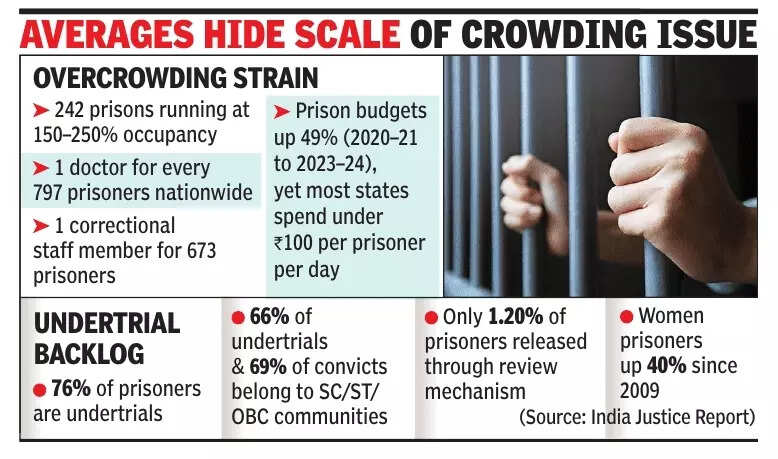
A civil society organization working in Karnataka recommended building a social and economic profile of every pending case upon admission, documenting family relationships, housing and livelihoods. When shared with the courts, this data can support individual bail. Occupancy rates in southern states are often lower, sometimes below 100%, but these civil society organizations warn that this is partly due to the construction of new prisons and does not necessarily actually reduce the incarceration population.For Murali Karnam of the National Institute of Legal Studies, meaningful reform depends on early intervention by civil society. “There is no point in being released on bail for a trial three months later. In any case, you are expected to be there for three months. But thanks to our intervention we were able to get assistance 15 days after arrest, which is a sign of intervention,” he said, stressing the need to strengthen prison legal aid clinics.Kannan believes that in the early stages, social workers are often more effective than lawyers. “They are able to identify multiple needs,” he said, referring to the many people on trial who are on bail and remain at home because their families are unaware or unable to get through the system, even though they have been granted bail. However, money alone will not solve the problem. Despite increases in prison budgets in recent years, many states still spend less than Rs 100 per prisoner per day, although new penal laws under the BNNS Act are expected to push the figures further.Salman Azmi, member secretary of the Maharashtra Legal Services Authority, told the consultation that judges today are more sensitive to prison conditions, partly because prison visits are now institutionalized. But he believes the real challenge is to stop incarceration before it starts. “Many problems start in police stations. A structured pre-arrest legal aid system could prevent thousands of people from ending up in overcrowded prisons in the first place.“Review boards aimed at relieving the pressure have so far made little progress and with just over 1% of prisoners nationwide being released, this is not just a numbers issue but one that plays out every day inside prison walls.