On a busy afternoon in Old Delhi’s Parathe Wali Gali, Darshit Singh held up his phone and did something unusual.He didn’t hype the food.He critiqued it.The reel — an “honest review” of a legacy eatery and Daulat ki Chaat — crossed 7.3 million views. Messages flooded in. Invitations followed. Cities called.That was 2024.Today, Singh calls himself India’s first “food deinfluencer”.Elsewhere, Santosh was boarding a late-night flight after wrapping up a full corporate workday.An IIT-Delhi alumnus by degree and a traveller by instinct, he refuses to choose between spreadsheets and sunsets.“I’m a traveller with a full-time job,” he says — a line that has now become his digital identity.Every month, a new state. Every trip, a vlog. Every journey, proof that passion doesn’t need permission.What once looked like just another viral reel is now part of something bigger — a creator economy projected to be worth thousands of crores, and increasingly recognised in India’s economic blueprint.This year’s Union Budget did something subtle but significant: it placed creativity inside the growth narrative.Welcome to India’s Orange Economy moment.
The Orange Economy: When creativity became economic policy
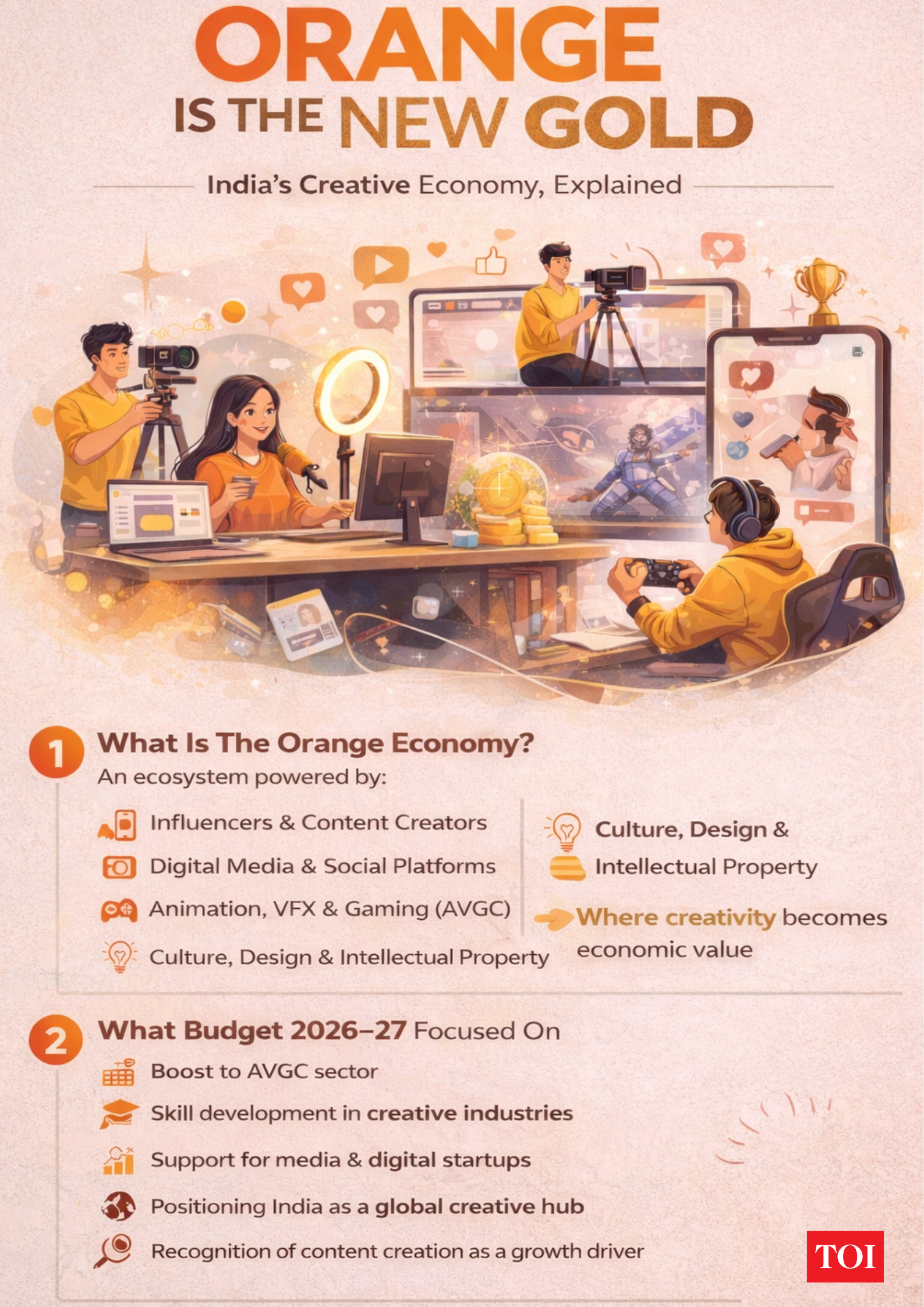
For decades, art, storytelling and digital creation lived in the margins of economic planning — celebrated culturally, rarely counted financially.That is beginning to change.The “Orange Economy” — a term popularised by the Inter-American Development Bank refers to industries that transform ideas into cultural goods and services protected by intellectual property. It includes media, film, music, publishing, animation, gaming, advertising, design, fashion, digital content and now, increasingly, independent creators.In India’s Union Budget 2026–27, finance minister Nirmala Sitharaman announced a major push for India’s creative industries — or what is increasingly being called the “Orange Economy.”
.
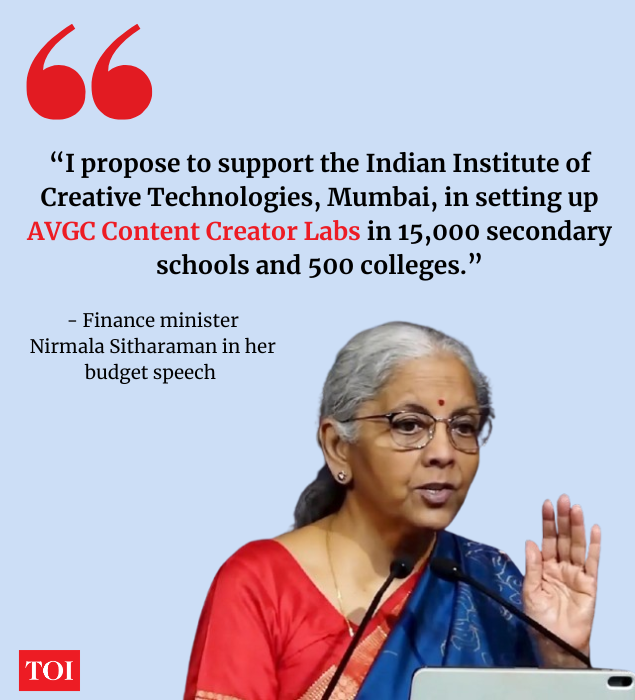
Presenting the Budget, Sitharaman emphasised that India’s creative and AVGC-XR (Animation, Visual Effects, Gaming, Comics and Extended Reality) ecosystem has the potential to generate large-scale employment and position India as a global content hub.She announced:
- Rs 400 crore allocation for the Indian Institute of Creative Technologies (IICT) in Mumbai
- 15,000 AVGC labs to be set up in schools
- Integration of creative and digital skills in 500 colleges across India
- Policy support aimed at building a workforce pipeline for the AVGC-XR sector
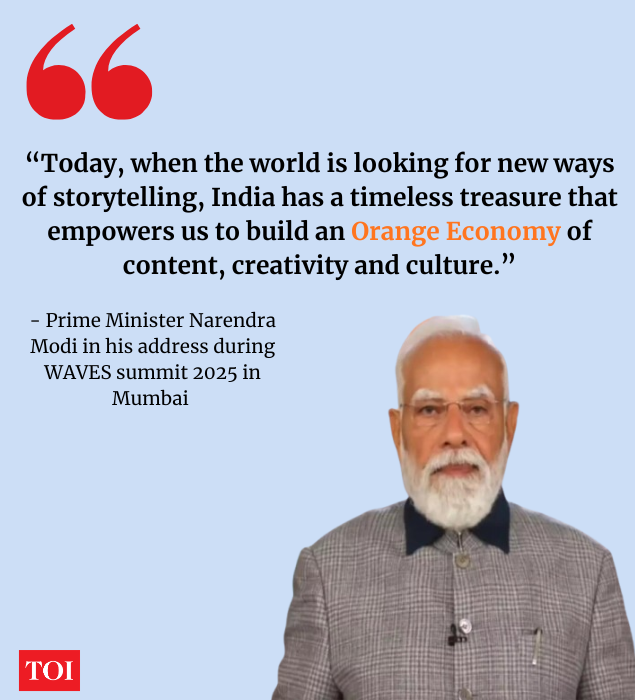
The Economic Survey projected that the AVGC sector alone could require up to 2 million skilled professionals by 2030.Sitharaman highlighted that India’s demographic dividend must be aligned with emerging sectors, particularly those driven by digital platforms and intellectual property.At the WAVES summit earlier this year, Prime Minister Narendra Modi reinforced this direction, describing India as a nation with “a billion-plus stories” and positioning the creative economy as both cultural capital and economic opportunity.
.
India’s creator economy is projected to grow at an 18% compound annual growth rate, rising from Rs 19 billion in 2023 to Rs 34 billion by 2026, according to Ernst & Young.
Influencer economy & marketing: From digital voices to structured media power
Influencer marketing is defined as “a collaboration between popular social-media users and brands to promote brands’ products or services.” What began as informal brand shoutouts has now evolved into a regulated, data-driven industry. The scale today is substantial. Globally, the influencer marketing economy was valued at $21.1 billion in 2023, having more than doubled since 2019 on the strength of platforms such as Instagram and YouTube. According to ET, the global influencer marketing platform market grew from $6 billion in 2020 to a projected $24.1 billion by 2025, at a CAGR of 32%.
.
Forbes highlighted that the broader creator economy is now a $250 billion global force, projected by Goldman Sachs to reach $480 billion by 2027. Statista reports that over 200 million creators operate globally, while social commerce is expected to touch $2.9 trillion by 2026.India’s influencer marketing sector is projected to reach Rs 3,375 crore by 2026, growing at a CAGR of 18%, according to EY’s ‘State of Influencer Marketing in India’ report. Exchange4Media estimates the core influencer market at around Rs 3,600 crore in 2024, projected to reach Rs 4,500 crore in 2025, though insiders suggest the real size may exceed Rs 10,000 crore due to direct brand-creator deals outside conventional tracking.Creator fees rose between 10–30%, while top-tier creators in India reportedly earned between Rs 10–25 crore annually through endorsements, platform monetisation, live events and equity partnerships.Types of InfluencersInfluencers are categorised by follower size:
- Nano influencers: Fewer than 10,000 followers
- Micro influencers: 10,000–50,000 followers
- Medium influencers: 50,000–100,000 followers
- Macro influencers: More than 500,000 followers
- Mega influencers: Over one million followers
EY observes that marketers leverage both large/macro and micro/nano influencers equally. While mega and macro influencers drive awareness and brand loyalty, micro and nano influencers often deliver stronger engagement and relatability.Regional creators are becoming central to brand strategies. According to Influencer.in (Social Beat), regional creators drive 35–40% better engagement in Tier-2 and Tier-3 cities. Budget allocation for regional creators has increased from 3–10% earlier to 8–20%, with expectations of further growth.
Gen Z: The creator generation
The ecosystem is increasingly youth-driven. A 2024 YouTube India–SmithGeiger report found that 83% of Indian Gen Zers consider themselves creators, and 75% see content creation as a genuine career path. More than 55% reported gaining financial independence through digital platforms.As ET highlights, influencer marketing is seen as cost-effective and personalised. Influencers build relatability and directly shape purchase decisions. In fact, 61% of consumers trust recommendations from creators more than traditional brand advertising, according to Sprout Social cited by Forbes.Influencer partnerships typically follow two models:
- Flat-fee brand deals per post (ranging from Rs 2,000 to Rs 30 lakh per post in India, depending on scale).
- Affiliate commissions, where influencers earn from sales generated via links or promo codes.
Increasingly, creators are moving beyond endorsements to ownership — launching brands, seeking equity partnerships and building independent revenue streams. Exchange4Media notes a visible shift from “endorser to owner.”From hyper-local memers to pan-India gaming stars, from nano creators in Tier-3 cities to mega influencers earning crores annually, India’s influencer economy is no longer peripheral to marketing. It has become a structured, high-growth pillar of brand strategy — reshaping commerce, culture and consumer trust in the digital age.For creators like Darshit, having a mass following of 51.7K followers, the viral Old Delhi reel was only the beginning. What followed was a clearer understanding of how the influencer economy actually works. “I started making content post-COVID but it was mostly just pictures and a few videos with music. No voiceover,” he says. It was only after that breakout moment in 2024 that he began studying the platform more closely — especially the algorithm.“Instagram is fundamentally different… it thrives on recommendations,” he explains. Unlike platforms that depend heavily on follower count, Instagram pushes reels to users who may never have heard of the creator but are likely to engage. “Someone who has never made a video in their life can come to this platform and make one and get millions of views.”Uploading identical content across YouTube Shorts, Facebook and Threads, Singh says Instagram consistently delivers his highest reach. For him, discovery is not accidental — it is engineered.But growth alone was never the goal. His identity as a “food deinfluencer” is built on resisting what he sees as blind positivity in brand culture.“Our society today has a trust crisis. Be it government, institutions, or media. Everyone is facing that. So for me, my audience’s trust is paramount,” he says. Even in paid collaborations, he critiques dishes he does not like. “I wanna be the reason behind someone’s memorable meal.” His approach reflects a broader shift in marketing strategy. “Earlier brands used to only work with celebrities and movie stars but now they prefer influencers in most cases as the latter gives them higher ROI,” he observes. “Celebrities promoting a product feels like an ad. But some influencers subtly promote the brand in their organic way… audiences are more likely to purchase that product later.”A few kilometres away from Old Delhi’s food lanes, Santosh is planning his next trip — between client calls.Santosh began his creator journey not in airports or mountains but inside hostel rooms. What started as campus vlogs on YouTube, hostel stories, placement anxiety, the reality of being an IIT student slowly built a community of aspirants and peers.Then came Instagram.Reels allowed him to compress entire journeys into seconds — a new state every month, documented between office deadlines. The platform’s real-time engagement — stories, reels, DMs helped him move beyond informational content into something more personal. “You can be discovered without being famous,” he says, pointing to how a few of his travel and IIT reels travelled far beyond his existing follower base.More importantly, he has watched the industry change.“When I started, content creation felt experimental,” Santosh says. “Now brands plan structured budgets. Long-term collaborations. There’s more professionalism.” In his words, the creative economy is no longer informal hustle. It’s recognised work.
Instagram’s revenue model: The business behind the scroll
If the orange economy is the ecosystem and creators are its lifeblood, then Instagram is the marketplace — the digital high street where attention turns into advertising, and creativity converts into commerce.To understand how influencer marketing thrives, it’s important to understand how Instagram itself makes money.Founded in 2010 by Kevin Systrom and Mike Krieger as a simple photo-sharing app, Instagram was built on one idea: visuals connect people. What started as a minimalist platform for filtered photos has evolved into a billion-user ecosystem of Stories, Reels, shopping tabs and creator tools.After Meta (then Facebook) acquired Instagram in 2012 for $1 billion, the platform scaled rapidly. Today, Instagram is estimated to be worth around $400 billion, making it one of the most valuable digital assets globally.The engine driving all of this? Advertising.Instagram’s primary revenue model is advertising. What makes Instagram powerful for marketers is its algorithmic precision. Content appears based on user behavior, engagement patterns and interests.The platform’s shift toward short-form video has supercharged engagement. According to a Meta-commissioned IPSOS study:
- 97% of Indian consumers watch short-form videos daily
- 95% daily usage for Reels, compared to 83% for television
Meta India’s Managing Director Arun Srinivas said: “India is leading the world in video adoption, and Reels is at the center of this shift. Five years since its launch, Reels is India’s leading short-form video platform—driving massive engagement, shaping culture, and delivering real business impact.”Instagram’s model is symbiotic with the influencer economy.
- Shoppable tags allow influencers to link products directly.
- Affiliate links enable commission-based earnings.
- Sponsored posts generate flat-fee income.
- Bonuses and milestone incentives reward engagement growth.
While food reels dominate one corner of the ecosystem, knowledge-driven creators are building influence in quieter but equally powerful ways.For Bikramjeet Dutta, having a massive following of 51.9K followers, Instagram’s inflexion point came during the 2024 Lok Sabha elections. “I was attending several political rallies, press conferences etc. I started uploading that it started gaining views and followers,” he says. His content extends beyond political coverage into books, geopolitics and history. “Instagram helped me to connect with those who are experts in these fields,” he says, adding that credibility assessment feels more immediate on the platform. “In Instagram it’s quite easy to verify whether the person is credible or not.” Discovery, he believes, has fundamentally shifted the opportunity landscape. Posting book reviews led to requests from publishers. Geopolitical commentary brought invitations to panel discussions and book launches. “Yes, Instagram has made it easier for creators to be discovered,” he says.
Instagram and small businesses: Visibility, trust and the new storefront
For many small businesses in India, Instagram is no longer just a marketing add-on. It functions as a storefront, catalogue, customer service desk and storytelling space — often all at once.The shift became especially visible during the pandemic. In 2020, Instagram introduced the ‘Support Small Business’ sticker, which grouped Stories using the sticker into a shared feed so “more people can discover more small businesses.” Around the same time, it rolled out features that made it easier to discover gift cards, online food orders and fundraisers, allowing users to tap directly and purchase through partner websites. For Nidhi who runs a handmade chocolate business, Instagram became more than a display window.“Instagram didn’t just become a platform… it became the space where my creativity found its voice,” she says. She explains that unlike other platforms, Instagram allowed her “to connect, not just sell — to share stories, build trust, and grow a community that appreciates handmade details and thoughtful gifting.”Instead of simply listing prices, she moved toward behind-the-scenes reels — melting chocolate, assembling hampers, last-minute packing. The shift from static posts to process-driven video felt “more genuine for the audience.”Another small business owner Harsh in the fabric trade echoes a similar sentiment.“Instagram has played a major role in building our fabric brand identity. Through reels, product videos, and live customer interactions, we showcase our manufacturing quality, fabric textures, and latest collections in a very visual way.”Increased competition, he highlights, has pushed businesses “to become more creative by high-quality reels and by making it more realistic.”In the architecture of the orange economy, small businesses are not just beneficiaries of digital platforms. They are active participants: adapting content, tone and strategy in response to algorithmic culture and rising competition.