


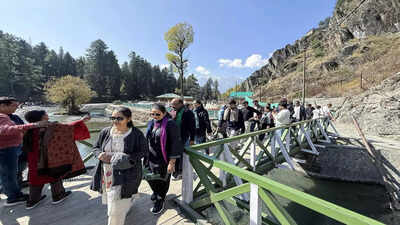
PAHALGAM: A motorable road from Pahalgam town passes through the mountains to a place known locally as CM’s Hut. From there, it’s about a 6-kilometer hike to the Baisaran Valley, site of last year’s massacre, when a terror attack killed 26 tourists and injured 17 others.At the junction near CM’s Hut, the journey stops. Anyone trying to walk further along the dirt path would be stopped. Police and Central Reserve Police Force personnel soon appeared and gently reminded visitors that the valley was off-limits. Ponywallahs (local horse guides) don’t go beyond this. Instead, they stop and let tourists take photos of the Pahalgam bowl from this vantage point before returning to Pahalgam town.There is no concertina wire and no visible barricades. Police said they wanted to avoid alerting tourists. But this closure is felt in a quieter way.At Pahalgam market, pony owners are trying to motivate tourists to at least visit the junction viewing platform. Abdul Waheed Wani, 39, known locally as “Moulvi Sahab”, is the leader of the pony union. Standing on the banks of the Lid River that bisects Pahalgam, he said Basilan’s closure has changed the town’s rhythm. “People come here to visit Baisaran and the four valleys around it. When the valley is closed, they stay in Pahalgam town for a few hours and then leave,” he said.He said about 5,500 ponies depended on tourism for their livelihood. Work was halted for nearly seven months after the attack last year. “There’s not much to do. Tourists are starting to return now, but it’s not the same as before.”Tourists still ask if they can go to Baisaran, he said. “It feels awkward to tell them it’s closed,” he said. A year on, he said, the changes are obvious. “Pahalgam was different after April 22. Earlier, we could move freely and go anywhere. Now there are red lines and responsibilities. Even if your horse crosses the red line, you have to bear the responsibility.”A sign outside Pahalgam’s main taxi rank reads: “Hard roads often lead to beautiful destinations.” The taxi rank is crowded with taxis, drivers standing in groups chatting, but only a handful of tourists around.In the office, Ghulam Nabi Lone, who has led the company for decades, likes to talk about his life and Pahalgam. Wearing a phelan and a long Kashmiri cloak, he sipped tea and told how he began his career four decades ago, driving an army jeep and then an ambassadorial car. He now owns three cars and has been a taxi rank manager for nearly 40 years.But he said he had never seen anything like this in Pahalgam. For seven months after the attack, everything stopped. “Sadakun par ghaas ug aayee thi (The road is overgrown with grass),” he described, as there was no movement at all. “Everything was closed. Only Chandanwari was open for a while. It is also closed now,” he said.Long said he had raised the issue with officials, including at a recent meeting of senior Army, civilian and police officials. “We told them these places, especially Baisaran, need to be opened. Without them, tourists will not stay in Pahalgam,” he warned. “If Baisaran opens, tourists will come,” he repeated many times.Lone wants to talk about a safety point. Baisaran had never been shut down before, he said. “I signed a ticketing contract there. Many people told me that I should tell the media that it would remain closed, but I refused. I told them that it had never been closed before the attack. I even said this in security meetings,” he said, dispelling rumors that the elected government of J&K had opened Baisaran months before the attack.An official from Pahalgam police station said there is no clear timetable for reopening of Baisaran. They said Chandanwari was closed due to road construction. Some roads lead to nowhere.


