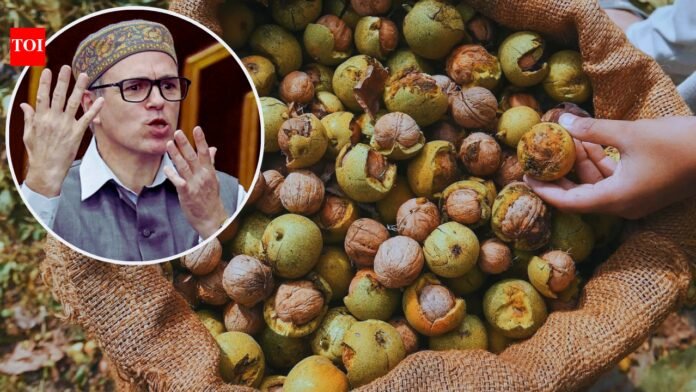
J&K CM Omar Abdullah strongly opposes amendments to Jammu and Kashmir Specified Tree Protection Act, 1969
Srinagar: Jammu and Kashmir CM Omar AbdullahOn Monday, he strongly opposed a bill introduced by his own party MLAs that would give landowners the right to cut down walnut trees on their properties.Omar said the passage of the bill would harm the country’s largest walnut economy, of which Kashmir accounts for about 90%, and would deprive J&K of a key part of its identity.The bill, introduced by National Conference legislator Altaf Ahmad Wani from Pahalgam, seeks to amend the Jammu and Kashmir Specified Trees Protection Act, 1969, to allow felling of walnut trees on private land.According to the 1969 law, no one is allowed to cut down walnut trees without prior permission from the competent authority, whether on private or state land, and any violation of the law is punishable by a fine of Rs 1,000 to Rs 10,000.Varney defended his bill, saying the law created a huge problem for landowners because walnut trees took up a lot of space, about three trees per canal (0.05 hectares), and they did not generate a reasonable income for landowners.Walnuts were once a major source of income in Kashmir, but most of the trees have aged and stopped bearing fruit, he said. Varney said the harvesting work is largely done by the owners themselves, and over the years many people have been injured or killed by falling from trees during harvesting. He advocates replacing aging trees with high-density plantations.“This is a strange law that does not allow me to cut down a tree on my land. One has to knock on many doors to get permission and this has become a source of corruption,” Wani said.Omar, however, defended the restrictions, saying the law had a broader purpose of protecting walnut and chinar trees. He said Johnson & Johnson produces about 350,000 tons of walnuts every year, accounting for about 90% of the country’s total production.The CM said walnut was an integral part of handicrafts, especially wood carving, and expressed concern that allowing felling of walnut trees could lead to their replacement by concrete construction. “I am sure that once the walnut trees are cut down, the owners will build houses or other structures there,” Omar said, adding that the government can only consider making changes if the felled trees are replaced with walnut planting on the same land.Although the walnut industry faces competition from soft-shelled varieties from California, Chile and other regions, Kashmir walnuts are valued for their superior taste. Major export destinations for Kashmiri walnuts include the United Arab Emirates, Turkey, Iraq, Singapore, Algeria, Qatar, Bhutan, Kuwait, Seychelles and Nigeria.