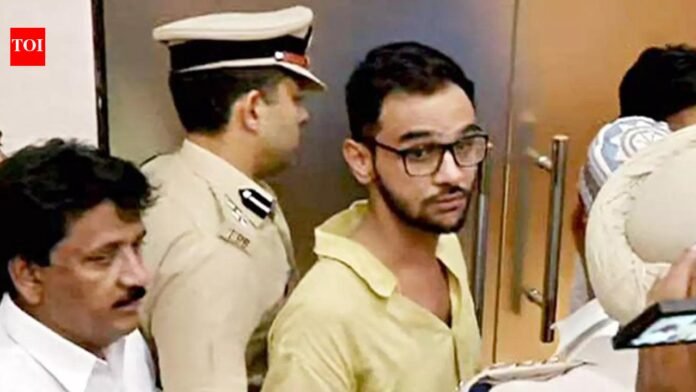
New Delhi: Student activist Omar Khalid has moved the Supreme Court seeking review of the judgment denying him bail while observing that there were reasonable grounds to believe that the charges against him were related to the conspiracy behind the 2020 Delhi riots.Senior advocate Kapil Sibal, appearing for Khalid, asked a bench of Justices Aravind Kumar and NV Anjaria to list the review petition in open court.Sibal said the matter will come before a judge in court on April 16 and they have submitted an application for a public court hearing.
“We will look into the files. We will make calls if required,” Justice Kumar said. As per the rules of the Supreme Court, review petitions are considered by judges, who pass judgment or pass orders before the court to correct a manifest error caused by a Supreme Court judgment or a gross injustice resulting therefrom. A party seeking review may ask a judge to hold a public hearing to correct a serious injustice caused by the review decision.On January 5, the Supreme Court denied bail to Sharjeel Imam, except Khalid, but allowed bail to five others, saying all the accused had different positions.Khalid and Imam, who have been jailed since 2020, can file fresh bail pleas after examining protected witnesses or one year from the date the order was passed, the court said as it rejected their arguments for delaying the trial.The Supreme Court said there was a prima facie case against Khalid and Imam under the Unlawful Activities (Prevention) Act (UAPA), noting that prosecution materials showed that they were involved in the “planning, mobilization and strategic guidance” of the riots.While the two will remain behind bars, activists Gulfisha Fatima, Meeran Haider, Shifa Ur Rehman, Mohammad Saleem Khan and Shadab Ahmad were granted bail by the court, which imposed 11 conditions and said any abuse of freedom would result in the bail being cancelled.The court noted that the guarantee of freedoms provided for in Article 21 of the Constitution was of fundamental importance, but at the same time, community safety, the fairness of judicial proceedings and the maintenance of public order were also legitimate constitutional concerns.The court said the positions of Khalid and Imam were qualitatively different compared to the other defendants.The judges said prosecutors had made preliminary disclosures about a “central and formative role” and “a degree of involvement in planning, mobilization and strategic direction that went beyond episodic and localized conduct”.In February 2020, riots broke out in northeast Delhi over protests against the Citizenship (Amendment) Act (CAA) and the National Register of Citizens (NRC), leaving 53 people dead and more than 700 injured.Delhi Police arrested a total of 18 people in this conspiracy case. Currently, 11 of them have been released on bail.The Supreme Court’s January order said delaying the trial does not serve as a “trump card” to automatically supersede statutory safeguards.“All appellants are not on an equal footing in terms of culpability. The levels of involvement that emerged from the prosecution’s case require the court to examine each application individually,” it said, adding that their roles were different.“This Court is satisfied that the prosecution material discloses the prima facie charges against the appellants Omar Khalid and Shahjeel Imam… The extension of bail is not justified at this stage of the proceedings,” the Supreme Court said.It cited Section 43D(5) of the UAPA, which provides that bail shall be refused if the court, on examination of the case diary or charge sheet, finds that there are reasonable grounds for believing that the charges against such person are prima facie true.Imam was arrested on January 28, 2020 for speaking at anti-CAA protests. He was later arrested in August 2020 in a larger conspiracy case.Khalid was arrested on September 13, 2020, for making provocative speeches during the first-term US President Donald Trump’s visit to India on February 24 and 25.The Delhi Police strongly opposed the bail plea and claimed that the riots were not spontaneous but a well-planned, pre-planned and well-crafted attack on India’s sovereignty.All seven accused have been booked under the strict anti-terrorism provisions of the UAPA and the Indian Penal Code as alleged “masterminds” of the riots.