
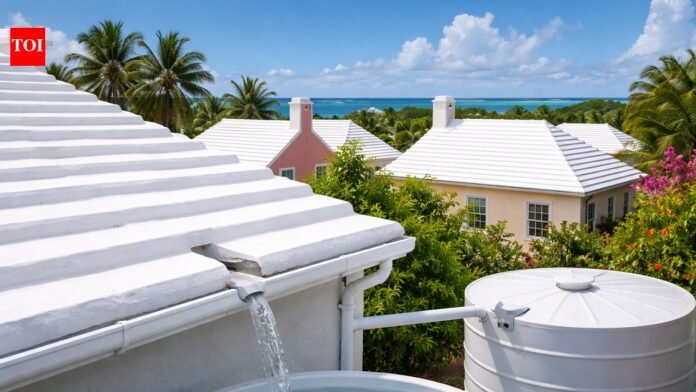
Bermuda is an island in the middle of the North Atlantic Ocean with no rivers, lakes, or natural springs of fresh water. For more than 400 years, islanders have relied on a brilliant and simple idea: every roof is a collector of drinking water. The island’s famous white stepped roofs are more than just picturesque postcard images; they are a rainwater harvesting system that has quietly and successfully served the islanders through storms, droughts and centuries of vicissitudes. Modern research from the Journal of the American Water Resources Association (JAWRA) still points to Bermuda as a living example of traditional design. The system is resilient and sustainable
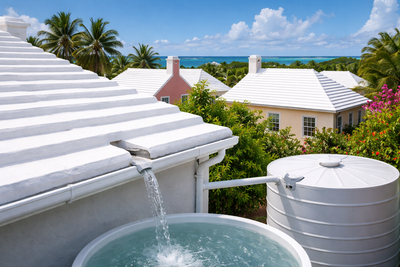
Rainwater harvesting roof in Bermuda
Geologically speaking, Bermuda is a porous limestone platform in the ocean. Therefore, available groundwater is very limited. In fact, the so-called lakes and wells are salty. The first settlers quickly realized that they could not rely on rivers and wells for water. They decided to take advantage of the rain. Their solution for collecting rainwater is a Bermuda roof. It is a stepped limestone roof painted white. It slows down rainwater and directs it to gutters and storage tanks. According to a 2011 JAWRA study, rooftop rainwater harvesting is “legally mandatory” for all residential buildings. It is the main source of water for many households. In fact, according to a government-endorsed article published in 2017, “vernacular architecture and rainwater harvesting solutions are now seen as cornerstones of the island’s overall water management infrastructure.
How a 400-year-old system still works
As Bermuda Geology puts it, “Virtually every home in Bermuda is a small water treatment plant. Rain falls on stepped roofs, which are designed to move water droplets slowly so they can be collected cleanly. The water is then directed into underground tanks that are large enough to store water for several months. “In the past, roofs were covered with limewater, which had antibacterial properties and kept the water clean. Today we keep the white paint for other reasons. It reflects UV rays, further purifying the water and inhibiting algae growth. “A project overview shows that the average Bermudian household could collect hundreds of thousands of liters of water per year from rooftop water collection systems. This is an astonishing feat even by modern standards.“
Lessons for a world facing water scarcity
The story of Bermuda is not one of clever roof design, but one of planning for harsh realities. A 2011 academic paper on rainwater harvesting in Bermuda reads: “Such rainwater harvesting systems provide opportunities to maintain water systems based primarily on traditional self-sufficiency and sustainability.” This is obviously different from huge energy-intensive systems that must be maintained to deliver water over long distances. The island model is considered a case study for other areas threatened by drought and saltwater intrusion due to climate change. In a conversation with Water Advocacy, Bermuda archaeologist and water historian Dr. Edward Harris discussed the ribbed roof rainwater harvesting model and said it “provides logical insight into Bermuda’s system of collecting drinking water for over 400 years.”
Modern Bermuda and the future of white roofs
Although the island still cherishes its roof, it has supplemented it with new technology. New desalination plants have been installed to provide the additional water needed, particularly due to the rise in tourism and the demand for water from industrial processes. However, rooftop tank systems remain the primary source of water supply. A 2017 feature article published by the government-funded School of Engineering and Technology showed that more than half of residential units do not have wells or are not connected to mains water supplies and rely almost entirely on collected rainwater.Today, the white roof has become a symbol of independence and identity for the people of Bermuda. As a recent article puts it, “The island sees this as a failure, with rooftops tied to a tradition of independence.” The answer for water-starved cities around the world is simple: Just like the islanders of 400 years ago, when you have no rivers or lakes, the sky is your river and your home is your center of water security.