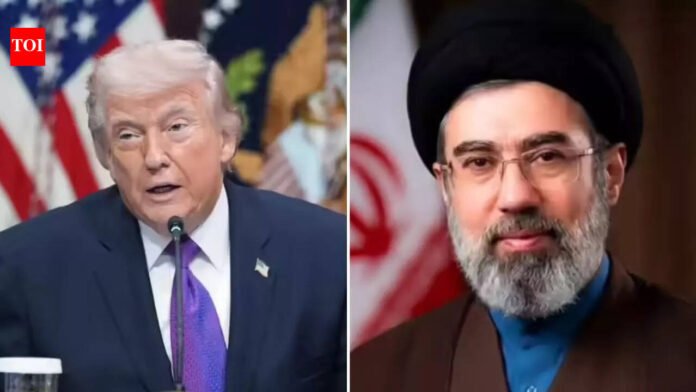
Conflicting accounts emerged between the United States and Iran after President Donald Trump announced a temporary halt to planned attacks on the region’s energy infrastructure, claiming he had had “very good” and “productive” talks with Tehran. However, the Iranian authorities deny any direct negotiations and accuse Washington of using diplomacy as a cover to “buy time” for military action.Speaking to reporters before boarding Air Force One, Trump reiterated that the United States and Iran were making significant progress toward a deal. “We have major agreement; I would say almost all agreement,” he added. “They very much want to make a deal; we want to make a deal.”
He also revealed that U.S. officials were in contact with “a high-level person” in Iran, though not the supreme leader, saying, “I can’t name that person… because I don’t want him to be killed.” Trump suggested a potential breakthrough could involve Iran giving up its nuclear weapons ambitions in exchange for peace and said further talks were expected soon. “We will get together today, probably by phone,” he added.
Strike threat suspended for five days
After Trump made the above remarks that day, he announced that the United States planned to suspend attacks on Iran’s energy infrastructure (including power plants) within five days.In a post shared on Truth Social, Trump said Washington and Tehran had had “productive conversations” over the past two days aimed at a “complete and complete resolution” of hostilities in the Middle East.
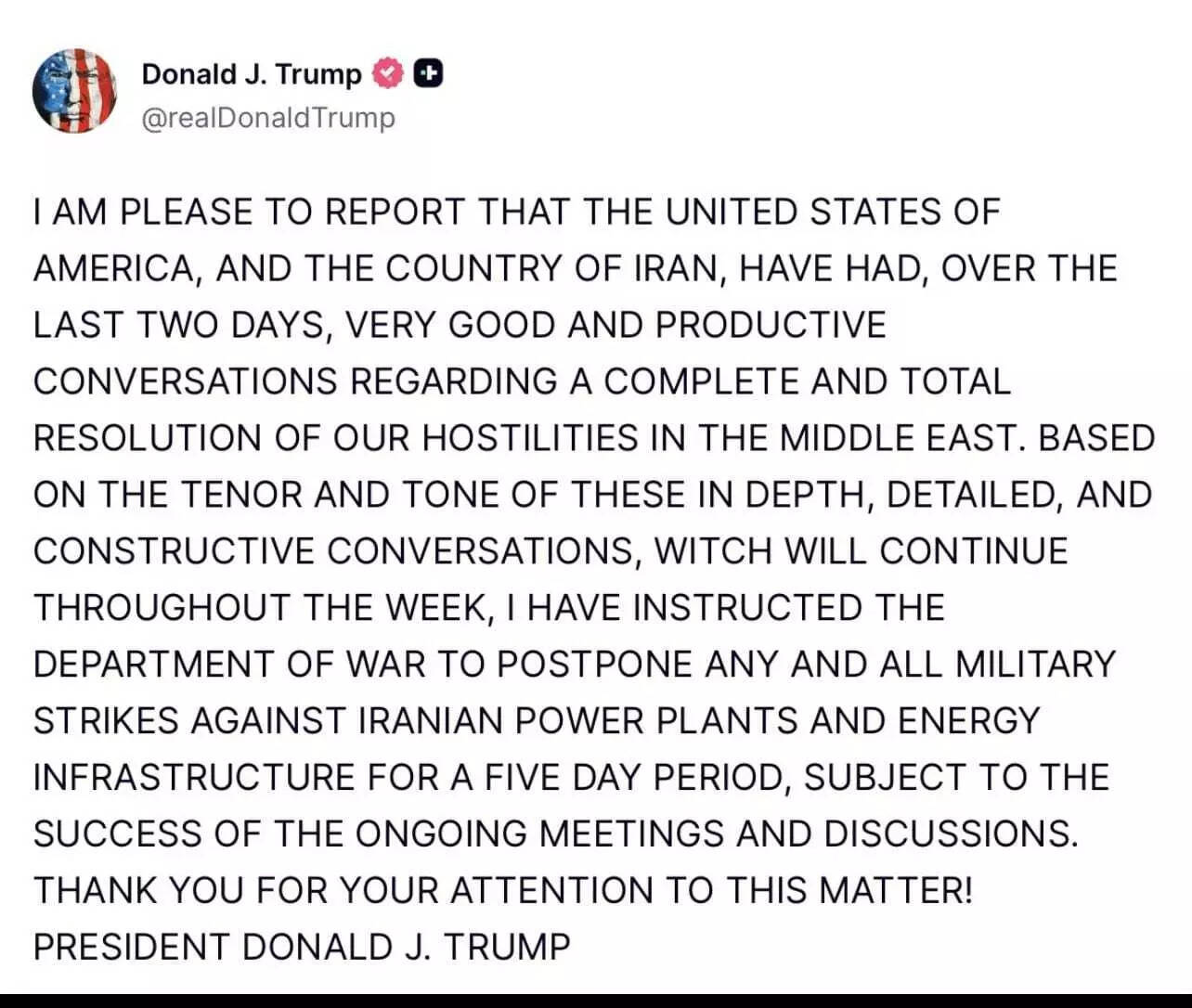
Citing the talks, Trump said he had directed the Pentagon to “defer for five days any and all military strikes on Iran’s power plants and energy infrastructure, subject to the success of ongoing meetings.”He added that previously undisclosed U.S.-Iran discussions would “continue throughout the week.” The announcement came ahead of an ultimatum issued to Iran on Monday night to reopen shipping routes through the Strait of Hormuz or face threats.Earlier on Saturday, Trump threatened to “destroy” Iran’s power infrastructure if Tehran failed to reopen the strategically important Strait of Hormuz. Nearly one-fifth of the world’s oil supply passes through the strait.
Iran denies talks, calls ‘psychological warfare’
However, Iran flatly rejected Trump’s claims.Iranian state media quoted the foreign ministry as saying the U.S. move to delay the attack was “part of efforts to lower energy prices and buy time to implement its military plans.” The ministry dismissed the idea of negotiations, saying “no negotiations have taken place and no negotiations are ongoing”. The statement added that while “initiatives by regional countries to ease tensions” were proposed, Tehran’s response remained consistent: “We are not the party that started this war and all such requests must be submitted to Washington.” Iranian media characterized the U.S. position as a retreat under pressure. “Since the start of the war, some mediators have sent messages to Tehran, but Iran’s clear response is that it will continue to defend until the required level of deterrence is achieved,” Tasnim News Agency reported. “Through this kind of psychological warfare, neither the Strait of Hormuz will return to its pre-war status quo nor energy markets will return to calm,” the report added.
Strikes continue despite diplomatic signals
Even as diplomatic signals emerged, military operations on the ground continued.Shortly after Trump announced a moratorium on attacks, the Israeli military said it was conducting another wave of strikes against targets in Tehran.Associated Press reporters reported that explosions were heard in multiple locations in the Iranian capital on Monday afternoon, but it was not yet clear where the attack was. Later in the day, more explosions were reported in the city, but details of the targets were not confirmed.Meanwhile, Iran launched two missiles and 36 drones towards Bahrain in the past 24 hours, according to the Iranian Ministry of Defense.Tehran has stepped up retaliation for U.S.-Israeli attacks, disrupting traffic in the Strait of Hormuz, which carries about a fifth of the world’s crude oil, while also targeting energy facilities, U.S. embassies in the Gulf and sites in Israel.
Oil market swings wildly
This uncertainty has triggered wild swings in global oil markets. Oil prices had soared above $100 a barrel amid concerns about supply disruptions in the Strait of Hormuz, but fell sharply after Trump’s announcement.Brent crude oil prices fell more than 15%, briefly falling below $100 before stabilizing. The volatility reflects the strait’s centrality in global energy flows, and its disruptions have raised concerns about longer-term supply shocks.
“No country is immune to its impact”
Energy experts warn that a prolonged disruption could trigger a crisis worse than past oil crises, given the scale of supplies at risk.The International Energy Agency (IEA) earlier warned that the ongoing conflict had triggered a global energy crisis.“The current crisis is two oil crises and one gas crisis combined,” International Energy Agency chief Fatih Birol said in a speech at Australia’s National Press Club.He warned that the global economy faces serious risks, adding, “Today the global economy faces a very, very big threat, and I very much hope that this problem can be resolved as soon as possible.”Birol further warned that “if developments continue in this direction, no country will be immune to the consequences of this crisis” and stressed the need for coordinated global action.The standoff has put the Strait of Hormuz at the center of the conflict, with military escalations and diplomatic maneuvers centered around the key waterway.The conflict, which began with a U.S. and Israeli attack on Iran on February 28, has killed more than 2,000 people, roiled global markets, pushed up fuel prices, heightened inflation concerns and strained the Western alliance, Reuters reported.There are also concerns about a possible attack on the Gulf power grid, which could disrupt desalination systems critical to drinking water supplies and further disrupt energy markets.