
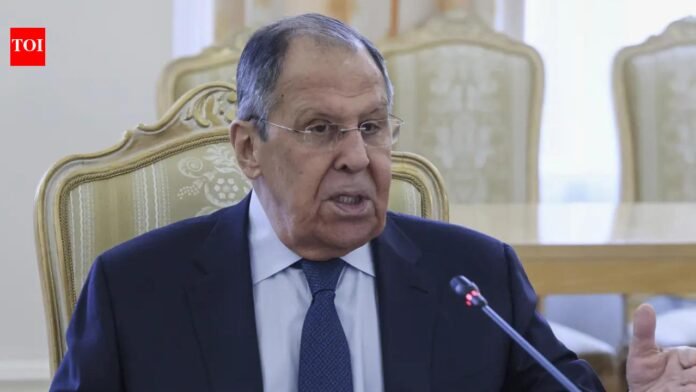
Russian Foreign Minister Sergey Lavrov said on Wednesday that Moscow will continue to abide by the limits set out in the New START treaty even after the treaty expires, as long as the United States abides by the same restrictions.New START officially expires on February 5, leaving the world’s two largest nuclear powers with no binding restrictions on their atomic arsenals for the first time in more than 50 years. The development has raised global concerns about the potential for an uncontrolled nuclear arms race.Last year, Russian President Vladimir Putin It said Moscow was prepared to continue to abide by the treaty’s restrictions for another year if the United States agreed to do so. However, US President Donald Trump has insisted that any future deal should include China, a proposal that Beijing has rejected.Speaking in the lower house of Russia’s parliament, Lavrov said Moscow would maintain its commitment to the treaty’s cap despite the absence of a formal extension.“As long as the United States does not exceed these limits, the suspension announced by the president will remain in place,” Lavrov told lawmakers. “We will act in a responsible and balanced manner based on an analysis of U.S. military policy.”He added, “We have reason to believe that the United States is in no rush to abandon these restrictions and will abide by them for the foreseeable future.”“We will pay close attention to how things actually progress,” Lavrov said. “If the intention of our American colleagues to maintain some cooperation on this is confirmed, we will actively work on a new agreement and consider issues beyond the strategic stability agreement.”Lavrov’s comments came after Axios reported that Russian and U.S. negotiators discussed a possible informal understanding during talks in Abu Dhabi last week to continue to abide by the treaty’s restrictions for at least six months.Commenting on the report, Kremlin spokesman Dmitry Peskov said any extension would have to be official. “It’s hard to imagine any informal expansion of this area,” he said.Meanwhile, Peskov confirmed that future nuclear weapons control was discussed at a meeting in Abu Dhabi, where Russian, Ukrainian and U.S. delegations held two days of talks focused on potential peaceful solutions to Ukraine.“Both sides talked about this in Abu Dhabi, and both sides will take a responsible stance, and both sides are aware of the need to start negotiations on this issue as soon as possible,” Peskov said.New START, signed in 2010 by then-U.S. President Barack Obama and Russian President Dmitry Medvedev, is the last in a series of agreements between the two countries aimed at limiting nuclear weapons since the 1972 START I treaty.Under New START, each country is limited to deploying no more than 1,550 nuclear warheads and no more than 700 missiles and bombers. The treaty was due to expire in 2021 but was extended for five years.The agreement also allows for on-site inspections to ensure compliance. However, inspections stopped in 2020 due to the COVID-19 pandemic and have never resumed. In February 2023, Putin announced the suspension of Russia’s accession to the treaty, citing tensions between Russia and the United States and NATO over the Ukraine conflict. Still, the Kremlin insists Russia will continue to respect the treaty’s quantitative limits.In September, Putin proposed extending the treaty’s compliance period for another year to give time to negotiate a replacement deal.Although the treaty has expired, the two countries agreed on February 5 to resume high-level military exchanges following discussions in Abu Dhabi. Direct contacts had been suspended in 2021 due to deterioration in relations before Russia launched military action against Ukraine in February 2022.


