
A new wargame conducted by former NATO, German and European officials concludes that Russia can exploit hesitancy within the alliance and a lack of clear leadership from the United States to “achieve most of its objectives” in the Baltic region within days. The exercise was jointly organized by Le Monde and Le Monde in December German Wargaming Center A program at Helmut Schmidt University that stages a fictional but detailed scenario set in October 2026. It envisioned Moscow using the narrative of a “humanitarian crisis” created by the Russian exclave of Kaliningrad to justify a rapid invasion of southern Lithuania, targeting the city of Marijampolje. Marijanpole is located at a key intersection of European infrastructure. The Baltic Highway used by the EU and Ukraine runs southwest into Poland, while an east-west road connects Belarus to Kaliningrad, and Lithuania is obliged under treaty obligations to remain open to Russian traffic. Taking control of the city would effectively cut off NATO’s land links with the Baltic states.
How the invasion unfolded
In the simulation, Russia initially deployed about 15,000 troops and viewed its advance as a limited humanitarian operation. The United States has refused to invoke NATO’s Article 5, the collective defense clause that requires members to provide aid to allies under attack. Although Germany already has a brigade deployed in Lithuania, it did not intervene after Russian forces used drones to plant mines near military bases. Poland mobilized its military but ultimately did not send troops across the border. The game shows that within days, Moscow had effectively taken control of the Baltic theater without escalating into a wider conventional war.
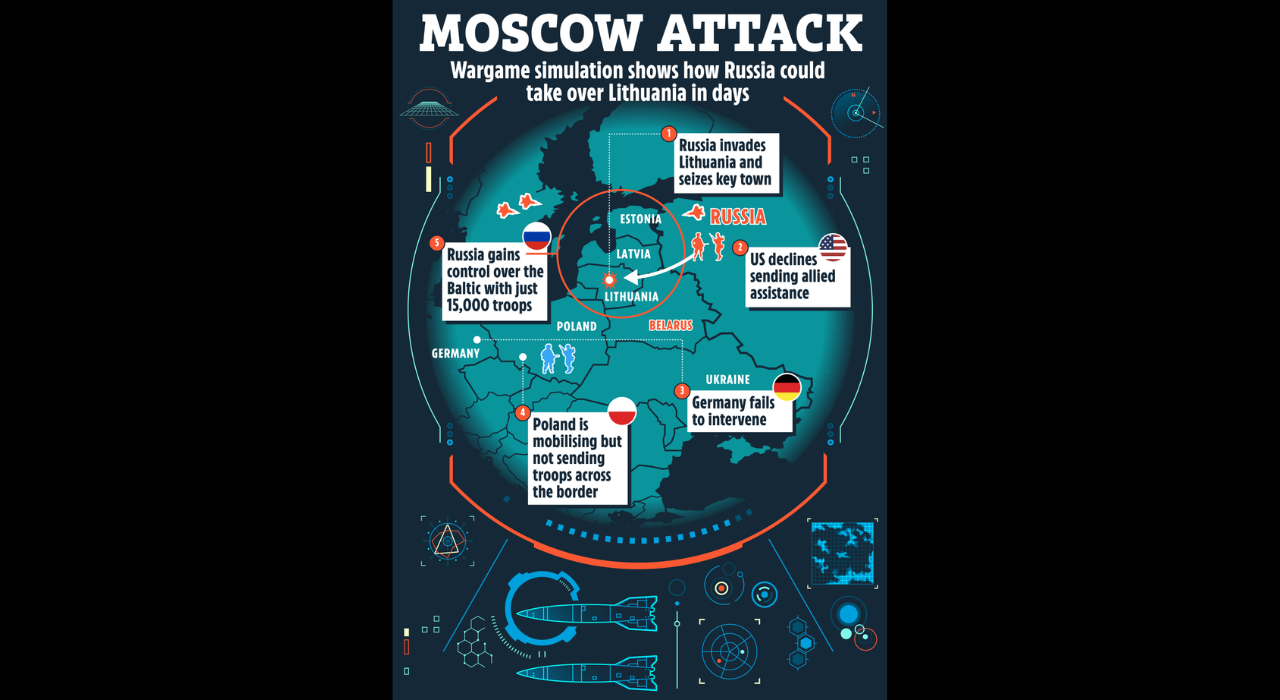
NATO wargames show Russia’s rapid conquest of the Baltic Sea, while the United States revokes Article 5 and Europe hesitates/Photo: US Sun
Bartłomiej Kot, a Polish security analyst who played the role of Poland’s prime minister in the exercise, told the Wall Street Journal: “The Russians achieved most of their objectives without mobilizing many of their own forces. That suggests to me that once we’re faced with the Russian narrative of escalation, we feel like we’re the ones who should be de-escalating the situation.”
Germany’s hesitation and Russia’s calculation
One of the core dynamics revealed by the wargame is the extent to which Russia’s success depends less on military strength than on political expectations. Franz-Stefan Gadi, a Vienna-based military analyst who serves as Russia’s chief of general staff, said Moscow had the advantage of anticipating Berlin’s caution. “Deterrence depends not only on capabilities, but also on the enemy’s perception of our will, and in the war games my ‘Russian colleagues’ and I knew: Germany would hesitate. And that would be enough to win,” he said.Conducted parallel public news wargames Le Monde Similar conclusions were reached, suggesting that Germany responded first with sanctions, Baltic maritime measures and internal civil protection preparations, while avoiding direct military confrontation. As the military facts are established on the ground, the burden of escalation shifts decisively to NATO, making reversal increasingly costly and risky. The exercise brought together former senior political decision-makers, retired military leaders and NATO officials, including former NATO chief spokesman Vana Lungescu and Germany’s former Bundeswehr Inspector General Eberhard Zorn. Participants worked independently and the scenarios were not scripted.
Wider European warning
The discovery comes amid growing concerns across Europe that Russia could pose a more serious threat to NATO sooner than previously thought. Last year, Russian drones and aircraft repeatedly invaded NATO airspace in what officials and analysts said was a test of the alliance’s response. Dutch Defense Minister Reuben Brekelmans told the media wall street journal His government assessed that “Russia will be able to mobilize significant forces within a year,” adding: “We see that they are already increasing their strategic stockpiles and are expanding their presence and assets along NATO’s borders.” Reflecting on the war game, Oana Lungescu warned that a freeze or unfavorable solution to Ukraine could make Moscow more dangerous, not less. “After some kind of peace in Ukraine, Russia could become more dangerous to NATO, especially if it’s a bad peace,” she said, calling the simulation “unfortunately very realistic.” While the scenario is fictional, its designers stress that its purpose is not prediction but exposure: to reveal how decision-making, hesitation and alliance politics may unfold under pressure, and how military realities can quickly overtake diplomatic intentions.