

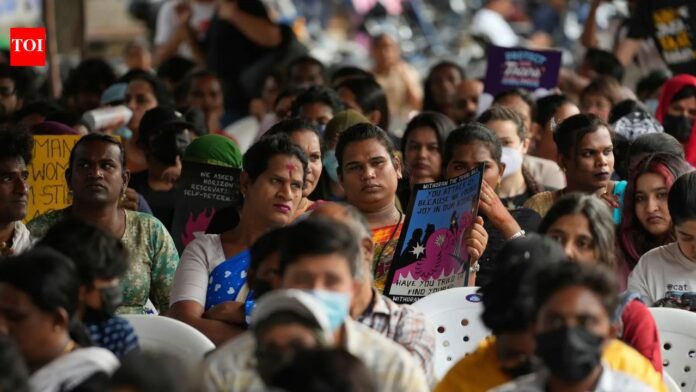
New Delhi: Amid intense community debate and growing protests against the proposed amendments to the Transgender Persons (Protection of Rights) Act, 2019, members of the National Transgender Community Council strongly reiterated at a meeting with senior officials of the Ministry of Social Justice and Empowerment on Saturday that “self-affirmation of transgender identity must remain the foundation of transgender identity, as upheld in the NALSA judgment”.On March 13, the “TG (Protection of Rights) Amendment Bill 2026” was proposed in the People’s House. Since then, there have been calls to withdraw the bill. On Sunday, the Press Club of India held a public discussion calling for the bill to be withdrawn, with a large number of community members gathering to speak.Meanwhile, a meeting convened on short notice by the ministry on Saturday was attended by community representatives Abhina Aher, Vidya Rajput, Raveena Bareeha and Kalaki Subramanyam, who are members of the National Transgender Commission, a legal statutory body. According to Ahe, community members on the committee were not consulted before the bill was tabled in parliament.Members highlighted the absence of Social Justice Minister Virendra Kumar, who they were told would chair the meeting. “We were informed that the minister was unable to attend due to ill health and a reported family emergency,” Aher said.According to Akh, at a meeting chaired by joint secretary Yogita Swaroop, the ministry’s senior economic adviser, government officials raised concerns about identifying “genuine” transgender people and mentioned biomarkers such as chromosomal combination (XX/XY). “NCTP members clarified the concepts of gender nonconformity/dysphoria, mental health aspects, and the impact of stigma, although they felt there were gaps in officials’ understanding of transgender issues,” she added.TG council members also stressed at the meeting that the proposed definition is not inclusive and must explicitly include trans men and trans women; use respectful terminology and recognize different regional identities such as Nupi Manabi and Nupi Mamba (Manipur).Regarding the proposed recommendations for screening by medical boards, NCTP members initially called for the provision to be scrapped. “However, given the government’s position, members recommended that any assessment should be limited to mental health support, should not involve an invasive medical examination, and should be dignified and consistent with the NALSA judgment,” Aher said. There are strong calls for gender-neutral laws to address violence against trans people.Meanwhile, at Sunday’s Jan Sunwai (public discussion) organized by the ‘Rachnatmak Congress’ – the party’s dedicated platform to engage with civil society groups – its chairman Sandeep Dixit strongly advocated for setting up the bill as a parliamentary standing committee. Congress Lok Sabha MP Renuka Chowdhary attended the meeting in solidarity.Rajya Sabha member RJD Manoj Jha warned that the BJP-led NDA government does not have a good track record in sending bills to standing committees, hence the need for street protests now. The CPI(M)’s John Brittas mentioned Prime Minister Narendra Modi’s appreciation for the 2019 Act and how it gives people the right to live with dignity and questioned why the sentiment suddenly changed.NCP national spokesperson Anish Gawande demanded the withdrawal of the bill, claiming “our identity is our right and it is enshrined in our constitution.”Members of the LGBTQI+ community participated extensively in the discussion. Samar, who is transgender, questions how the medical board decides how he feels and how he wants to live his life. How can his identity be questioned by the country, doctors and society?Trans-Dalit activist Grace Banu was also present. She spoke of the struggles they have faced since 2009 for recognition and the right to live a dignified life. In 2009, she joined others who experienced medical board scrutiny and police brutality. “In 2014, after a long battle, the NALSA Supreme Court finally said that you are not others, not aliens, but human beings, and gave the transgender community the right to self-identify and live a dignified life. Yet, so many years later, we are again in the same place, being asked to prove our gender identity and being told that they should not have the same rights as others,” Banu said. She ended her speech with a collective, “We don’t need your sympathetic welfare, we need basic rights!”
National council members tell government: ‘Self-perceived identity’ must remain basis for transgender identity

WEB DESK TEAMhttps://articles.thelocalreport.in
Our team of more than 15 experienced writers brings diverse perspectives, deep research, and on-the-ground insights to deliver accurate, timely, and engaging stories. From breaking news to in-depth analysis, they are committed to credibility, clarity, and responsible journalism across every category we cover.
Related articles
Recent articles
