
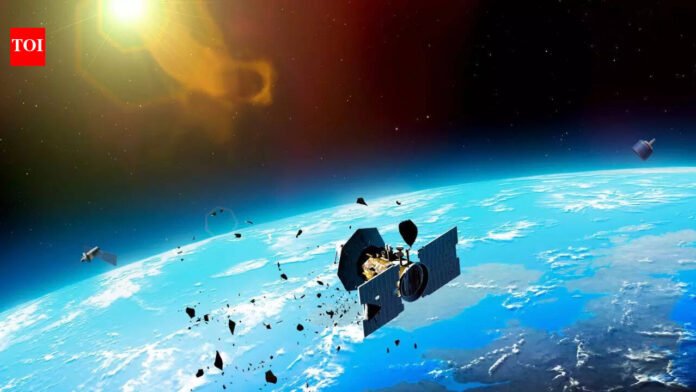

A NASA satellite is expected to crash back to Earth on Tuesday, March 10, after nearly 14 years in orbit. The spacecraft in question is Van Allen Probe A, which weighs about 1,323 pounds (600 kilograms). It was launched in August 2012 with its twin Van Allen Probes B to study the radiation belts around Earth. Both detectors were decommissioned in 2019, but Detector A’s time in orbit has now ended. Experts say most of the satellite will burn up upon re-entry, but some fragments may survive. The risk to people on site is low, about 1 in 4,200.According to the U.S. Space Force, re-entry is expected to take approximately 24 hours at 7:45 pm EST on March 10. Observers note that this is just an estimate and may be adjusted as tracking data improves. Any surviving debris is likely to fall into the ocean, since water covers nearly 70% of the Earth’s surface. It seems unlikely that any major city would see debris falling nearby.
NASA’s Van Allen probe satellite is expected to re-enter the Earth’s atmosphere on March 10
The Van Allen Probes were originally called the Radiation Belt Storm Probes. They orbit the Earth in highly elliptical orbits at distances from approximately 384 miles (618 kilometers) to 18,900 miles (30,415 kilometers). The mission was designed to last only two years, but both satellites exceeded expectations. Detector A continued to collect data until October 2019, and Detector B operated until July 2019. Experts say that solar activity in recent years has expanded the Earth’s atmosphere and increased the frictional resistance of satellites. This may cause Probe A to descend earlier than originally planned.During its operation, the Van Allen Probes collected data from the radiation belts surrounding Earth. Scientists use this information to understand how solar activity affects satellites, astronauts, and even ground-based systems such as communications networks, GPS, and power grids. By studying these areas, researchers have reportedly improved predictions of space weather events that sometimes disrupt electronic systems on Earth. The data can also help plan future missions and better predict the hazards of solar storms.
NASA details satellite re-entry and debris risks
NASA noted that most of the satellite will burn up as it passes through the atmosphere. Still, some components may survive. The debris could splash into the ocean, posing minimal risk to humans. Experts estimate the likelihood of injury to be about 0.02%. While it’s fun to track, there’s nothing to worry about, observers say. The Space Force will update the reentry forecast in real time, so a more precise time may be closer to the event.
What to expect with NASA’s second Van Allen probe satellite
Probe B is not expected to return to Earth until around 2030. Its decline appears to be less affected by recent solar activity than Probe A’s. Both satellites were deactivated but remained in orbit until re-entry. They continue to provide a reference for scientists studying space weather and its effects. Experts say tracking their descent helps improve understanding of orbital decay and atmospheric drag, which could be useful for other satellites still in use.