

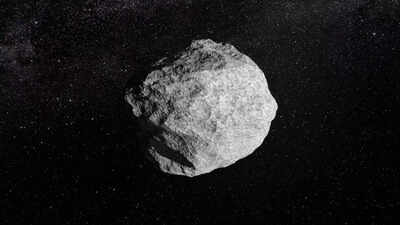
Asteroids frequently pass by Earth’s cosmic neighborhood, and most of them never come to public attention. Every now and then, however, a newly discovered space rock piques the curiosity of scientists and space enthusiasts alike. This is the case for asteroid 2024 YR4, an object first discovered in late 2024. Early calculations suggest it could come unusually close to the moon in 2032. For a short time, astronomers even considered the possibility of an impact. The odds were never particularly high, but the idea of a lunar collision was enough to generate headlines and speculation. Now the situation becomes clearer. Scientists say that the asteroid will not hit the moon after all, and the latest observations show that the possibility of an impact has dropped to zero.
NASA Ruling out the possibility of asteroid 2024 YR4 hitting the moon in 2032
The asteroid, called 2024 YR4, is estimated to be about 200 feet (about 60 meters) in diameter. Such a size would allow it to attract the attention of astronomers, but it is still far from the largest object to pass through the solar system. When it was first discovered through sky observations in 2024, its exact orbit was not fully understood. Early orbit models suggest the asteroid may pass extremely close to the moon in December 2032.Preliminary estimates suggest the probability of a collision is about 4.3%. For planetary scientists, this number is small, but still worthy of careful monitoring. As time passes, researchers continue to observe the asteroid in the hope that more data will shed light on its future path.
James Webb Space Telescope observations refine asteroid 2024 YR4’s orbit
This year, a major breakthrough was made in observing the asteroid with the powerful James Webb Space Telescope. Located outside Earth’s atmosphere, this telescope is capable of providing very precise data on the locations of distant objects. In February, scientists used the data to update their calculations of the asteroid’s path.The new data gives experts a new perspective on the asteroid’s path. After analyzing the new data, NASA experts concluded that the asteroid’s path was farther from the moon than originally expected.With the help of the new data, NASA experts calculated that the asteroid will pass within 13,200 miles (or 21,200 kilometers) of the moon.
Scientists confirm asteroid 2024 YR4 poses no threat to Earth
When asteroid 2024 YR4 was first discovered, some early predictions briefly suggested that it might also come close to Earth. Astronomers who specialize in tracking near-Earth objects were quick to investigate these possibilities.Further analysis quickly ruled out any possibility of an asteroid hitting Earth within the next century. As more observations come in, the Moon remains the only celestial body that may be at risk. Scientists stress that such situations are quite common. When asteroids are newly discovered, researchers often have limited observations. Over time, additional measurements can improve the accuracy of predicted orbits. In many cases, early uncertainties fade away as objects are tracked more accurately.
Why astronomers monitor asteroids so closely
Space agencies around the world regularly track objects passing near Earth. These objects are called near-Earth objects and include asteroids and comets. Most of them follow stable paths and pose no threat to our planet or moon.Knowing the exact orbit of each object helps scientists identify any potential hazards decades in advance. Early detection can provide valuable time if an object is discovered on a collision course with Earth. The Planetary Defense Program exists for this very reason, and researchers continue to improve detection systems and monitoring techniques.
Asteroid 2024 YR4 will safely pass by the moon in 2032
Currently, the moon appears to be completely safe from asteroid 2024 YR4. The latest predictions suggest the space rock will fly by quietly in December 2032 without getting dangerously close.The Moon has experienced countless impacts throughout its long history, and its pitted surface still records those ancient collisions. Even so, high-impact events are relatively rare in this day and age.