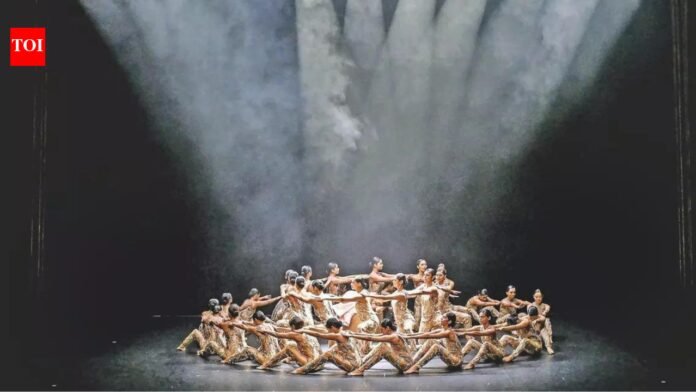
There’s a moment near the end of Stanley Kubrick’s Eyes Wide Shut when a waltz plays out over a scene of unsettling beauty. The piece, Shostakovich’s Waltz No. 2, was composed for a Soviet film in the mid-1950s, was completely mistakenly attributed to another suite, and is now one of the most recognized orchestral works in the world precisely because of its impact on a room. It’s not comforting. It’s unsettling and elegant. It was the first piece of music the audience heard as they walked into Tesseract: The Geometry of Truth, a choice that spoke volumes about the evening’s purpose.The musical direction of Tesseract was no accident. Michael composed eleven works covering Soviet orchestral music jacksonBilly Joel , Queen and three of them Hans ZimmerIn the most famous film scores, a coherent argument is made. This is amplified by the choreography and staging. Music worked. Taken together, these songs form their own geometry: approaching the same central questions from different angles: what is truth, who holds it, who denies it, and what it costs to honestly seek it.Waltz No. 2 – Dmitri Shostakovich
Shostakovich composed this waltz for a Soviet film in the mid-1950s, and it circulated for decades under an incorrect title—a piece of music whose identity has been recorded. Its fame soared when Kubrick used it in Eyes Wide Shut, emphasizing a world where beautiful surfaces conceal dark truths lurking beneath. As a prelude to a show about perception and reality, this is entirely true.Michael Jackson appears three times on the Tesseract soundtrack, and this progression is no accident.Man in the Mirror – Michael Jackson
It’s the most inward-looking piece from Jackson’s 1988 album Bad, a gospel-flavored self-examination song that Jackson performed at that year’s Grammy Awards, with a choir behind it. Unusually, the music video contains almost no Jackson himself. Instead, it runs through a montage of pain, protest, and injustice, as if to say: This is what you’re avoiding.They don’t care about us – Michael Jackson
Released eight years later and more confrontational, this shifted the focus outward. This is a song about the people history has left unmentioned, the voices conveniently ignored by systems of power. The anger in it is concrete and deserved. Where “Man in the Mirror” asked individuals to look inward, this film asks the world to take responsibility.Earth Song – Michael Jackson
Released in 1995, it is a gospel lament for the natural world that asks what humankind’s collective ambitions – including ambitions to discover, build and develop – cost the planet to make all this possible. The pursuit of progress, even the pursuit of truth, is not free. Of Jackson’s three essays, this one has the broadest moral weight and the most thorny issue.Billy Joel offers two distinct registers.She’ll always be a woman – Billy Joel
Written in 1977, the book is a portrait of a man who refused to be reduced to a simple narrative – a study of the gap between who a person really is and who others insist on seeing. Joel wrote this book in part out of frustration with critics who misread the people he loved, but it’s something much bigger: a quiet argument against the laziness of accepted opinion. In a show about the geometry of truth, it’s worth noting that truth about people is almost always more complex than the shapes we assign.We didn’t set the fire – Billy Joel
The book was written after a conversation with a young man who believed that the 1950s were calm, the opposite of calm – 119 historical references compressed into less than 5 minutes, presenting a series of events without hierarchy or conclusion. Joel said he never meant to apologize for his generation, nor was the accusation directed at anyone else. He believes that the world has always been a mess. The fire was burning long before we arrived.We are the champions – the queen
When Freddie Mercury wrote these words in 1977, he was speaking directly to his audience—not as a boast of victory, but as an acknowledgment of a shared journey of failure, persistence, and, ultimately, something that might resemble victory. Among us we are truly open. It belongs to anyone who is entitled to it. A paean to collective resilience, it carries the emotional heart of the evening and needs no explanation.Hans Zimmer exhibited three works spanning the decade of his most famous work.Time – Hans Zimmer (“Inception”, 2010)
The piece builds from a fragile subject into something vast and unresolved; it accompanies the final moments of Christopher Nolan’s Inception, where the lines between dreaming and waking are deliberately left open and the music refuses to close either. For a show built around perception and truth, few musical productions do more with less.The Dark Knight Theme — Hans Zimmer & James Newton Howard (2008)
Almost out of nothing – Zimmer ties this two-note theme to a character defined by his desire to expose the fragility of everything people think will keep them safe. In Nolan’s interpretation, the Joker doesn’t want power or money; He wanted to show that the systems people trust are more fragile than they appear. In other words, it’s a subject about what happens when the comfort of fiction collapses.Interstellar Theme — Hans Zimmer (2014)
Recorded almost entirely with a pipe organ – an unusual choice for a science fiction film, and a very well thought out one. The organ carries centuries of associations: sacred, vast, unknowable. It has a unique place in the Tesseract soundtrack. It doesn’t argue. It doesn’t accuse. It bears witness.Knight of Cups — Hans Zimmer (The Da Vinci Code, 2006)
The climactic theme of Ron Howard’s adaptation of Dan Brown’s novel revolves entirely around the proposition that the truths most protected are the ones that institutions have the most to lose by revealing them. Zimmer’s score for the apocalyptic moment is less triumphant than solemn: the choir rises slowly, as if truth itself is walking into the light. This is the final piece of the Tesseract soundtrack. It felt good to end the night.
| S size. | song title | Artist/Composer | Source/Annotation |
|---|---|---|---|
| 1 | Waltz No. 2 | Dmitri Shostakovich | Russian National Symphony Orchestra/performed by Dmitry Yablonsky |
| 2 | man in mirror | michael jackson | — |
| 3 | they don’t care about us | michael jackson | — |
| 4 | she will always be a woman | billy joel | — |
| 5 | we didn’t set fire | billy joel | — |
| 6 | we are champions | Queen | — |
| 7 | time | Hans Zimmer | from Inception |
| 8 | dark knight theme | Hans Zimmer and James Newton Howard | from dark knight |
| 9 | song of the earth | michael jackson | — |
| 10 | interstellar theme song | Hans Zimmer | from Interstellar |
| 11 | Knights of the Holy Grail | Hans Zimmer | from The Da Vinci Code |
Tesseract is a work about perception, geometry, and the many shapes truth can take depending on where you are. Its music was chosen with the same seriousness. From a Soviet waltz that has been misnamed for decades to a choir that moves towards revelation in its final moments, these songs retain their truth for a brief moment in human memory.