
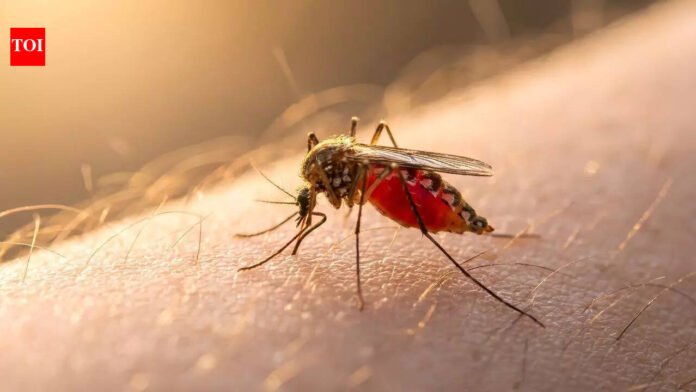
Spring marks the beginning of mosquito activity in many areas, especially in the United States. For decades, researchers have been studying why some people seem to be more susceptible to mosquito bites than others. A recent study published in Science Advances provides detailed insights into the behavior of one of the most common species, Aedes aegypti. The study examined how these mosquitoes use environmental cues, such as visual contrast and carbon dioxide, to locate their hosts. Understanding these mechanisms is critical to developing more effective control methods. The study also provides data on specific patterns that mosquitoes follow when approaching potential hosts.
How mosquitoes use visual and chemical cues to find humans
According to published in scientific progresstitled “Learning to predict mosquito flight behavior using Bayesian dynamical systems,” explains how mosquitoes use a combination of sensory inputs to identify targets. Visual contrast is a major factor. Experiments have shown that dark surfaces are easier to detect than light surfaces. However, visual information alone is not enough to consistently attract mosquitoes. Chemical signals, especially carbon dioxide exhaled by humans, are also important. Carbon dioxide acts as a long-range signal, guiding mosquitoes to potential hosts. When combined with high-contrast visuals, the appeal is significantly stronger. Researchers are at Georgia Institute of Technology Three controlled experiments were conducted in a dedicated room. The room contains hundreds of mosquitoes and is monitored using 3D infrared cameras to track their flight paths. The initial tests involved simple objects: black and white spheres. Observations showed that mosquitoes had little contact with the monochromatic spheres unless a chemical signal was present. The addition of carbon dioxide significantly increased target behavior. In particular, the combination of black objects with carbon dioxide produced the highest frequency of approaches.
How mosquitoes target humans without following each other
To confirm the interaction of visual and chemical cues, one of the researchers, Christopher Zuo, participated in the study as a human subject. The clothes he wears come in three styles: all black, all white and a black and white split design. Mosquito swarming patterns were recorded around his body. The analysis showed that most activity was concentrated in the head and shoulder areas, corresponding to areas with higher CO2 emissions and heat output. The results strengthen the conclusion that mosquitoes respond to independent sensory cues rather than following each other. The approach of individual insects is based on direct detection of signals rather than collective behavior.Data analysis conducted by MIT showed that mosquitoes do not coordinate their movements when approaching their hosts. Each insect independently detects and responds to visual contrast and chemical emissions. This rule-based behavior creates the appearance of group coordination but no actual interaction. The study compared mosquito movements to simple algorithmic patterns, showing predictable trajectories based on sensory input.
Practical Strategies to Reduce Mosquito Bites and Exposure
- Wear light-colored clothing – Dark colors are more likely to attract mosquitoes, so light-colored clothing may make it harder for mosquitoes to see you.
- Limit chemical attractants – Reducing the strong smell of perfume, lotion or sweat can reduce attraction.
- Use sensory disruption devices or traps – Traps that intermittently release carbon dioxide or light can attract mosquitoes more effectively without requiring constant exposure.
- Minimize prolonged exposure outdoors in areas with high mosquito activity, especially during peak hours such as dusk and dawn.