
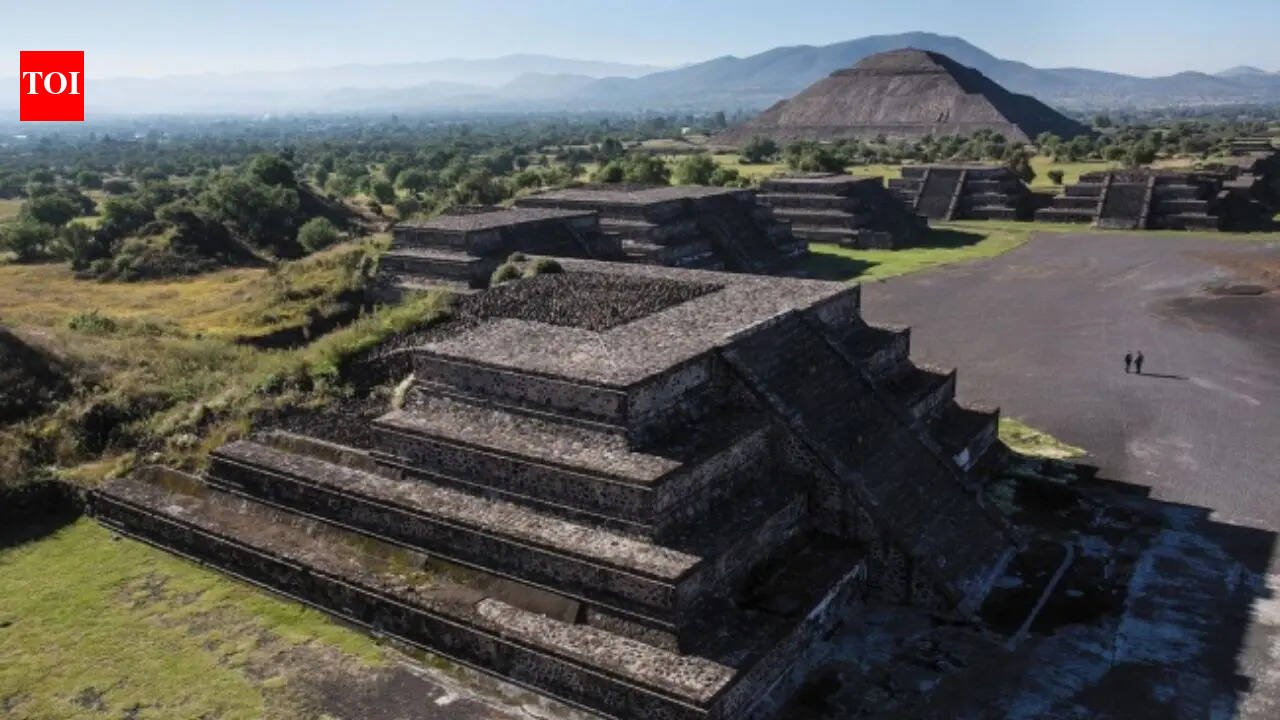
Beneath Mexico City’s modern skyline, something ancient still lingers. On the surface it is a crowded capital city, full of traffic, offices and constant movement. But just a few meters below, there seems to be another world where time has almost frozen. Ancient temples, underground courtyards, carved stones and ritual remains are hidden beneath layers of concrete and history. It is invisible in everyday life, yet it keeps reappearing in fragments. Workers excavating foundations often uncover unexpected traces of the past. Archaeologists say the city is like a living archive, with each excavation opening a new chapter of an ancient civilization that never completely disappeared.
The buried history of Tenochtitlan under the development of modern Mexico City
The center of Mexico City is located directly above Tenochtitlan, the former capital of Mexico. It was a powerful and well-organized city built on islands in the lake. Experts believe it was one of the most advanced urban settlements in the Americas before the Spanish conquest. After the Spanish arrived, much of the old city was demolished or buried under new construction. Churches, palaces and roads were built directly over sacred Mexica spaces. Over time, the original city became hidden beneath the growing colonial capital.Even today, traces of that ancient world continue to appear, according to the BBC . Archaeologists working near the historic center have discovered the remains of temple platforms, ritual objects and ceremonial buildings. The findings show that much of the ancient city remains untouched beneath modern structures. It’s a layered landscape where past and present actually occupy the same land.
Underground temple beneath Mexico City Metropolitan Cathedral
One of the most striking examples of this hidden history lies beneath the Metropolitan Cathedral in Mexico City. Archaeologists have discovered remains related to the Great Temple, the main religious center of the Mexica civilization. This temple was once located in the center of Tenochtitlan and was dedicated to a powerful deity. Today, parts of its base still exist underground, beneath busy streets and religious buildings.Visitors can now take guided tours of these underground spaces. As they descend below the ground, the noise of the city fades away, replaced by stone walls and ancient foundations. Some describe the experience as disturbing, while others find it fascinating. Experts say these underground ruins help reconstruct how the ancient city was once organized. They also illustrate modern Mexico City’s strong ties to its pre-Hispanic past.
Skulls, ball courts and rituals discovered beneath Mexico City
Over the years, excavations have revealed surprising and sometimes shocking discoveries. Archaeologists have discovered a large skull skeleton believed to have been used for ritual display. Hundreds of skulls were found, arranged in a structured pattern, suggesting they were once part of a ceremonial platform. Remains of a ball court, an ancient Mesoamerican ball game played using heavy rubber balls and physical skills, were also discovered nearby.Other finds include ritual offerings placed near the temple steps. These include animal bones, shells, coral and carefully arranged objects. Some finds suggest links to important rulers of the Mexican civilization. Experts believe that more structures, including possible tombs, may still be hidden beneath the city. Each dig seemed to add another piece to a larger puzzle that was yet to be completed.
Sunken city reveals secrets beneath Mexico City
Mexico City’s complex geology makes this process even more challenging. Mexico City sits on a former lake bed that slowly sank at different rates in different places. Buildings tilted, roads developed cracks and underground utilities shifted. According to archaeologists, some buried artifacts were exposed due to the constant shifting of the foundations.Today, technological advancements are used to survey underground areas through radar and 3D scanners. Despite technological advances, mining is still done manually because signals can be misread. Some artifacts from the colonial era may be considered older.
Daily life in Mexico City’s buried civilization
What is unusual about Mexico City is how daily life continues directly on top of this hidden history. As people commute, shop and work, they are often unaware that they are walking through one of the most important archaeological sites in the world. Metro stations sometimes display ancient symbols, and some underground areas reveal parts of pre-Hispanic architecture behind glass panels.Experts say the constant overlap of past and present gives the city its unique identity. It is not only a modern capital, but also a place built on centuries of stratified civilization. The remains of Tenochtitlan are not separate from present-day Mexico City. They were part of it and still influence its structure and story.In the end, Mexico City feels like a place where two timelines exist simultaneously. One is visible, the other is buried. Even now, much of this ancient world remains undiscovered, quietly waiting beneath the streets for the next unexpected discovery.