
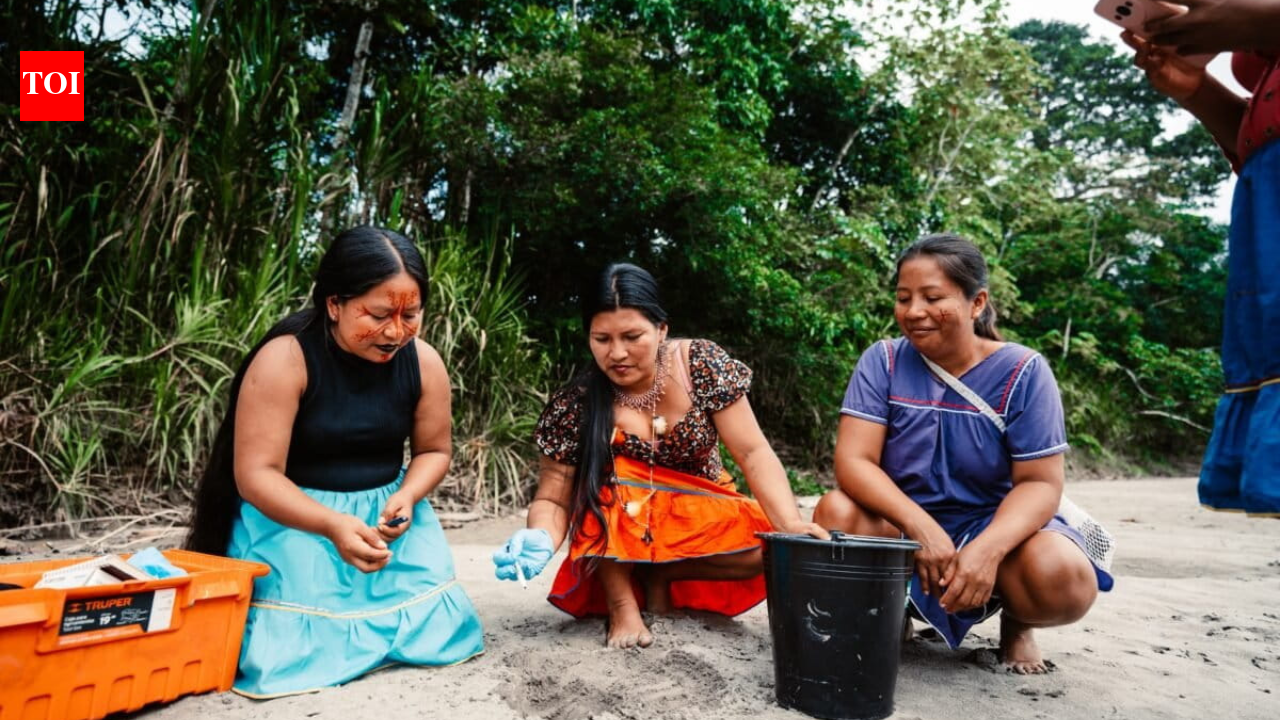
Seven Indigenous Siekopai women in Ecuador’s Amazon are using ancestral knowledge, modern technology and community-led conservation to give vulnerable river turtles a better chance of survival. Known as the Tari Nomiowa’i, or “Turtle Women”, the group patrols the banks of the Aguarico River in search of charapa turtle nests, carefully collects eggs threatened by flooding, predators and human activity, and raises the hatchlings in protected conditions before returning them to the river. During the 2025-26 nesting season, the women collected 235 eggs and successfully hatched and released 208 young turtles into the Aguarico River in March and April 2026. Their work is not only helping protect Podocnemis unifilis, also known as the yellow-spotted Amazon River turtle, but is also preserving an Indigenous relationship with the river and its wildlife.
How seven Indigenous women became the ‘Turtle Women ’ of the Amazon
The conservation effort is centred on seven Siekopai women who call themselves Tari Nomiowa’i, a name that translates as “Turtle Women”. Their work combines traditional ecological knowledge passed down through generations with modern conservation techniques. Janeth Piaguaje, a Siekopai community leader involved in the project, learned how to handle turtle eggs from her father, including how to recognise nesting periods and identify suitable nests along the riverbanks. The women now patrol the Aguarico River looking for tracks and nests and record information including the date, time, location and number of eggs using the Epicollect5 field-data collection app.Their approach allows knowledge that has traditionally been passed between generations to be combined with systematic records that can help conservationists understand nesting patterns and measure the results of their work. Rather than separating conservation from Indigenous life, the project places local women and their knowledge at the centre of efforts to protect a species that has long been part of the community’s relationship with the river.
Why the Amazon river turtles are under growing pressure
The charapa turtle faces several threats across its range, with human activity placing particular pressure on populations. Adult turtles are hunted for meat, while their eggs can be collected from nests for consumption. Pollution is another problem, with rubbish, plastic and discarded materials entering waterways and nesting areas. Along the Aguarico River, the women have also observed dead animals floating downstream and regularly encounter plastic and garbage on the beaches where turtles nest. Boat traffic can contribute to erosion of riverbanks, while changing water levels associated with climate change can flood the low-lying areas where turtles lay their eggs.The combination of these pressures can make natural reproduction difficult because eggs and nests are exposed to threats before hatchlings ever reach the water. The species is classified as Vulnerable on the IUCN Red List, meaning it faces a high risk of extinction in the wild in the medium term if the threats affecting it are not adequately addressed. Protecting nesting sites is therefore an important part of giving the species a better chance of maintaining and rebuilding populations.
How the women rescue eggs and raise baby turtles
When the Turtle Women find nests at risk, they carefully collect the eggs and transport them to an incubation facility where they can develop under controlled and protected conditions. The eggs are kept away from predators, pollution and flooding that could destroy nests in the wild. The women monitor the eggs until they hatch and then continue caring for the young turtles for about another month before releasing them. During this period, the hatchlings are fed locally available plant foods including cassava, sweet potato and taro leaves. The process effectively gives the young turtles a protected start to life during one of their most vulnerable stages.The women also document their work digitally, recording information about individual nests and the number of eggs collected. This creates a record of the project’s performance and provides information that can be used when planning future conservation activities. Such intervention does not remove all the dangers facing the turtles once they return to the river, but it can substantially reduce the immediate risks of nest flooding, predation and human disturbance during the egg and early hatchling stages.
208 hatchlings returned to the Aguarico River
The 2025-26 nesting season provided a significant result for the community-led project. The seven women collected 235 eggs and successfully hatched 208 young turtles, which were released into the Aguarico River during March and April 2026. The releases became more than a conservation exercise because the women invited members of the local community, including schoolchildren, to take part and attend educational workshops. These activities gave younger generations an opportunity to see the turtles being returned to their natural environment and learn why their nests and habitats need protection. One child reportedly told Piaguaje that she would look after the turtles and tell others not to touch their eggs, illustrating how the project is also trying to change attitudes towards wildlife.The 208 releases represent a strong short-term outcome for the programme, but they should not be interpreted as proof that the wider wild population has already recovered. The turtles will still face predators, pollution, habitat pressures and other dangers after release, making continued protection of the river and nesting beaches essential to turning successful hatchling production into lasting population recovery.
Protecting turtles also means protecting Siekopai culture
For the Turtle Women, the project has significance that goes beyond wildlife management. The Siekopai have an ancestral relationship with the river and its animals, and the women see the turtles as part of a cultural and spiritual connection with nature. According to Piaguaje, the turtles are linked to the visible and spiritual worlds and are protected by Koouwajëo, regarded in their tradition as the spiritual chief, mother and ancestral guardian of the turtles. This belief provides an important cultural motivation for the conservation work.Protecting the turtles is therefore understood not simply as saving an animal but as honouring the river, maintaining cultural traditions and passing knowledge to younger generations. The project also demonstrates how Indigenous communities can combine traditional ecological knowledge with tools such as digital mapping and nest monitoring to address modern conservation challenges. The seven women are now part of a wider effort to ensure that the Aguarico River continues to support both wildlife and the communities whose lives and traditions are closely connected to it. Their work shows that conservation can become more effective and meaningful when local communities are not simply participants in wildlife projects but are the people leading them.