

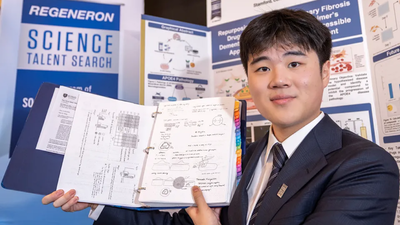
Alzheimer’s disease remains one of the most difficult neurological disorders to treat, partly because the processes behind it can begin damaging brain cells long before symptoms become apparent. Now, a project by 17-year-old Connecticut student Leon Wang has drawn attention for exploring whether medicines already approved for other uses could help protect brain cells from some Alzheimer’s-linked damage. According to the Society for Science, Wang investigated whether existing medicines could counter this damage and identified two FDA-approved drugs, nintedanib and pirfenidone, that showed protective effects in his cellular model. His research earned recognition at the 2026 Regeneron Science Talent Search, highlighting drug repurposing’s potential in the search for new approaches to complex diseases.
Understanding the role of APOE4
Wang’s project focused on APOE4, a variant of the APOE gene and the strongest known genetic risk factor for Alzheimer’s disease. Although APOE4 has long been associated with a higher risk of developing the condition, scientists are still working to understand exactly how it contributes to damage in the brain.Rather than looking only at neurons, Wang examined cells that line blood vessels in the brain. This approach is important because Alzheimer’s is increasingly understood as a complex disease involving not just nerve cells but also the brain’s blood vessels and other supporting systems.Using publicly available scientific data, Wang confirmed earlier findings that people carrying the APOE4 variant showed increased activity in a cellular signalling pathway involving a protein called transforming growth factor beta, or TGFβ. He then investigated what this increased activity might do to brain vascular cells.His experiments using lab-grown versions of these cells found that excessive TGFβ activity was associated with signs of cellular damage. The finding suggested that the overactive pathway could be one possible mechanism linking APOE4 to harmful changes in the brain.
Searching for an existing solution
Instead of starting from scratch to develop an entirely new medicine, Wang explored a strategy known as drug repurposing. This involves investigating whether medicines already approved for one condition could potentially be useful against another. He identified two FDA-approved drugs, nintedanib and pirfenidone, which treat lung scarring and are known to reduce TGFβ-related activity. Wang tested them in his lab-grown cellular model to see whether they could counter the damage associated with an overactive TGFβ pathway.Both drugs reduced signs of cellular damage in the experiments, according to the Society for Science. The results do not mean that the medicines are now proven treatments for Alzheimer’s disease. The work was conducted in a cell model, and much more research, including further laboratory studies and clinical trials, would be needed before any potential use in people could be established.
Why drug repurposing matters
Developing a completely new medicine can take years and require extensive testing. Repurposing an existing drug could potentially offer a faster and less expensive starting point because some safety and pharmacological information is already available from its approved use. Wang’s research therefore points to a possible new direction for studying Alzheimer’s: targeting biological changes linked to APOE4 and the brain’s vascular system. His findings also raise the possibility that other drugs capable of influencing the TGFβ pathway could be worth investigating. The project was titled “Repurposing Idiopathic Pulmonary Fibrosis Drugs To Treat Vascular Alzheimer’s Dementia: A Safe, Effective and Accessible Approach to Alzheimer’s Treatment.”
Recognition at Regeneron STS
Wang, a student at King School in Stamford, Connecticut, received eighth place and a $60,000 award at the 2026 Regeneron Science Talent Search. The competition selected 40 finalists from more than 2,600 entrants, who presented original research across a wide range of scientific fields. His work stands out not because it has already produced an Alzheimer’s treatment, but because it demonstrates how existing medicines can be investigated in new ways. By connecting a major genetic risk factor, changes in brain blood-vessel cells and an already available class of drugs, Wang identified a potential avenue for further research.For now, the results remain an early-stage finding from laboratory-grown cells. But the project offers an example of how researchers can look at familiar medicines with fresh questions, and potentially uncover new possibilities in the fight against one of the world’s most challenging neurological diseases.