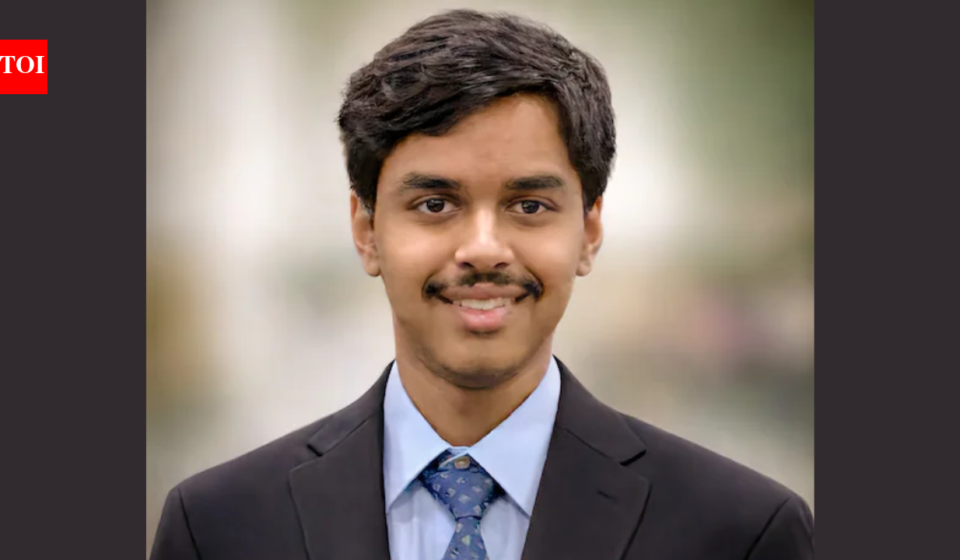
Meet Aditya Sengupta, the 18-year-old Bellevue student who built an AI system to better predict dangerous clear-air turbulence; his research won $100,000

An 18-year-old student from Bellevue, Washington, has built an artificial intelligence model designed to predict dangerous clear-air turbulence, earning a $100,000 (£75,000) scholarship from the Davidson Institute. Aditya Sengupta developed the machine-learning system, named ForeCAT, after experiencing severe and unexpected turbulence during commercial flights. The Davidson Institute, an American educational foundation supporting high-achieving youth, named Sengupta a 2026 Davidson Fellow Laureate for his independent research combining atmospheric physics with computing to solve aviation hazards. Clear-air turbulence occurs without visual indicators such as cloud formations or severe storms. This lack of visibility leaves commercial pilots with minimal warning before aircraft enter chaotic atmospheric air pockets, creating risks of passenger injuries and operational disruptions that cost the airline industry an estimated $500 million annually, according to findings presented at the Regeneron International Science and Engineering Fair (ISEF).
Combining AI with atmospheric physics
Sengupta designed ForeCAT to process spatiotemporal weather data alongside partial differential equations that describe fluid dynamics and atmospheric behavior. By embedding physical laws directly into the neural network, the system evaluates where invisible air currents are likely to form and estimates their potential severity. According to research documentation published by the Davidson Institute, ForeCAT demonstrated significant accuracy improvements over standard turbulence forecasting methods currently used across commercial aviation. In additional project data submitted to the Regeneron ISEF, the ForeCAT model achieved a 95% classification accuracy in tests, outperforming traditional industry tools such as the Graphical Turbulence Guidance algorithm. The system also evaluated historic flight data, successfully retro-predicting the severe turbulence event experienced on a Singapore Airlines flight in May 2024 with 87% confidence.Sengupta explained that his motivation to address the problem grew out of personal experience during travel. “I became interested in this problem after experiencing sudden and frightening turbulence myself on flights,” Sengupta said in his profile for the Davidson Institute. “I started wondering why something that can be so dangerous is still so difficult to predict.”
Independent research and data challenges
Sengupta completed the ForeCAT project independently while attending secondary school, teaching himself advanced atmospheric science and computer science concepts alongside his regular school curriculum. Building the model required gathering and processing large volumes of atmospheric datasets, adjusting algorithms to handle imperfect data, and working through several initial designs that proved unsuccessful. “One of my biggest challenges was learning how to conduct research spanning different areas that I had never formally studied,” Sengupta stated in his Davidson Institute biography. “I had to learn about atmospheric science and turbulence while also learning how to work with large datasets and develop machine learning models. I also had to deal with imperfect data and work through multiple initial ideas that did not succeed. These experiences taught me that research rarely follows a straight path and that failed experiments can be just as valuable as successful ones.” In addition to his aviation computing research, records from the Davidson Institute show Sengupta competed in VEX Robotics competitions, where his team placed first in the United States and second globally at the World Championship. He has also been recognized as a Regeneron Science Talent Search Scholar and a National Junior Science and Humanities Symposium finalist.
Integration with air traffic systems
Climate models indicate that rising global temperatures are intensifying high-altitude jet streams, which atmospheric scientists project will increase the frequency and severity of clear-air turbulence along major flight routes. Sengupta structured ForeCAT so it could eventually integrate directly into existing Air Traffic Control systems and flight-planning software. Giving air traffic controllers and pilots early warnings about unstable air pockets would allow flight paths and altitudes to be adjusted long before an aircraft reaches hazardous airspace. “Being named a Davidson Fellow is an incredible honor because it gives me the opportunity to join a community of young people who are curious, ambitious, and passionate about using their ideas to improve lives,” Sengupta said in statement provided to the Davidson Institute. “I am excited to learn from this community, share ideas with peer Fellows, and carry that spirit of curiosity and inquiry into the next stage of my journey.” According to the Davidson Institute, Sengupta plans to pursue a university degree focusing on computing and the natural sciences, aiming to continue developing engineering applications grounded in physics and computer science.